Refine search
Actions for selected content:
26077 results in Abstract analysis
Shapes of worn stones
- Part of
-
- Journal:
- Mathematika / Volume 21 / Issue 1 / June 1974
- Published online by Cambridge University Press:
- 26 February 2010, pp. 1-11
- Print publication:
- June 1974
-
- Article
- Export citation
CHAPTER 15 - Schwarz Functions and Iterations
-
- Book:
- The Schwarz Function and its Applications
- Published by:
- Mathematical Association of America
- Published online:
- 05 June 2014
- Print publication:
- 01 June 1974, pp 173-206
-
- Chapter
- Export citation
CHAPTER 14 - Schwarz Functions of Specified Type
-
- Book:
- The Schwarz Function and its Applications
- Published by:
- Mathematical Association of America
- Published online:
- 05 June 2014
- Print publication:
- 01 June 1974, pp 153-172
-
- Chapter
- Export citation
Frontmatter
-
- Book:
- The Schwarz Function and its Applications
- Published by:
- Mathematical Association of America
- Published online:
- 05 June 2014
- Print publication:
- 01 June 1974, pp i-vi
-
- Chapter
- Export citation
CHAPTER 8 - Conformal Maps, Reflections, and their Algebra
-
- Book:
- The Schwarz Function and its Applications
- Published by:
- Mathematical Association of America
- Published online:
- 05 June 2014
- Print publication:
- 01 June 1974, pp 49-88
-
- Chapter
- Export citation
The class groups of quaternion and dihedral 2-groups
-
- Journal:
- Mathematika / Volume 21 / Issue 1 / June 1974
- Published online by Cambridge University Press:
- 26 February 2010, pp. 64-71
- Print publication:
- June 1974
-
- Article
- Export citation
-
Let
 be a = ℤ-order in A, a finite dimensional Q-algebra. K0() denotes the Grothendieck group of projective right -modules.
  locally isomorphic to } is a subgroup of K0() and is called the locally free classgroup of . (If = ℤΓ for some finite group Γ then
  as all ℤΓ projectives are locally free [12].)
 be a = ℤ-order in A, a finite dimensional Q-algebra. K
 locally isomorphic to
  as all ℤΓ projectives are locally free [12].)
CHAPTER 12 - Application to Elementary Fluid Mechanics
-
- Book:
- The Schwarz Function and its Applications
- Published by:
- Mathematical Association of America
- Published online:
- 05 June 2014
- Print publication:
- 01 June 1974, pp 135-148
-
- Chapter
- Export citation
On irregularities of integer sequences
-
- Journal:
- Mathematika / Volume 21 / Issue 1 / June 1974
- Published online by Cambridge University Press:
- 26 February 2010, pp. 101-106
- Print publication:
- June 1974
-
- Article
- Export citation
-
Let f(m;n) denote the largest integer so that, given any m integers a1 < … < am in [1, 2n], one can always choose f integers b1 < … < bf from [1, n], so that bi + bj = a1 (1 ≤ i ≤ j ≤ f; l ≤ l ≤ m) will never hold. Trivially f(m; n) ≥ n/ (m + 1). In this paper we shall attempt to improve upon this trivial bound by exploiting the possible irregularities of distribution of the sequence among certain congruence classes. One of our main results is

provided m ≥ log n. Related questions and results are also discussed.
Contents
-
- Book:
- The Schwarz Function and its Applications
- Published by:
- Mathematical Association of America
- Published online:
- 05 June 2014
- Print publication:
- 01 June 1974, pp ix-x
-
- Chapter
- Export citation
CHAPTER 10 - Properties in the Large of the Schwarz Function
-
- Book:
- The Schwarz Function and its Applications
- Published by:
- Mathematical Association of America
- Published online:
- 05 June 2014
- Print publication:
- 01 June 1974, pp 103-108
-
- Chapter
- Export citation
CHAPTER 5 - The Schwarz Function for an Analytic Arc
-
- Book:
- The Schwarz Function and its Applications
- Published by:
- Mathematical Association of America
- Published online:
- 05 June 2014
- Print publication:
- 01 June 1974, pp 19-28
-
- Chapter
- Export citation
The number of neighbourly d-polytopes with d+3 vertices
-
- Journal:
- Mathematika / Volume 21 / Issue 1 / June 1974
- Published online by Cambridge University Press:
- 26 February 2010, pp. 26-31
- Print publication:
- June 1974
-
- Article
- Export citation
CHAPTER 4 - The Nine-Point Circle
-
- Book:
- The Schwarz Function and its Applications
- Published by:
- Mathematical Association of America
- Published online:
- 05 June 2014
- Print publication:
- 01 June 1974, pp 13-18
-
- Chapter
- Export citation
CHAPTER 2 - Conjugate Coordinates in the Plane
-
- Book:
- The Schwarz Function and its Applications
- Published by:
- Mathematical Association of America
- Published online:
- 05 June 2014
- Print publication:
- 01 June 1974, pp 5-6
-
- Chapter
- Export citation
The zeros of a function occurring in the solution of the Graetz problem
- Part of
-
- Journal:
- Mathematika / Volume 21 / Issue 1 / June 1974
- Published online by Cambridge University Press:
- 26 February 2010, pp. 55-63
- Print publication:
- June 1974
-
- Article
- Export citation
Bibliography
-
- Book:
- The Schwarz Function and its Applications
- Published by:
- Mathematical Association of America
- Published online:
- 05 June 2014
- Print publication:
- 01 June 1974, pp 219-224
-
- Chapter
- Export citation
CHAPTER 16 - Dictionary of Functional Relationships
-
- Book:
- The Schwarz Function and its Applications
- Published by:
- Mathematical Association of America
- Published online:
- 05 June 2014
- Print publication:
- 01 June 1974, pp 207-208
-
- Chapter
- Export citation
The average size of gaps between primes
-
- Journal:
- Mathematika / Volume 21 / Issue 1 / June 1974
- Published online by Cambridge University Press:
- 26 February 2010, pp. 96-100
- Print publication:
- June 1974
-
- Article
- Export citation
-
Erdoső has asked whether there exists a positive constant c < 1 such that
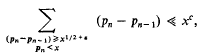
where pn is the n-th prime. In 1943 Selberg «3» proved, on the assumption of the Riemann Hypothesis, that
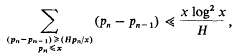
uniformly for H > 0. By an elementary extension of Selberg's method we prove the following two results free of any unproved assumptions.
Class groups of metacyclic groups of order p'q,p a regular prime
-
- Journal:
- Mathematika / Volume 21 / Issue 1 / June 1974
- Published online by Cambridge University Press:
- 26 February 2010, pp. 90-95
- Print publication:
- June 1974
-
- Article
- Export citation
-
Let p be an odd prime, let q be a divisor of p – 1, and let α be a primitive q-th root modulo p. For each natural number r the metacyclic group Gr is defined by

CHAPTER 11 - Derivatives and Integrals
-
- Book:
- The Schwarz Function and its Applications
- Published by:
- Mathematical Association of America
- Published online:
- 05 June 2014
- Print publication:
- 01 June 1974, pp 109-134
-
- Chapter
- Export citation
