Refine search
Actions for selected content:
26077 results in Abstract analysis
27.—The Quantum Theory of the Klystron and the Modulation of Electron Beams at Optical Frequencies*
-
- Journal:
- Proceedings of the Royal Society of Edinburgh Section A: Mathematical and Physical Sciences / Volume 71 / Issue 4 / 1974
- Published online by Cambridge University Press:
- 14 February 2012, pp. 305-321
- Print publication:
- 1974
-
- Article
- Export citation
PRM volume 72 issue 2 Cover and Front matter
-
- Journal:
- Proceedings of the Royal Society of Edinburgh Section A: Mathematical and Physical Sciences / Volume 72 / Issue 2 / 1974
- Published online by Cambridge University Press:
- 14 February 2012, pp. f1-f2
- Print publication:
- 1974
-
- Article
-
- You have access
- Export citation
4.—A Cauchy Problem for an Ordinary Integro-differential Equation*
-
- Journal:
- Proceedings of the Royal Society of Edinburgh Section A: Mathematical and Physical Sciences / Volume 72 / Issue 1 / 1974
- Published online by Cambridge University Press:
- 14 February 2012, pp. 39-55
- Print publication:
- 1974
-
- Article
- Export citation
1.—On Measurable Selections
-
- Journal:
- Proceedings of the Royal Society of Edinburgh Section A: Mathematical and Physical Sciences / Volume 72 / Issue 1 / 1974
- Published online by Cambridge University Press:
- 14 February 2012, pp. 1-7
- Print publication:
- 1974
-
- Article
- Export citation
PRM volume 71 issue 4 Cover and Back matter
-
- Journal:
- Proceedings of the Royal Society of Edinburgh Section A: Mathematical and Physical Sciences / Volume 71 / Issue 4 / 1974
- Published online by Cambridge University Press:
- 14 February 2012, pp. b1-b6
- Print publication:
- 1974
-
- Article
-
- You have access
- Export citation
9.—A Note on the Hypergraph of a Mapping between Uniform Spaces*
-
- Journal:
- Proceedings of the Royal Society of Edinburgh Section A: Mathematical and Physical Sciences / Volume 72 / Issue 2 / 1974
- Published online by Cambridge University Press:
- 14 February 2012, pp. 129-134
- Print publication:
- 1974
-
- Article
- Export citation
11.—High-Frequency Scattering in a Certain Stratified Medium. The Two-part Problem*
-
- Journal:
- Proceedings of the Royal Society of Edinburgh Section A: Mathematical and Physical Sciences / Volume 72 / Issue 2 / 1974
- Published online by Cambridge University Press:
- 14 February 2012, pp. 149-178
- Print publication:
- 1974
-
- Article
- Export citation
5.—Separation of Variables (An Abstract Approach)
-
- Journal:
- Proceedings of the Royal Society of Edinburgh Section A: Mathematical and Physical Sciences / Volume 72 / Issue 1 / 1974
- Published online by Cambridge University Press:
- 14 February 2012, pp. 57-78
- Print publication:
- 1974
-
- Article
- Export citation
23.—The Synthesis of Derivatives of Acenaphthenone
-
- Journal:
- Proceedings of the Royal Society of Edinburgh Section A: Mathematical and Physical Sciences / Volume 71 / Issue 4 / 1974
- Published online by Cambridge University Press:
- 14 February 2012, pp. 279-283
- Print publication:
- 1974
-
- Article
- Export citation
-
Acenaphthenequinone (I) condensed with ethyl cyanoacetate in ethanol to give the unsaturated ester (IIIb) while condensation with malonic acid in toluene in the presence of diethylamine gave the hydroxy acid (IIa). Esterification of this acid gave an ester (IIb) which could also be obtained by condensation of acenaphthenequinone
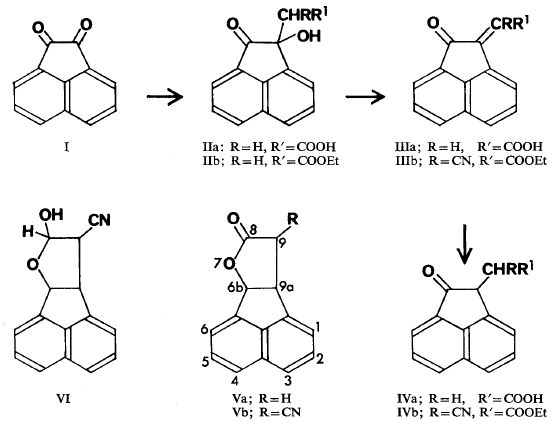
with ethyl hydrogen malonate. The acid (IIa) on dehydration gave 2-oxo-Δ1,α-acenaphtheneacetic acid (IIIa) of m.p. 230°C. This result seems to be in conflict with that of Rodionov and Federova (1950) who reported a m.p. of 160° for the acid (IIIa) which they obtained directly by condensation of acenaphthenequinone with malonic acid in ethanol in the presence of ammonia. Our efforts to repeat their result gave only impure polymeric material and it seems unlikely, therefore, that their product was simply the geometric isomer of our acid.
22.—Attempted Synthesis of Dibenzo[a,g]biphenylene.*
-
- Journal:
- Proceedings of the Royal Society of Edinburgh Section A: Mathematical and Physical Sciences / Volume 71 / Issue 4 / 1974
- Published online by Cambridge University Press:
- 14 February 2012, pp. 275-277
- Print publication:
- 1974
-
- Article
- Export citation
7.—High-frequency Scattering in a Certain Stratified Medium*
-
- Journal:
- Proceedings of the Royal Society of Edinburgh Section A: Mathematical and Physical Sciences / Volume 72 / Issue 2 / 1974
- Published online by Cambridge University Press:
- 14 February 2012, pp. 93-107
- Print publication:
- 1974
-
- Article
- Export citation
28.—Simultaneous Emission of two Light Charged Particles in Fission*
-
- Journal:
- Proceedings of the Royal Society of Edinburgh Section A: Mathematical and Physical Sciences / Volume 71 / Issue 4 / 1974
- Published online by Cambridge University Press:
- 14 February 2012, pp. 323-331
- Print publication:
- 1974
-
- Article
- Export citation
PRM volume 72 issue 2 Cover and Back matter
-
- Journal:
- Proceedings of the Royal Society of Edinburgh Section A: Mathematical and Physical Sciences / Volume 72 / Issue 2 / 1974
- Published online by Cambridge University Press:
- 14 February 2012, pp. b1-b2
- Print publication:
- 1974
-
- Article
-
- You have access
- Export citation
30.—The Chord Locus of a Certain Curve in [n]*
-
- Journal:
- Proceedings of the Royal Society of Edinburgh Section A: Mathematical and Physical Sciences / Volume 71 / Issue 4 / 1974
- Published online by Cambridge University Press:
- 14 February 2012, pp. 337-343
- Print publication:
- 1974
-
- Article
- Export citation
2.—Semi-bounded Second-order Differential Operators
-
- Journal:
- Proceedings of the Royal Society of Edinburgh Section A: Mathematical and Physical Sciences / Volume 72 / Issue 1 / 1974
- Published online by Cambridge University Press:
- 14 February 2012, pp. 9-16
- Print publication:
- 1974
-
- Article
- Export citation
-
Differential operators generated by the differential expression My(x) = —y″(x)+q(x)y(x) in L2(0, ∞) are considered. It is assumed that

is bounded for all x in [0, ∞) and some fixed ω > 0. The operators are shown to be bounded below and an estimate for the lower bound is obtained in terms of q(x). In the case where q(x) is LP (0, ∞) for some p ≧ 1, the results are compared with recent ones of W. N. Everitt. Some comments are made on the best-possible nature of the results.

8.—On Second-order Differential Inequalities
-
- Journal:
- Proceedings of the Royal Society of Edinburgh Section A: Mathematical and Physical Sciences / Volume 72 / Issue 2 / 1974
- Published online by Cambridge University Press:
- 14 February 2012, pp. 109-127
- Print publication:
- 1974
-
- Article
- Export citation
-
This paper is devoted to a study of differential equations and inequalities of the form

and

The results are mainly concerned with the existence of positive solutions, their uniqueness in the case of (*), and bounds for these solutions.
25.—Further calculations, being an Addendum to the paper ‘Calculations relative to the Experimental Observation of the Products of Disintegration of 5He liberated as a Light Particle in Ternary Fission’.*
-
- Journal:
- Proceedings of the Royal Society of Edinburgh Section A: Mathematical and Physical Sciences / Volume 71 / Issue 4 / 1974
- Published online by Cambridge University Press:
- 14 February 2012, pp. 293-296
- Print publication:
- 1974
-
- Article
- Export citation
31.—Dubreil-Jacotin Inverse Semigroups.*
-
- Journal:
- Proceedings of the Royal Society of Edinburgh Section A: Mathematical and Physical Sciences / Volume 71 / Issue 4 / 1974
- Published online by Cambridge University Press:
- 14 February 2012, pp. 345-360
- Print publication:
- 1974
-
- Article
- Export citation
26.—The Strong Limit-2 Case of Fourth-order Differential Equations
-
- Journal:
- Proceedings of the Royal Society of Edinburgh Section A: Mathematical and Physical Sciences / Volume 71 / Issue 4 / 1974
- Published online by Cambridge University Press:
- 14 February 2012, pp. 297-304
- Print publication:
- 1974
-
- Article
- Export citation
-
The fourth-order equation considered is

Conditions are given on the coefficients r, p and q which ensure that this differential equation (*) is in the strong limit-2 case at ∞, i.e. is limit-2 at ∞. This implies that (*) has exactly two linearly independent solutions which are in the integrable-square space ℒ2(0, ∞) for all complex numbers λ with im [λ] ≠ 0. Additionally the conditions imply that self-adjoint operators generated by M[·] in ℒ2(0, ∞) are semi-bounded below. The results obtained are applied to the case when the coefficients r, p and q are powers of x ∈ [0, ∞).
PRM volume 72 issue 1 Cover and Back matter
-
- Journal:
- Proceedings of the Royal Society of Edinburgh Section A: Mathematical and Physical Sciences / Volume 72 / Issue 1 / 1974
- Published online by Cambridge University Press:
- 14 February 2012, pp. b1-b2
- Print publication:
- 1974
-
- Article
-
- You have access
- Export citation
