Refine search
Actions for selected content:
26077 results in Abstract analysis
The residual set dimension of the Apollonian packing
-
- Journal:
- Mathematika / Volume 20 / Issue 2 / December 1973
- Published online by Cambridge University Press:
- 26 February 2010, pp. 170-174
- Print publication:
- December 1973
-
- Article
- Export citation
On the slow viscous rotation of a body straddling the interface between two immiscible semi-infinite fluids
- Part of
-
- Journal:
- Mathematika / Volume 20 / Issue 2 / December 1973
- Published online by Cambridge University Press:
- 26 February 2010, pp. 175-196
- Print publication:
- December 1973
-
- Article
- Export citation
Two singular measures can agree on balls
- Part of
-
- Journal:
- Mathematika / Volume 20 / Issue 2 / December 1973
- Published online by Cambridge University Press:
- 26 February 2010, pp. 224-225
- Print publication:
- December 1973
-
- Article
- Export citation
A class of additive arithmetic functions with asymptotically normal distribution
-
- Journal:
- Mathematika / Volume 20 / Issue 2 / December 1973
- Published online by Cambridge University Press:
- 26 February 2010, pp. 144-154
- Print publication:
- December 1973
-
- Article
- Export citation
-
Let f(n) be a real-valued additive arithmetic function. For each positive rational integer n set

For the duration of this paper we shall assume that as n → ∞ both

The Picone identity for self-adjoint differential equations of even order
- Part of
-
- Journal:
- Mathematika / Volume 20 / Issue 2 / December 1973
- Published online by Cambridge University Press:
- 26 February 2010, pp. 197-200
- Print publication:
- December 1973
-
- Article
- Export citation
-
The Picone identity which occurs in the oscillation theory of second-order ordinary differential equations is

Index to volume 20
-
- Journal:
- Mathematika / Volume 20 / Issue 2 / December 1973
- Published online by Cambridge University Press:
- 26 February 2010, p. 267
- Print publication:
- December 1973
-
- Article
- Export citation
Projecting and uniformising Borel sets with Kσ-sections II
- Part of
-
- Journal:
- Mathematika / Volume 20 / Issue 2 / December 1973
- Published online by Cambridge University Press:
- 26 February 2010, pp. 233-246
- Print publication:
- December 1973
-
- Article
- Export citation
The sequential stability index of a function space
- Part of
-
- Journal:
- Mathematika / Volume 20 / Issue 2 / December 1973
- Published online by Cambridge University Press:
- 26 February 2010, pp. 210-213
- Print publication:
- December 1973
-
- Article
- Export citation
-
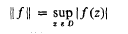
One of the substantial differences between real and complex analysis is the behaviour of pointwise sequential limits of functions. It is well known that, if f(z) is a bounded analytic function in D = {z∈ C: |z| < 1}, then there exists a sequence {pn(z): n = 1,2,…} of polynomials such that
(i) ‖Pn‖ ≤ ‖f‖ for all n = 1,2,3,…, and
(ii) for each z ∈ D, Pn(Z) → f(z) as n → ∞,
where we have used the notation
Riemann-Roch formulae for group representations
-
- Journal:
- Mathematika / Volume 20 / Issue 2 / December 1973
- Published online by Cambridge University Press:
- 26 February 2010, pp. 253-262
- Print publication:
- December 1973
-
- Article
- Export citation
-
Our investigation starts from the question: is the even dimensional cohomology of the non-abelian group of order p3 and exponent p generated by Chern classes? From the computation of the complete cohomology ring in [8] one quickly sees that the essential problem is to express elements of the form cor (γk), γ ∈ H2 (k, ℤ), K a subgroup of index p, in terms of Chern classes. For a more general pair of groups (K ≤ G) it is known, see [7] that the best for which one can hope is a description of some multiple of cor (γk) in this way. Our first theorem shows that, under suitable hypotheses (satisfied in particular by the example of order p3) the numerical factor may be removed. Thus

A lattice problem in the plane
- Part of
-
- Journal:
- Mathematika / Volume 20 / Issue 2 / December 1973
- Published online by Cambridge University Press:
- 26 February 2010, pp. 247-252
- Print publication:
- December 1973
-
- Article
- Export citation
-
In [2], Sawyer considers a closed, central, convex region K which is such that, however it is displaced in the plane, a point of the integral lattice is covered. He shows that the area A(K) of K satisfies
 . We prove here a result in the opposite direction.
 . We prove here a result in the opposite direction.
Index to volumes 11 to 20
-
- Journal:
- Mathematika / Volume 20 / Issue 2 / December 1973
- Published online by Cambridge University Press:
- 26 February 2010, pp. i-viii
- Print publication:
- December 1973
-
- Article
- Export citation
The Farey density of norm subgroups in global fields (I)
-
- Journal:
- Mathematika / Volume 20 / Issue 2 / December 1973
- Published online by Cambridge University Press:
- 26 February 2010, pp. 155-169
- Print publication:
- December 1973
-
- Article
- Export citation
-
Let Ω be an algebraic number field, and let NΩ ⊂ ℚ be the group of norms of fractional ideals of Ω. Then NΩ is a subgroup of the positive rationals; the latter is the direct sum of a denumerable infinity of infinite cyclic groups, and so it is free abelian; thus NΩ is free abelian, and, since it is not finitely generated, we must have
 qua abstract groups. The purpose of this paper is, in the first place, to find a “metrical ” way of distinguishing these isomorphic groups, and, to this end, we introduce the notion of Farey density, defined as follows; let X be a positive integer, and consider the Farey section ℱ(X) of order X, thus the set of all reduced positive fractions with denominator < X; then the quotient
measures the proportion of elements of ℱ(X) which are in NΩ, and, as X → ∞, it gives a measure of the “density ” of fractional ideal norms in the rational interval (0, 1).
 qua abstract groups. The purpose of this paper is, in the first place, to find a “metrical ” way of distinguishing these isomorphic groups, and, to this end, we introduce the notion of Farey density, defined as follows; let X be a positive integer, and consider the Farey section ℱ(X) of order X, thus the set of all reduced positive fractions with denominator < X; then the quotient
Charges on Boolean algebras and almost discrete spaces
- Part of
-
- Journal:
- Mathematika / Volume 20 / Issue 2 / December 1973
- Published online by Cambridge University Press:
- 26 February 2010, pp. 214-223
- Print publication:
- December 1973
-
- Article
- Export citation
On a problem of P. Erdős
- Part of
-
- Journal:
- Mathematika / Volume 20 / Issue 2 / December 1973
- Published online by Cambridge University Press:
- 26 February 2010, pp. 226-228
- Print publication:
- December 1973
-
- Article
- Export citation
The number of simplicial neighbourly d-polytopes with d+3 vertices
-
- Journal:
- Mathematika / Volume 20 / Issue 2 / December 1973
- Published online by Cambridge University Press:
- 26 February 2010, pp. 263-266
- Print publication:
- December 1973
-
- Article
- Export citation
MTK volume 20 issue 2 Front matter
-
- Journal:
- Mathematika / Volume 20 / Issue 2 / December 1973
- Published online by Cambridge University Press:
- 26 February 2010, pp. f1-f2
- Print publication:
- December 1973
-
- Article
-
- You have access
- Export citation
Small differences between consecutive primes
-
- Journal:
- Mathematika / Volume 20 / Issue 2 / December 1973
- Published online by Cambridge University Press:
- 26 February 2010, pp. 229-232
- Print publication:
- December 1973
-
- Article
- Export citation
-
Let pn denote the n-th prime number, and let
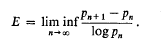
It follows from the prime number theorem that E ≤ 1. Erdős used a sieve argument to show that E < 1, and Rankin and Ricci gave the explicit estimates E ≤ 57/59 and E ≤ 15/16 respectively. A more powerful approach used by Hardy and Little-wood and by Rankin depended on hypotheses about the zeros of L-functions until Bombieri's Theorem was found. With its aid Bombieri and Davenport [1] proved that

A fuller history, with bibliography, is to be found in [1]
On the largest prime factor of p+a
-
- Journal:
- Mathematika / Volume 20 / Issue 2 / December 1973
- Published online by Cambridge University Press:
- 26 February 2010, pp. 135-143
- Print publication:
- December 1973
-
- Article
- Export citation
-
Among several interesting analogues of Chebyshev's problem about the largest prime factor of
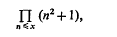
there is the question of the largest prime factor of
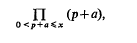
where a is a given non-zero integer and the product is taken over positive primes p. The latter subject appears to have been first treated by Goldfeld [2] and Motohashi [6], who showed that, if Px be the greatest prime factor in question, then there exists a constant
 such that Px > xθ for all sufficiently large x. Their method, which involved the use of both Bombieri's theorem and the Brun-Titchmarsh theorem, had some affinity with the earlier treatments of Chebyshev's original problem.
 such that P
On incomparable collections of sets
- Part of
-
- Journal:
- Mathematika / Volume 20 / Issue 2 / December 1973
- Published online by Cambridge University Press:
- 26 February 2010, pp. 208-209
- Print publication:
- December 1973
-
- Article
- Export citation
The large sieve
-
- Journal:
- Mathematika / Volume 20 / Issue 2 / December 1973
- Published online by Cambridge University Press:
- 26 February 2010, pp. 119-134
- Print publication:
- December 1973
-
- Article
- Export citation
-
Let S(x) be a trigonometric polynomial,

where N > 0 and M are integers, the an are arbitrary complex numbers, and e(x) = e2πix. In its basic form, the large sieve of Linnik and Rényi is an inequality of the form

