Refine search
Actions for selected content:
26076 results in Abstract analysis
Index
-
- Book:
- Metric Spaces
- Published online:
- 06 January 2010
- Print publication:
- 01 May 1968, pp 143-143
-
- Chapter
- Export citation
5 - Connected Sets
-
- Book:
- Metric Spaces
- Published online:
- 06 January 2010
- Print publication:
- 01 May 1968, pp 62-71
-
- Chapter
- Export citation
6 - Compactness
-
- Book:
- Metric Spaces
- Published online:
- 06 January 2010
- Print publication:
- 01 May 1968, pp 72-84
-
- Chapter
- Export citation
Preface
-
-
- Book:
- Metric Spaces
- Published online:
- 06 January 2010
- Print publication:
- 01 May 1968, pp vii-viii
-
- Chapter
- Export citation
8 - Some Applications
-
- Book:
- Metric Spaces
- Published online:
- 06 January 2010
- Print publication:
- 01 May 1968, pp 111-136
-
- Chapter
- Export citation
2 - Metric Spaces
-
- Book:
- Metric Spaces
- Published online:
- 06 January 2010
- Print publication:
- 01 May 1968, pp 21-30
-
- Chapter
- Export citation
9 - Further Developments
-
- Book:
- Metric Spaces
- Published online:
- 06 January 2010
- Print publication:
- 01 May 1968, pp 137-142
-
- Chapter
- Export citation
Frontmatter
-
- Book:
- Metric Spaces
- Published online:
- 06 January 2010
- Print publication:
- 01 May 1968, pp i-iv
-
- Chapter
- Export citation
7 - Functions and Mappings
-
- Book:
- Metric Spaces
- Published online:
- 06 January 2010
- Print publication:
- 01 May 1968, pp 85-110
-
- Chapter
- Export citation
3 - Open and Closed Sets
-
- Book:
- Metric Spaces
- Published online:
- 06 January 2010
- Print publication:
- 01 May 1968, pp 31-45
-
- Chapter
- Export citation
IV.—On the Integrals of Hua and James.*
-
- Journal:
- Proceedings of the Royal Society of Edinburgh Section A: Mathematical and Physical Sciences / Volume 68 / Issue 1 / 1968
- Published online by Cambridge University Press:
- 14 February 2012, pp. 54-69
- Print publication:
- 1968
-
- Article
- Export citation
PRM volume 68 issue 1 Cover and Front matter
-
- Journal:
- Proceedings of the Royal Society of Edinburgh Section A: Mathematical and Physical Sciences / Volume 68 / Issue 1 / 1968
- Published online by Cambridge University Press:
- 14 February 2012, pp. f1-f2
- Print publication:
- 1968
-
- Article
-
- You have access
- Export citation
II.—The Attempted Synthesis of Benzo[a]biphenylene
-
- Journal:
- Proceedings of the Royal Society of Edinburgh Section A: Mathematical and Physical Sciences / Volume 68 / Issue 1 / 1968
- Published online by Cambridge University Press:
- 14 February 2012, pp. 23-29
- Print publication:
- 1968
-
- Article
- Export citation
A Sceptical Chemist in a Biological Wonderland
-
- Journal:
- Proceedings of the Royal Society of Edinburgh Section A: Mathematical and Physical Sciences / Volume 68 / Issue 1 / 1968
- Published online by Cambridge University Press:
- 14 February 2012, pp. 1-22
- Print publication:
- 1968
-
- Article
- Export citation
PRM volume 68 issue 1 Cover and Back matter
-
- Journal:
- Proceedings of the Royal Society of Edinburgh Section A: Mathematical and Physical Sciences / Volume 68 / Issue 1 / 1968
- Published online by Cambridge University Press:
- 14 February 2012, pp. b1-b2
- Print publication:
- 1968
-
- Article
-
- You have access
- Export citation
III.—Multiplicative Ideal Theory and Rings of Quotients. I.*
-
- Journal:
- Proceedings of the Royal Society of Edinburgh Section A: Mathematical and Physical Sciences / Volume 68 / Issue 1 / 1968
- Published online by Cambridge University Press:
- 14 February 2012, pp. 30-53
- Print publication:
- 1968
-
- Article
- Export citation
VI.—On Solvability of Some Two-Parameter Eigenvalue Problems in Hilbert Space
-
- Journal:
- Proceedings of the Royal Society of Edinburgh Section A: Mathematical and Physical Sciences / Volume 68 / Issue 1 / 1968
- Published online by Cambridge University Press:
- 14 February 2012, pp. 83-93
- Print publication:
- 1968
-
- Article
- Export citation
-
This paper studies two particular cases of the general 2-parameter eigenvalue problem namely
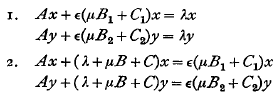
where A, B, B1, B2, C, C1, C2 are self-adjoint operators in Hilbert space, all except A being bounded. The disposable parameters λ and μ have to be determined so that the equations have non-trivial solutions x, y.
On the assumption that the solution is known for ∊ = o, solutions are constructed in the form of series for λ, μ, x, y as power series in ∊ with finite radius of convergence.
V—The Brownian Movement of a One-Dimensional Non-Harmonic Oscillator
-
- Journal:
- Proceedings of the Royal Society of Edinburgh Section A: Mathematical and Physical Sciences / Volume 68 / Issue 1 / 1968
- Published online by Cambridge University Press:
- 14 February 2012, pp. 70-82
- Print publication:
- 1968
-
- Article
- Export citation
On the selection of non-σ-finite subsets
-
- Journal:
- Mathematika / Volume 14 / Issue 2 / December 1967
- Published online by Cambridge University Press:
- 26 February 2010, pp. 161-164
- Print publication:
- December 1967
-
- Article
- Export citation
On the finite deformation of inhomogeneous elastic materials
-
- Journal:
- Mathematika / Volume 14 / Issue 2 / December 1967
- Published online by Cambridge University Press:
- 26 February 2010, pp. 215-219
- Print publication:
- December 1967
-
- Article
- Export citation
-
Truesdell and Noll [1; sections 22, 27, 34] have discussed the concepts of material uniformity and homogeneity in continuum mechanics. A body is said to be materially uniform if, roughly speaking, all the particles composing the body are of the same material and homogeneous if there exists a global reference configuration which can be taken as a natural state for the whole body. To make the ideas precise for elastic materials, consider a small neighbourhood
 of each particle X and suppose that a reference configuration κ is chosen for each . Then during the motion, the deformation gradients may be calculated at each point X relative to the local reference configurations k. The stress at X is a function of these deformation gradients and if the stress relation does not depend explicitly on X the body is said to be materially uniform. If each local reference configuration κ can be taken as the configuration of its associated set of particles in some global reference configuration for the whole body, the body is said to be homogeneous. In general, however, the configurations κ need not fit together to form a global reference configuration. The body is then said to contain a distribution of dislocations.
 of each particle X and suppose that a reference configuration κ is chosen for each