Refine search
Actions for selected content:
26077 results in Abstract analysis
Classnumbers and unit signatures
-
- Journal:
- Mathematika / Volume 14 / Issue 1 / June 1967
- Published online by Cambridge University Press:
- 26 February 2010, pp. 94-98
- Print publication:
- June 1967
-
- Article
- Export citation
On the zeros of Epstein's zeta function
-
- Journal:
- Mathematika / Volume 14 / Issue 1 / June 1967
- Published online by Cambridge University Press:
- 26 February 2010, pp. 47-55
- Print publication:
- June 1967
-
- Article
- Export citation
-
Let Q(x, y) = ax2 + bxy + cy2 be a positive definite quadratic form with discriminant d = b2 – 4ac. The Epstein zeta function associated with Q is given by

where Σ′ means the sum is over all pairs (x, y) of integers not both zero, and as usual, s = σ + it.
Slow motion of an incompressible viscous liquid generated by the rotation of two spheres in contact
-
- Journal:
- Mathematika / Volume 14 / Issue 1 / June 1967
- Published online by Cambridge University Press:
- 26 February 2010, pp. 43-46
- Print publication:
- June 1967
-
- Article
- Export citation
The determination of convex bodies from their mean radius of curvature functions
-
- Journal:
- Mathematika / Volume 14 / Issue 1 / June 1967
- Published online by Cambridge University Press:
- 26 February 2010, pp. 1-13
- Print publication:
- June 1967
-
- Article
- Export citation
Uniqueness theorems for linearized theories of interacting continua
-
- Journal:
- Mathematika / Volume 14 / Issue 1 / June 1967
- Published online by Cambridge University Press:
- 26 February 2010, pp. 27-42
- Print publication:
- June 1967
-
- Article
- Export citation
On the existence of non-atomic measures
-
- Journal:
- Mathematika / Volume 14 / Issue 1 / June 1967
- Published online by Cambridge University Press:
- 26 February 2010, pp. 62-67
- Print publication:
- June 1967
-
- Article
- Export citation
On the power free values of polynomials
-
- Journal:
- Mathematika / Volume 14 / Issue 1 / June 1967
- Published online by Cambridge University Press:
- 26 February 2010, pp. 21-26
- Print publication:
- June 1967
-
- Article
- Export citation
The large sieve
-
- Journal:
- Mathematika / Volume 14 / Issue 1 / June 1967
- Published online by Cambridge University Press:
- 26 February 2010, pp. 14-20
- Print publication:
- June 1967
-
- Article
- Export citation
A note on successive approximation
-
- Journal:
- Mathematika / Volume 14 / Issue 1 / June 1967
- Published online by Cambridge University Press:
- 26 February 2010, pp. 99-101
- Print publication:
- June 1967
-
- Article
- Export citation
-
A well-known theorem of Schauder asserts that a continuous self-map T of a closed convex subset K of a normed linear space X, such that the closure
 of T(K) is compact, has at least one fixed point. No general method is known for a computation of the fixed point(s) of T.
 of T(K) is compact, has at least one fixed point. No general method is known for a computation of the fixed point(s) of T.
MTK volume 14 issue 1 Cover and Front matter
-
- Journal:
- Mathematika / Volume 14 / Issue 1 / June 1967
- Published online by Cambridge University Press:
- 26 February 2010, pp. f1-f4
- Print publication:
- June 1967
-
- Article
-
- You have access
- Export citation
Linear forms in the logarithms of algebraic numbers (II)
-
- Journal:
- Mathematika / Volume 14 / Issue 1 / June 1967
- Published online by Cambridge University Press:
- 26 February 2010, pp. 102-107
- Print publication:
- June 1967
-
- Article
- Export citation
-
It was proved in a recent paper† that if au α1, …, αn denote non-zero algebraic numbers and if‡ logαn, …, log αn and and 2πi are linearly independent over the rationals then log α1, …, log αn are linearly independent over the field of all algebraic numbers. Further it was shown that if α1 …, αn are positive real algebraic numbers other than 1 and if β1, …, βn denote real algebraic numbers with 1, β1 …, βn linearly independent over the rationals then
 is transcendental.
 is transcendental.
Supersonic flow and wing-body interference
-
- Journal:
- Mathematika / Volume 14 / Issue 1 / June 1967
- Published online by Cambridge University Press:
- 26 February 2010, pp. 68-93
- Print publication:
- June 1967
-
- Article
- Export citation
XIX.—On the Determination of the General Term in Green-type Expansions*
-
- Journal:
- Proceedings of the Royal Society of Edinburgh Section A: Mathematical and Physical Sciences / Volume 67 / Issue 4 / 1967
- Published online by Cambridge University Press:
- 14 February 2012, pp. 243-255
- Print publication:
- 1967
-
- Article
- Export citation
XX.—Some New Results in Maximum Likelihood Factor Analysis*
-
- Journal:
- Proceedings of the Royal Society of Edinburgh Section A: Mathematical and Physical Sciences / Volume 67 / Issue 4 / 1967
- Published online by Cambridge University Press:
- 14 February 2012, pp. 256-264
- Print publication:
- 1967
-
- Article
- Export citation
XIII.—The Generating Function of Solid Partitions
-
- Journal:
- Proceedings of the Royal Society of Edinburgh Section A: Mathematical and Physical Sciences / Volume 67 / Issue 3 / 1967
- Published online by Cambridge University Press:
- 14 February 2012, pp. 185-195
- Print publication:
- 1967
-
- Article
- Export citation
-
The generating function for the number of linear partitions was found by Euler, the method being almost trivial. That for plane partitions is due to Macmahon, but, even in a simplified form found by Chaundy, the proof is far from trivial. The number of solid partitions of n, i.e. the number of solutions of

is denoted by r(n). It has often been conjectured that the generating function of r(n) is
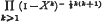 , but this is now known to be false. We write η(a, b, c) for the generating function of the number of solutions of (1) subject to the additional condition that
Macmahon 1916 found n(a, 1, 1) for general a. Here we find η(a, b, c) for general a, b. c.
 , but this is now known to be false. We write η(a, b, c) for the generating function of the number of solutions of (1) subject to the additional condition that
Index
-
- Journal:
- Proceedings of the Royal Society of Edinburgh Section A: Mathematical and Physical Sciences / Volume 67 / Issue 4 / 1967
- Published online by Cambridge University Press:
- 14 February 2012, pp. 353-354
- Print publication:
- 1967
-
- Article
- Export citation
XVI.—On Certain Numerical Coefficients Associated with Partitions
-
- Journal:
- Proceedings of the Royal Society of Edinburgh Section A: Mathematical and Physical Sciences / Volume 67 / Issue 3 / 1967
- Published online by Cambridge University Press:
- 14 February 2012, pp. 215-219
- Print publication:
- 1967
-
- Article
- Export citation
-
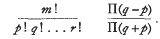
§ 1. The principal object of this note is to establish formula (16) of the preceding paper by H. Jack (1966). This formula, which was conjectured by Jack, evaluates a certain coefficient which is attached to a symbol {p, q, …, r}. In this symbols, p, q, …, r form a partition of m such that o≤p≤q≤…≤r,p+q+…+r=m. The symbol however vanishes if any two of the integers p, q, … r are equal but non-zero. In the remaining cases we have to show that the coefficient in question has the value
XVIII.—The Solution of Equations in a Lattice.
-
- Journal:
- Proceedings of the Royal Society of Edinburgh Section A: Mathematical and Physical Sciences / Volume 67 / Issue 3 / 1967
- Published online by Cambridge University Press:
- 14 February 2012, pp. 231-242
- Print publication:
- 1967
-
- Article
- Export citation
XV.—A Matrix Analogue of the Integral

-
- Journal:
- Proceedings of the Royal Society of Edinburgh Section A: Mathematical and Physical Sciences / Volume 67 / Issue 3 / 1967
- Published online by Cambridge University Press:
- 14 February 2012, pp. 205-214
- Print publication:
- 1967
-
- Article
- Export citation

PRM volume 67 issue 3 Cover and Back matter
-
- Journal:
- Proceedings of the Royal Society of Edinburgh Section A: Mathematical and Physical Sciences / Volume 67 / Issue 3 / 1967
- Published online by Cambridge University Press:
- 14 February 2012, pp. b1-b2
- Print publication:
- 1967
-
- Article
-
- You have access
- Export citation
