Refine search
Actions for selected content:
26063 results in Abstract analysis
XXV.—Axiomatic Treatment of Kinematical Relativity: A Reply to Dr G. C. McVittie
-
- Journal:
- Proceedings of the Royal Society of Edinburgh Section A: Mathematical and Physical Sciences / Volume 61 / Issue 3 / 1943
- Published online by Cambridge University Press:
- 14 February 2012, pp. 298-299
- Print publication:
- 1943
-
- Article
- Export citation
XXI.—Sylvester's Unravelment of a Ternary Quartic
-
- Journal:
- Proceedings of the Royal Society of Edinburgh Section A: Mathematical and Physical Sciences / Volume 61 / Issue 3 / 1943
- Published online by Cambridge University Press:
- 14 February 2012, pp. 247-259
- Print publication:
- 1943
-
- Article
- Export citation
XX.—Aristotle, Newton, Einstein
-
- Journal:
- Proceedings of the Royal Society of Edinburgh Section A: Mathematical and Physical Sciences / Volume 61 / Issue 3 / 1943
- Published online by Cambridge University Press:
- 14 February 2012, pp. 231-246
- Print publication:
- 1943
-
- Article
- Export citation
XXVI.—The Monomial Expansion of Determinantal Symmetric Functions
-
- Journal:
- Proceedings of the Royal Society of Edinburgh Section A: Mathematical and Physical Sciences / Volume 61 / Issue 3 / 1943
- Published online by Cambridge University Press:
- 14 February 2012, pp. 300-310
- Print publication:
- 1943
-
- Article
- Export citation
-
The quotient of alternants
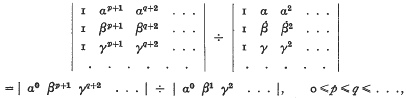
the denominator being the difference-product of the arguments a, β, γ, …, is an important symmetric function, introduced into algebra by Jacobi in 1841.
XV.—On the Estimation of Statistical Parameters
-
- Journal:
- Proceedings of the Royal Society of Edinburgh Section A: Mathematical and Physical Sciences / Volume 61 / Issue 2 / 1942
- Published online by Cambridge University Press:
- 14 February 2012, pp. 186-194
- Print publication:
- 1942
-
- Article
- Export citation
PRM volume 61 issue 2 Cover and Back matter
-
- Journal:
- Proceedings of the Royal Society of Edinburgh Section A: Mathematical and Physical Sciences / Volume 61 / Issue 2 / 1942
- Published online by Cambridge University Press:
- 14 February 2012, pp. b1-b2
- Print publication:
- 1942
-
- Article
-
- You have access
- Export citation
XIII.—Some Disputed Questions in the Philosophy of the Physical Sciences
-
- Journal:
- Proceedings of the Royal Society of Edinburgh Section A: Mathematical and Physical Sciences / Volume 61 / Issue 2 / 1942
- Published online by Cambridge University Press:
- 14 February 2012, pp. 160-175
- Print publication:
- 1942
-
- Article
- Export citation
PRM volume 61 issue 2 Cover and Front matter
-
- Journal:
- Proceedings of the Royal Society of Edinburgh Section A: Mathematical and Physical Sciences / Volume 61 / Issue 2 / 1942
- Published online by Cambridge University Press:
- 14 February 2012, pp. f1-f4
- Print publication:
- 1942
-
- Article
-
- You have access
- Export citation
XII.—Some Remarks occasioned by the Geometry of the Veronese Surface
-
- Journal:
- Proceedings of the Royal Society of Edinburgh Section A: Mathematical and Physical Sciences / Volume 61 / Issue 2 / 1942
- Published online by Cambridge University Press:
- 14 February 2012, pp. 140-159
- Print publication:
- 1942
-
- Article
- Export citation
XI.—Quantum Theory of the Chemical Bond
-
- Journal:
- Proceedings of the Royal Society of Edinburgh Section A: Mathematical and Physical Sciences / Volume 61 / Issue 2 / 1942
- Published online by Cambridge University Press:
- 14 February 2012, pp. 115-139
- Print publication:
- 1942
-
- Article
- Export citation
XIV.—Further Investigations in Factor Estimation
-
- Journal:
- Proceedings of the Royal Society of Edinburgh Section A: Mathematical and Physical Sciences / Volume 61 / Issue 2 / 1942
- Published online by Cambridge University Press:
- 14 February 2012, pp. 176-185
- Print publication:
- 1942
-
- Article
- Export citation
VII.—The Clear-Day Barometric Curve at Ben Nevis
-
- Journal:
- Proceedings of the Royal Society of Edinburgh Section A: Mathematical and Physical Sciences / Volume 61 / Issue 1 / 1941
- Published online by Cambridge University Press:
- 14 February 2012, pp. 71-76
- Print publication:
- 1941
-
- Article
- Export citation
PRM volume 61 issue 1 Cover and Back matter
-
- Journal:
- Proceedings of the Royal Society of Edinburgh Section A: Mathematical and Physical Sciences / Volume 61 / Issue 1 / 1941
- Published online by Cambridge University Press:
- 14 February 2012, pp. b1-b2
- Print publication:
- 1941
-
- Article
-
- You have access
- Export citation
X.—A New Way of Measuring the Velocity of Light
-
- Journal:
- Proceedings of the Royal Society of Edinburgh Section A: Mathematical and Physical Sciences / Volume 61 / Issue 1 / 1941
- Published online by Cambridge University Press:
- 14 February 2012, pp. 102-114
- Print publication:
- 1941
-
- Article
- Export citation
VI.—Generating Functions of Certain Continuous Orthogonal Systems
-
- Journal:
- Proceedings of the Royal Society of Edinburgh Section A: Mathematical and Physical Sciences / Volume 61 / Issue 1 / 1941
- Published online by Cambridge University Press:
- 14 February 2012, pp. 61-70
- Print publication:
- 1941
-
- Article
- Export citation
II.—The Van der Waals Force between a Proton and a Hydrogen Atom
-
- Journal:
- Proceedings of the Royal Society of Edinburgh Section A: Mathematical and Physical Sciences / Volume 61 / Issue 1 / 1941
- Published online by Cambridge University Press:
- 14 February 2012, pp. 20-25
- Print publication:
- 1941
-
- Article
- Export citation
IX.—On a Certain Variation of the Distributive Law for a Commutative Algebraic Field
-
- Journal:
- Proceedings of the Royal Society of Edinburgh Section A: Mathematical and Physical Sciences / Volume 61 / Issue 1 / 1941
- Published online by Cambridge University Press:
- 14 February 2012, pp. 93-101
- Print publication:
- 1941
-
- Article
- Export citation
I.—On Hamilton's Principal Function in Quantum Mechanics
-
- Journal:
- Proceedings of the Royal Society of Edinburgh Section A: Mathematical and Physical Sciences / Volume 61 / Issue 1 / 1941
- Published online by Cambridge University Press:
- 14 February 2012, pp. 1-19
- Print publication:
- 1941
-
- Article
- Export citation
-
The solution of a problem in classical dynamics can be described, as Hamilton showed in 1834, by its Principal Function. Considering for simplicity a conservative problem with one degree of freedom, let the co-ordinate at the instant t be q, and let the Lagrangean function be L. Let Q be the value of the co-ordinate at a previous instant T. Let the quantity
 , after the integration has been performed, be expressed in terms of (q, Q, t — T), and let the function thus obtained, which is Hamilton's Principal Function, be denoted by W.
 , after the integration has been performed, be expressed in terms of (q, Q, t — T), and let the function thus obtained, which is Hamilton's Principal Function, be denoted by W.
III.—Reciprocity. Part V: Reciprocal Spinor Functions*
-
- Journal:
- Proceedings of the Royal Society of Edinburgh Section A: Mathematical and Physical Sciences / Volume 61 / Issue 1 / 1941
- Published online by Cambridge University Press:
- 14 February 2012, pp. 26-36
- Print publication:
- 1941
-
- Article
- Export citation
IV.—On an Elementary Solution of a Partial Differential Equation of Parabolic Type. Part I
-
- Journal:
- Proceedings of the Royal Society of Edinburgh Section A: Mathematical and Physical Sciences / Volume 61 / Issue 1 / 1941
- Published online by Cambridge University Press:
- 14 February 2012, pp. 37-53
- Print publication:
- 1941
-
- Article
- Export citation
-
Professor E. T. Whittaker has recently discovered a Third Quantum-Mechanical Principal Function R(q, Q, t - T) and has worked out the theory of this function in detail when the Hamiltonian is

By using the Sturm-Liouville theory of linear differential equations and the properties of Green's function, it is shown that the function
 is an elementary solution of the adjoint of the Schrodinger wave equation associated with the Hamiltonian H.
It is pointed out that the modified Planck constant ħ arises solely from the commutation relation
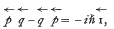 and may, from the analytical view-point, be any constant, real or complex. In particular, if ħ = i, the use of an algebra with the commutation relation
  leads to an elementary solution of the real equation of parabolic type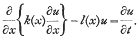
 is an elementary solution of the adjoint of the Schrodinger wave equation associated with the Hamiltonian H.
 and may, from the analytical view-point, be any constant, real or complex. In particular, if ħ = i, the use of an algebra with the commutation relation
  leads to an elementary solution of the real equation of parabolic type
