Refine search
Actions for selected content:
26080 results in Abstract analysis
The maximum voltage drop in an on-chip power distribution network: analysis of square, triangular and hexagonal power pad arrangements
-
- Journal:
- European Journal of Applied Mathematics / Volume 25 / Issue 5 / October 2014
- Published online by Cambridge University Press:
- 23 April 2014, pp. 531-551
-
- Article
- Export citation
An Optimal Algorithm for Finding Frieze–Kannan Regular Partitions
-
- Journal:
- Combinatorics, Probability and Computing / Volume 24 / Issue 2 / March 2015
- Published online by Cambridge University Press:
- 23 April 2014, pp. 407-437
-
- Article
- Export citation
Comparison and Positive Solutions for Problems with the (p, q)-Laplacian and a Convection Term
-
- Journal:
- Proceedings of the Edinburgh Mathematical Society / Volume 57 / Issue 3 / October 2014
- Published online by Cambridge University Press:
- 16 April 2014, pp. 687-698
-
- Article
-
- You have access
- Export citation
Covers of Acts Over Monoids and Pure Epimorphisms
-
- Journal:
- Proceedings of the Edinburgh Mathematical Society / Volume 57 / Issue 3 / October 2014
- Published online by Cambridge University Press:
- 16 April 2014, pp. 589-617
-
- Article
-
- You have access
- Export citation
Gorenstein Isolated Quotient Singularities Over ℂ
-
- Journal:
- Proceedings of the Edinburgh Mathematical Society / Volume 57 / Issue 3 / October 2014
- Published online by Cambridge University Press:
- 16 April 2014, pp. 811-839
-
- Article
-
- You have access
- Export citation
Existence, Stability and Oscillation Properties of Slow-Decay Positive Solutions of Supercritical Elliptic Equations with Hardy Potential
- Part of
-
- Journal:
- Proceedings of the Edinburgh Mathematical Society / Volume 58 / Issue 1 / February 2015
- Published online by Cambridge University Press:
- 16 April 2014, pp. 255-271
-
- Article
-
- You have access
- Export citation
-
We prove the existence of a family of slow-decay positive solutions of a supercritical elliptic equation with Hardy potential

and study the stability and oscillation properties of these solutions. We also show that if the equation on ℝN has a stable slow-decay positive solution, then for any smooth compact K ⊂ ℝN a family of the exterior Dirichlet problems inℝN \ K admits a continuum of stable slow-decay infinite-energy solutions.
Quasilinear Problems Involving Changing-Sign Nonlinearities without an Ambrosetti–Rabinowitz-Type Condition
-
- Journal:
- Proceedings of the Edinburgh Mathematical Society / Volume 57 / Issue 3 / October 2014
- Published online by Cambridge University Press:
- 16 April 2014, pp. 755-762
-
- Article
-
- You have access
- Export citation
Central Cohomology Operations and K-Theory
-
- Journal:
- Proceedings of the Edinburgh Mathematical Society / Volume 57 / Issue 3 / October 2014
- Published online by Cambridge University Press:
- 16 April 2014, pp. 699-711
-
- Article
-
- You have access
- Export citation
On Fano Varieties with Torus Action of Complexity 1
-
- Journal:
- Proceedings of the Edinburgh Mathematical Society / Volume 57 / Issue 3 / October 2014
- Published online by Cambridge University Press:
- 16 April 2014, pp. 737-753
-
- Article
-
- You have access
- Export citation
Sequences of Weak Solutions for Non-Local Elliptic Problems with Dirichlet Boundary Condition
-
- Journal:
- Proceedings of the Edinburgh Mathematical Society / Volume 57 / Issue 3 / October 2014
- Published online by Cambridge University Press:
- 16 April 2014, pp. 779-809
-
- Article
-
- You have access
- Export citation
Explicit flock solutions for Quasi-Morse potentials
-
- Journal:
- European Journal of Applied Mathematics / Volume 25 / Issue 5 / October 2014
- Published online by Cambridge University Press:
- 15 April 2014, pp. 553-578
-
- Article
-
- You have access
- Open access
- Export citation
On the Cohomology of Classifying Spaces of Groups of Homeomorphisms
-
- Journal:
- Proceedings of the Edinburgh Mathematical Society / Volume 57 / Issue 3 / October 2014
- Published online by Cambridge University Press:
- 10 April 2014, pp. 763-778
-
- Article
-
- You have access
- Export citation
Counting Independent Sets in Hypergraphs
-
- Journal:
- Combinatorics, Probability and Computing / Volume 23 / Issue 4 / July 2014
- Published online by Cambridge University Press:
- 08 April 2014, pp. 539-550
-
- Article
- Export citation
-
Let G be a triangle-free graph with n vertices and average degree t. We show that G contains at least
independent sets. This improves a recent result of the first and third authors [8]. In particular, it implies that as n → ∞, every triangle-free graph on n vertices has at least ${\exp\biggl({1-n^{-1/12})\frac{1}{2}\frac{n}{t}\ln t} \biggl(\frac{1}{2}\ln t-1\biggr)\biggr)}$ ${e^{(c_1-o(1)) \sqrt{n} \ln n}}$ independent sets, where $c_1 = \sqrt{\ln 2}/4 = 0.208138 \ldots$. Further, we show that for all n, there exists a triangle-free graph with n vertices which has at most ${e^{(c_2+o(1))\sqrt{n}\ln n}}$ independent sets, where $c_2 = 2\sqrt{\ln 2} = 1.665109 \ldots$. This disproves a conjecture from [8].
Let H be a (k+1)-uniform linear hypergraph with n vertices and average degree t. We also show that there exists a constant ck such that the number of independent sets in H is at least
This is tight apart from the constant ck and generalizes a result of Duke, Lefmann and Rödl [9], which guarantees the existence of an independent set of size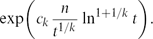 ${\exp\biggl({c_{k} \frac{n}{t^{1/k}}\ln^{1+1/k}{t}\biggr})}.$Both of our lower bounds follow from a more general statement, which applies to hereditary properties of hypergraphs.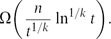 $\Omega\biggl(\frac{n}{t^{1/k}} \ln^{1/k}t\biggr).$


Reduced ODE dynamics as formal relativistic asymptotics of a Peierls–Nabarro model
-
- Journal:
- European Journal of Applied Mathematics / Volume 25 / Issue 4 / August 2014
- Published online by Cambridge University Press:
- 08 April 2014, pp. 511-529
-
- Article
- Export citation
The First k-Regular Subgraph is Large
-
- Journal:
- Combinatorics, Probability and Computing / Volume 23 / Issue 3 / May 2014
- Published online by Cambridge University Press:
- 07 April 2014, pp. 412-433
-
- Article
- Export citation
-
Let $(G_m)_{0\le m\le \binom{n}{2}}$ be the random graph process starting from the empty graph on vertex set [n] and with a random edge added in each step. Let mk denote the minimum integer such that Gmk contains a k-regular subgraph. We prove that for all sufficiently large k, there exist two constants εk ≥ σk > 0, with εk → 0 as k → ∞, such that asymptotically almost surely any k-regular subgraph of Gmk has size between (1 − εk)| ${\mathcal C}_k$| and (1 − σk)|${\mathcal C}_k$|, where ${\mathcal C}_k$ denotes the k-core of Gmk.


CPC volume 23 issue 3 Cover and Back matter
-
- Journal:
- Combinatorics, Probability and Computing / Volume 23 / Issue 3 / May 2014
- Published online by Cambridge University Press:
- 07 April 2014, pp. b1-b2
-
- Article
-
- You have access
- Export citation
DIFFERENTIAL OPERATORS ON $G/U$ AND THE AFFINE GRASSMANNIAN
-
- Journal:
- Journal of the Institute of Mathematics of Jussieu / Volume 14 / Issue 3 / July 2015
- Published online by Cambridge University Press:
- 07 April 2014, pp. 493-575
- Print publication:
- July 2015
-
- Article
- Export citation
-
We describe the equivariant cohomology of cofibers of spherical perverse sheaves on the affine Grassmannian of a reductive algebraic group in terms of the geometry of the Langlands dual group. In fact we give two equivalent descriptions: one in terms of $\mathscr{D}$-modules of the basic affine space, and one in terms of intertwining operators for universal Verma modules. We also construct natural collections of isomorphisms parameterized by the Weyl group in these three contexts, and prove that they are compatible with our isomorphisms. As applications we reprove some results of the first author and of Braverman and Finkelberg.


Vitali Liskevich
-
- Journal:
- Proceedings of the Edinburgh Mathematical Society / Volume 57 / Issue 2 / June 2014
- Published online by Cambridge University Press:
- 07 April 2014, pp. 573-574
-
- Article
-
- You have access
- Export citation
CPC volume 23 issue 3 Cover and Front matter
-
- Journal:
- Combinatorics, Probability and Computing / Volume 23 / Issue 3 / May 2014
- Published online by Cambridge University Press:
- 07 April 2014, pp. f1-f2
-
- Article
-
- You have access
- Export citation
GMJ volume 56 issue 2 Cover and Back matter
-
- Journal:
- Glasgow Mathematical Journal / Volume 56 / Issue 2 / May 2014
- Published online by Cambridge University Press:
- 01 April 2014, pp. b1-b2
-
- Article
-
- You have access
- Export citation
