Refine search
Actions for selected content:
26077 results in Abstract analysis

Analysis on Fractals
-
- Published online:
- 22 September 2009
- Print publication:
- 07 June 2001

Introduction to Hp Spaces
-
- Published online:
- 22 September 2009
- Print publication:
- 07 January 1999
A drift-diffusion model for semiconductors with temperature effects
-
- Journal:
- Proceedings of the Royal Society of Edinburgh. Section A: Mathematics / Volume 139 / Issue 5 / October 2009
- Published online by Cambridge University Press:
- 21 September 2009, pp. 1101-1119
- Print publication:
- October 2009
-
- Article
- Export citation
A boundary value problem on the half-line for higher-order nonlinear differential equations
-
- Journal:
- Proceedings of the Royal Society of Edinburgh. Section A: Mathematics / Volume 139 / Issue 5 / October 2009
- Published online by Cambridge University Press:
- 21 September 2009, pp. 1017-1035
- Print publication:
- October 2009
-
- Article
- Export citation
Stability of periodic optical solitons for a nonlinear Schrödinger system
-
- Journal:
- Proceedings of the Royal Society of Edinburgh. Section A: Mathematics / Volume 139 / Issue 5 / October 2009
- Published online by Cambridge University Press:
- 21 September 2009, pp. 927-959
- Print publication:
- October 2009
-
- Article
- Export citation
Duality and compactness results in high-contrast homogenization of incompressible two-dimensional elasticity problems
-
- Journal:
- Proceedings of the Royal Society of Edinburgh. Section A: Mathematics / Volume 139 / Issue 5 / October 2009
- Published online by Cambridge University Press:
- 21 September 2009, pp. 997-1015
- Print publication:
- October 2009
-
- Article
- Export citation
-
We study incompressible two-dimensional elasticity problems with high-contrast coefficients. The Keller–Dykhne duality relations are extended to the case of Hooke's laws which are equicoercive and uniformly bounded in L1 but not in L∞. A compactness result is obtained for Hooke's laws which are uniformly bounded from above and such that their inverses are bounded in L1 but not in L∞, with a refinement in the periodic case. Moreover, we establish a compactness result in
 for a sequence of two-dimensional vector-valued functions in
  which are only bounded in L2.
 for a sequence of two-dimensional vector-valued functions in
  which are only bounded in L
Picard values and normal families of meromorphic functions
-
- Journal:
- Proceedings of the Royal Society of Edinburgh. Section A: Mathematics / Volume 139 / Issue 5 / October 2009
- Published online by Cambridge University Press:
- 21 September 2009, pp. 1091-1099
- Print publication:
- October 2009
-
- Article
- Export citation
-
Let f be a transcendental meromorphic function on the complex plane ℂ, let a be a non-zero finite complex number and let n and k be two positive integers. In this paper, we prove that if n≥k+1, then
 assumes each value b∈ℂ infinitely often. Also, the related normal criterion for families of meromorphic functions is given. Our results generalize the related results of Fang and Zalcman.
 assumes each value b∈ℂ infinitely often. Also, the related normal criterion for families of meromorphic functions is given. Our results generalize the related results of Fang and Zalcman.
Influence of the Hardy potential in a semilinear heat equation
-
- Journal:
- Proceedings of the Royal Society of Edinburgh. Section A: Mathematics / Volume 139 / Issue 5 / October 2009
- Published online by Cambridge University Press:
- 21 September 2009, pp. 897-926
- Print publication:
- October 2009
-
- Article
- Export citation
-
This paper deals with the influence of the Hardy potential in a semilinear heat equation. Precisely, we consider the problem
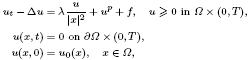
where Ω⊂ℝN, N≥3, is a bounded regular domain such that 0∈Ω, p>1, and u0≥0, f≥0 are in a suitable class of functions.
There is a great difference between this result and the heat equation (λ=0); indeed, if λ>0, there exists a critical exponent p+(λ) such that for p≥p+(λ) there is no solution for any non-trivial initial datum.
The Cauchy problem, Ω=ℝN, is also analysed for 1<p<+(λ). We find the same phenomenon about the critical power p+(λ) as above. Moreover, there exists a Fujita-type exponent, F(λ), in the sense that, independently of the initial datum, for 1<p<F(λ), any solution blows up in a finite time. Moreover, F(λ)>1+2/N, which is the Fujita exponent for the heat equation (λ=0).
Filtration-preserving mappings and centralizers within graded Lie algebras
-
- Journal:
- Proceedings of the Royal Society of Edinburgh. Section A: Mathematics / Volume 139 / Issue 5 / October 2009
- Published online by Cambridge University Press:
- 21 September 2009, pp. 961-996
- Print publication:
- October 2009
-
- Article
- Export citation
Applications of Riccati-type inequalities to asymptotic theory of elliptic problems
-
- Journal:
- Proceedings of the Royal Society of Edinburgh. Section A: Mathematics / Volume 139 / Issue 5 / October 2009
- Published online by Cambridge University Press:
- 21 September 2009, pp. 1071-1089
- Print publication:
- October 2009
-
- Article
- Export citation
Asymptotic models for curved rods derived from nonlinear elasticity by Γ-convergence
-
- Journal:
- Proceedings of the Royal Society of Edinburgh. Section A: Mathematics / Volume 139 / Issue 5 / October 2009
- Published online by Cambridge University Press:
- 21 September 2009, pp. 1037-1070
- Print publication:
- October 2009
-
- Article
- Export citation

Hilbert C*-Modules
- A Toolkit for Operator Algebraists
-
- Published online:
- 19 September 2009
- Print publication:
- 16 March 1995

General Irreducible Markov Chains and Non-Negative Operators
-
- Published online:
- 19 September 2009
- Print publication:
- 18 October 1984
Asymptotic Efficiency of Nonparametric Tests
-
- Published online:
- 18 September 2009
- Print publication:
- 30 June 1995
Harmonic Approximation
-
- Published online:
- 17 September 2009
- Print publication:
- 18 May 1995

Fourier Integrals in Classical Analysis
-
- Published online:
- 15 September 2009
- Print publication:
- 26 February 1993
Asymptotic Expansions
-
- Published online:
- 14 September 2009
- Print publication:
- 01 January 1965
The Regular Excluded Minors for Signed-Graphic Matroids
-
- Journal:
- Combinatorics, Probability and Computing / Volume 18 / Issue 6 / November 2009
- Published online by Cambridge University Press:
- 14 September 2009, pp. 953-978
-
- Article
- Export citation
JMJ volume 8 issue 4 Cover and Back matter
-
- Journal:
- Journal of the Institute of Mathematics of Jussieu / Volume 8 / Issue 4 / October 2009
- Published online by Cambridge University Press:
- 11 September 2009, pp. b1-b2
- Print publication:
- October 2009
-
- Article
-
- You have access
- Export citation
JMJ volume 8 issue 4 Cover and Front matter
-
- Journal:
- Journal of the Institute of Mathematics of Jussieu / Volume 8 / Issue 4 / October 2009
- Published online by Cambridge University Press:
- 11 September 2009, pp. f1-f2
- Print publication:
- October 2009
-
- Article
-
- You have access
- Export citation
