Refine search
Actions for selected content:
26077 results in Abstract analysis
Geometric Applications of Fourier Series and Spherical Harmonics
-
- Published online:
- 11 September 2009
- Print publication:
- 13 September 1996
EJM volume 20 issue 5 Cover and Front matter
-
- Journal:
- European Journal of Applied Mathematics / Volume 20 / Issue 5 / October 2009
- Published online by Cambridge University Press:
- 09 September 2009, pp. f1-f2
-
- Article
-
- You have access
- Export citation
The t-Improper Chromatic Number of Random Graphs
-
- Journal:
- Combinatorics, Probability and Computing / Volume 19 / Issue 1 / January 2010
- Published online by Cambridge University Press:
- 09 September 2009, pp. 87-98
-
- Article
- Export citation
EJM volume 20 issue 5 Cover and Back matter
-
- Journal:
- European Journal of Applied Mathematics / Volume 20 / Issue 5 / October 2009
- Published online by Cambridge University Press:
- 09 September 2009, pp. b1-b2
-
- Article
-
- You have access
- Export citation
Fixed Point Theory and Applications
-
- Published online:
- 04 September 2009
- Print publication:
- 22 March 2001
Economical Elimination of Cycles in the Torus
-
- Journal:
- Combinatorics, Probability and Computing / Volume 18 / Issue 5 / September 2009
- Published online by Cambridge University Press:
- 01 September 2009, pp. 619-627
-
- Article
- Export citation
-
Let m > 2 be an integer, let C2m denote the cycle of length 2m on the set of vertices [−m, m) = {−m, −m + 1, . . ., m − 2, m − 1}, and let G = G(m, d) denote the graph on the set of vertices [−m, m)d, in which two vertices are adjacent if and only if they are adjacent in C2m in one coordinate, and equal in all others. This graph can be viewed as the graph of the d-dimensional torus. We prove that one can delete a fraction of at most
 of the vertices of G so that no topologically non-trivial cycles remain. This is tight up to the logd factor and improves earlier estimates by various researchers.
 of the vertices of G so that no topologically non-trivial cycles remain. This is tight up to the logd factor and improves earlier estimates by various researchers.
EXISTENCE RESULT FOR NONUNIFORMLY DEGENERATE SEMILINEAR ELLIPTIC SYSTEMS IN
 N
N
-
- Journal:
- Glasgow Mathematical Journal / Volume 51 / Issue 3 / September 2009
- Published online by Cambridge University Press:
- 01 September 2009, pp. 561-570
-
- Article
-
- You have access
- Export citation
-
We study the existence of solutions for a class of nonuniformly degenerate elliptic systems in
 where hi ∈ L1loc(

ORE EXTENSIONS OF WEAK ZIP RINGS*
-
- Journal:
- Glasgow Mathematical Journal / Volume 51 / Issue 3 / September 2009
- Published online by Cambridge University Press:
- 01 September 2009, pp. 525-537
-
- Article
-
- You have access
- Export citation
ON THE WARING–GOLDBACH PROBLEM FOR CUBES
-
- Journal:
- Glasgow Mathematical Journal / Volume 51 / Issue 3 / September 2009
- Published online by Cambridge University Press:
- 01 September 2009, pp. 703-712
-
- Article
-
- You have access
- Export citation
GMJ volume 51 issue 3 Cover and Front matter
-
- Journal:
- Glasgow Mathematical Journal / Volume 51 / Issue 3 / September 2009
- Published online by Cambridge University Press:
- 01 September 2009, pp. f1-f2
-
- Article
-
- You have access
- Export citation
MC2 RINGS AND WQD RINGS*
-
- Journal:
- Glasgow Mathematical Journal / Volume 51 / Issue 3 / September 2009
- Published online by Cambridge University Press:
- 01 September 2009, pp. 691-702
-
- Article
-
- You have access
- Export citation
THE CENTRE OF THE MAXIMAL p-SUBGROUP OF
 (
( pkD2p)
-
- Journal:
- Glasgow Mathematical Journal / Volume 51 / Issue 3 / September 2009
- Published online by Cambridge University Press:
- 01 September 2009, pp. 651-657
-
- Article
-
- You have access
- Export citation
-
The centre of the maximal p-subgroup of
 (
(
On the Random Satisfiable Process
-
- Journal:
- Combinatorics, Probability and Computing / Volume 18 / Issue 5 / September 2009
- Published online by Cambridge University Press:
- 01 September 2009, pp. 775-801
-
- Article
- Export citation
-
In this work we suggest a new model for generating random satisfiable k-CNF formulas. To generate such formulas. randomly permute all
 possible clauses over the variables x1,. . .,xn, and starting from the empty formula, go over the clauses one by one, including each new clause as you go along if, after its addition, the formula remains satisfiable. We study the evolution of this process, namely the distribution over formulas obtained after scanning through the first m clauses (in the random permutation's order).
Random processes with conditioning on a certain property being respected are widely studied in the context of graph properties. This study was pioneered by Ruciński and Wormald in 1992 for graphs with a fixed degree sequence, and also by Erdős, Suen and Winkler in 1995 for triangle-free and bipartite graphs. Since then many other graph properties have been studied, such as planarity and H-freeness. Thus our model is a natural extension of this approach to the satisfiability setting.
Our main contribution is as follows. For m ≥ cn, c = c(k) a sufficiently large constant, we are able to characterize the structure of the solution space of a typical formula in this distribution. Specifically, we show that typically all satisfying assignments are essentially clustered in one cluster, and all but e−Ω(m/n)n of the variables take the same value in all satisfying assignments. We also describe a polynomial-time algorithm that finds w.h.p. a satisfying assignment for such formulas.
 possible clauses over the variables x
ON THE LINEAR COMBINANTS OF A BINARY PENCIL
-
- Journal:
- Glasgow Mathematical Journal / Volume 51 / Issue 3 / September 2009
- Published online by Cambridge University Press:
- 01 September 2009, pp. 481-498
-
- Article
-
- You have access
- Export citation
-
Let A, B denote binary forms of order d, and let

 . It is known that

 . It is known that
 POSITIVE SOLUTIONS FOR A CLASS OF p(x)-LAPLACIAN PROBLEMS
-
- Journal:
- Glasgow Mathematical Journal / Volume 51 / Issue 3 / September 2009
- Published online by Cambridge University Press:
- 01 September 2009, pp. 571-578
-
- Article
-
- You have access
- Export citation
-
We consider the system
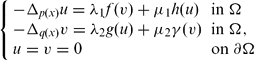 where p(x), q(x) ∈ C1(RN) are radial symmetric functions such that sup|∇ p(x)| < ∞, sup|∇ q(x)| < ∞ and 1 < inf p(x) ≤ sup p(x) < ∞, 1 < inf q(x) ≤ sup q(x) < ∞, where −Δp(x)u = −div(|∇u|p(x)−2∇u), −Δq(x)v = −div(|∇v|q(x)−2∇v), respectively are called p(x)-Laplacian and q(x)-Laplacian, λ1, λ2, μ1 and μ2 are positive parameters and Ω = B(0, R) ⊂ RN is a bounded radial symmetric domain, where R is sufficiently large. We prove the existence of a positive solution when
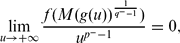 for every M > 0,
  and
and  . In particular, we do not assume any sign conditions on f(0), g(0), h(0) or γ(0).
 and
and  . In particular, we do not assume any sign conditions on f(0), g(0), h(0) or γ(0).
ON SUBMANIFOLDS WITH TAMED SECOND FUNDAMENTAL FORM
-
- Journal:
- Glasgow Mathematical Journal / Volume 51 / Issue 3 / September 2009
- Published online by Cambridge University Press:
- 01 September 2009, pp. 669-680
-
- Article
-
- You have access
- Export citation
On 14-Cycle-Free Subgraphs of the Hypercube
-
- Journal:
- Combinatorics, Probability and Computing / Volume 18 / Issue 5 / September 2009
- Published online by Cambridge University Press:
- 01 September 2009, pp. 725-729
-
- Article
- Export citation
On Colourings of Hypergraphs Without Monochromatic Fano Planes
-
- Journal:
- Combinatorics, Probability and Computing / Volume 18 / Issue 5 / September 2009
- Published online by Cambridge University Press:
- 01 September 2009, pp. 803-818
-
- Article
- Export citation
-
For k-uniform hypergraphs F and H and an integer r, let cr,F(H) denote the number of r-colourings of the set of hyperedges of H with no monochromatic copy of F, and let
 , where the maximum runs over all k-uniform hypergraphs on n vertices. Moreover, let ex(n,F) be the usual extremal or Turán function, i.e., the maximum number of hyperedges of an n-vertex k-uniform hypergraph which contains no copy of F.
For complete graphs F = Kℓ and r = 2, Erdős and Rothschild conjectured that c2,Kℓ(n) = 2ex(n,Kℓ). This conjecture was proved by Yuster for ℓ = 3 and by Alon, Balogh, Keevash and Sudakov for arbitrary ℓ. In this paper, we consider the question for hypergraphs and show that, in the special case when F is the Fano plane and r = 2 or 3, then cr,F(n) = rex(n,F), while cr,F(n) ≫ rex(n,F) for r ≥ 4.
 , where the maximum runs over all k-uniform hypergraphs on n vertices. Moreover, let ex(n,F) be the usual extremal or Turán function, i.e., the maximum number of hyperedges of an n-vertex k-uniform hypergraph which contains no copy of F.
Introduction
-
- Journal:
- Combinatorics, Probability and Computing / Volume 18 / Issue 5 / September 2009
- Published online by Cambridge University Press:
- 01 September 2009, pp. 617-618
-
- Article
- Export citation
CPC volume 18 issue 5 Cover and Back matter
-
- Journal:
- Combinatorics, Probability and Computing / Volume 18 / Issue 5 / September 2009
- Published online by Cambridge University Press:
- 01 September 2009, pp. b1-b4
-
- Article
-
- You have access
- Export citation
