Refine search
Actions for selected content:
25990 results in Abstract analysis
Some Local Extremal Connectivity Results for Matroids
-
- Journal:
- Combinatorics, Probability and Computing / Volume 2 / Issue 4 / December 1993
- Published online by Cambridge University Press:
- 12 September 2008, pp. 367-384
-
- Article
- Export citation
Duality for Random Sequential Adsorption on a Lattice†
-
- Journal:
- Combinatorics, Probability and Computing / Volume 1 / Issue 3 / September 1992
- Published online by Cambridge University Press:
- 12 September 2008, pp. 219-222
-
- Article
- Export citation
Conditional Independences among Four Random Variables I*
-
- Journal:
- Combinatorics, Probability and Computing / Volume 4 / Issue 3 / September 1995
- Published online by Cambridge University Press:
- 12 September 2008, pp. 269-278
-
- Article
- Export citation
CPC volume 4 issue 1 Cover and Front matter
-
- Journal:
- Combinatorics, Probability and Computing / Volume 4 / Issue 1 / March 1995
- Published online by Cambridge University Press:
- 12 September 2008, pp. f1-f2
-
- Article
-
- You have access
- Export citation
CPC volume 5 issue 2 Cover and Front matter
-
- Journal:
- Combinatorics, Probability and Computing / Volume 5 / Issue 2 / June 1996
- Published online by Cambridge University Press:
- 12 September 2008, pp. f1-f2
-
- Article
-
- You have access
- Export citation
Clique Partitions of Chordal Graphs†
-
- Journal:
- Combinatorics, Probability and Computing / Volume 2 / Issue 4 / December 1993
- Published online by Cambridge University Press:
- 12 September 2008, pp. 409-415
-
- Article
- Export citation
On Universal Threshold Graphs
-
- Journal:
- Combinatorics, Probability and Computing / Volume 3 / Issue 3 / September 1994
- Published online by Cambridge University Press:
- 12 September 2008, pp. 327-344
-
- Article
- Export citation
-
A graph G is threshold if there exists a ‘weight’ function w: V(G) → R such that the total weight of any stable set of G is less than the total weight of any non-stable set of G. Let
 n denote the set of threshold graphs with n vertices. A graph is called n-universal if it contains every threshold graph with n vertices as an induced subgraph. n-universal threshold graphs are of special interest, since they are precisely those n-universal graphs that do not contain any non-threshold induced subgraph.
In this paper we shall study minimum
n-universal (threshold) graphs, i.e.n-universal (threshold) graphs having the minimum number of vertices.It is shown that for any n ≥ 3 there exist minimum
n-universal graphs, which are themselves threshold, and others which are not.Two extremal minimum
n-universal graphs having respectively the minimum and the maximum number of edges are described, it is proved that they are unique, and that they are threshold graphs.The set of all minimum
n-universal threshold graphs is then described constructively; it is shown that it forms a lattice isomorphic to the n − 1 dimensional Boolean cube, and that the minimum and the maximum elements of this lattice are the two extremal graphs introduced above.The proofs provide a (polynomial) recursive procedure that determines for any threshold graph G with n vertices and for any minimum
n-universal threshold graph T, an induced subgraph G' of T isomorphic to G.

Random Graph Processes with Degree Restrictions
-
- Journal:
- Combinatorics, Probability and Computing / Volume 1 / Issue 2 / June 1992
- Published online by Cambridge University Press:
- 12 September 2008, pp. 169-180
-
- Article
- Export citation
A Stochastic Comparison for Arrangement Increasing Functions
-
- Journal:
- Combinatorics, Probability and Computing / Volume 3 / Issue 3 / September 1994
- Published online by Cambridge University Press:
- 12 September 2008, pp. 345-348
-
- Article
- Export citation
Triangle-Free Graphs with High Minimal Degrees
-
- Journal:
- Combinatorics, Probability and Computing / Volume 2 / Issue 4 / December 1993
- Published online by Cambridge University Press:
- 12 September 2008, pp. 479-490
-
- Article
- Export citation
On the Maximum Number of Triangles in Wheel-Free Graphs
-
- Journal:
- Combinatorics, Probability and Computing / Volume 3 / Issue 1 / March 1994
- Published online by Cambridge University Press:
- 12 September 2008, pp. 63-75
-
- Article
- Export citation
Conditional Independences among Four Random Variables II
-
- Journal:
- Combinatorics, Probability and Computing / Volume 4 / Issue 4 / December 1995
- Published online by Cambridge University Press:
- 12 September 2008, pp. 407-417
-
- Article
- Export citation
Properties of Classes of Random Graphs
-
- Journal:
- Combinatorics, Probability and Computing / Volume 3 / Issue 4 / December 1994
- Published online by Cambridge University Press:
- 12 September 2008, pp. 435-454
-
- Article
- Export citation
The Computational Complexity of the Tutte Plane: the Bipartite Case
-
- Journal:
- Combinatorics, Probability and Computing / Volume 1 / Issue 2 / June 1992
- Published online by Cambridge University Press:
- 12 September 2008, pp. 181-187
-
- Article
- Export citation
Predecessors in Random Mappings
-
- Journal:
- Combinatorics, Probability and Computing / Volume 5 / Issue 4 / December 1996
- Published online by Cambridge University Press:
- 12 September 2008, pp. 317-335
-
- Article
- Export citation
-
Let ℱn be the set of random mappings ϕ : {1,…,n} → {1,…,n} (such that every mapping is equally likely). For x ε {l,…,n} the elements
 are called the predecessors of x. Let Nr denote the random variable which counts the number of points x ε {l,…,n} with exactly r predecessors. In this paper we identify the limiting distribution of Nr as n → ∞. If r = r(n) = o(n⅔) then the limiting distribution is Gaussian, if r ˜ Cn⅔ then it is Poisson, and in the remaining case rn−⅔ → ∞ it is degenerate. Furthermore, it is shown that Nr is a Poisson approximation if r → ∞.
 are called the predecessors of
 Random Matrices and Brownian Motion†
-
- Journal:
- Combinatorics, Probability and Computing / Volume 2 / Issue 2 / June 1993
- Published online by Cambridge University Press:
- 12 September 2008, pp. 157-180
-
- Article
- Export citation
-
For T ∈ GLn (Fq), let Ωn (t, T) be the number of irreducible factors of degree less than or equal to nt in the characteristic polynomial of T. Let
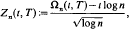
and suppose T is chosen from G Ln(Fq) at random uniformly. We prove that the stochastic process ≺Zn(t)≻t∈[0, 1] converges to the standard Brownian motion process W(t), as n → ∞.
Randomised Approximation in the Tutte Plane
-
- Journal:
- Combinatorics, Probability and Computing / Volume 3 / Issue 1 / March 1994
- Published online by Cambridge University Press:
- 12 September 2008, pp. 137-143
-
- Article
- Export citation
CPC volume 4 issue 3 Cover and Front matter
-
- Journal:
- Combinatorics, Probability and Computing / Volume 4 / Issue 3 / September 1995
- Published online by Cambridge University Press:
- 12 September 2008, pp. f1-f2
-
- Article
-
- You have access
- Export citation
A Rate for the Erdős-Turán Law*
-
- Journal:
- Combinatorics, Probability and Computing / Volume 3 / Issue 2 / June 1994
- Published online by Cambridge University Press:
- 12 September 2008, pp. 167-176
-
- Article
- Export citation
On Random Generation of the Symmetric Group
-
- Journal:
- Combinatorics, Probability and Computing / Volume 2 / Issue 4 / December 1993
- Published online by Cambridge University Press:
- 12 September 2008, pp. 505-512
-
- Article
- Export citation
