Refine search
Actions for selected content:
25990 results in Abstract analysis
Some Small Circuit-Cocircuit Ramsey Numbers for Matroids
-
- Journal:
- Combinatorics, Probability and Computing / Volume 4 / Issue 1 / March 1995
- Published online by Cambridge University Press:
- 12 September 2008, pp. 67-80
-
- Article
- Export citation
Choice Numbers of Graphs: a Probabilistic Approach
-
- Journal:
- Combinatorics, Probability and Computing / Volume 1 / Issue 2 / June 1992
- Published online by Cambridge University Press:
- 12 September 2008, pp. 107-114
-
- Article
- Export citation
Hamilton Cycles in Random Regular Digraphs
-
- Journal:
- Combinatorics, Probability and Computing / Volume 3 / Issue 1 / March 1994
- Published online by Cambridge University Press:
- 12 September 2008, pp. 39-49
-
- Article
- Export citation
CPC volume 3 issue 4 Cover and Front matter
-
- Journal:
- Combinatorics, Probability and Computing / Volume 3 / Issue 4 / December 1994
- Published online by Cambridge University Press:
- 12 September 2008, pp. f1-f2
-
- Article
-
- You have access
- Export citation
Matchings in Lattice Graphs and Hamming Graphs
-
- Journal:
- Combinatorics, Probability and Computing / Volume 3 / Issue 2 / June 1994
- Published online by Cambridge University Press:
- 12 September 2008, pp. 157-166
-
- Article
- Export citation
On the Hardness of Approximating Some Optimization Problems That Are Supposedly Easier Than MAX CLIQUE
-
- Journal:
- Combinatorics, Probability and Computing / Volume 4 / Issue 2 / June 1995
- Published online by Cambridge University Press:
- 12 September 2008, pp. 167-180
-
- Article
- Export citation
A Winning Strategy for the Ramsey Graph Game
-
- Journal:
- Combinatorics, Probability and Computing / Volume 5 / Issue 3 / September 1996
- Published online by Cambridge University Press:
- 12 September 2008, pp. 267-276
-
- Article
- Export citation
A Phase Transition for the Distribution of Matching Blocks
-
- Journal:
- Combinatorics, Probability and Computing / Volume 5 / Issue 2 / June 1996
- Published online by Cambridge University Press:
- 12 September 2008, pp. 139-159
-
- Article
- Export citation
On the Structure of Non-Hamiltonian Graphs I
-
- Journal:
- Combinatorics, Probability and Computing / Volume 1 / Issue 1 / March 1992
- Published online by Cambridge University Press:
- 12 September 2008, pp. 27-34
-
- Article
- Export citation
On Brooks' Theorem for Sparse Graphs
-
- Journal:
- Combinatorics, Probability and Computing / Volume 4 / Issue 2 / June 1995
- Published online by Cambridge University Press:
- 12 September 2008, pp. 97-132
-
- Article
- Export citation
-
Let G be a graph with maximum degree Δ(G). In this paper we prove that if the girth g(G) of G is greater than 4 then its chromatic number, χ(G), satisfies
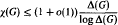
where o(l) goes to zero as Δ(G) goes to infinity. (Our logarithms are base e.) More generally, we prove the same bound for the list-chromatic (or choice) number:
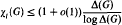
provided g(G) < 4.
Excluding Minors in Cubic Graphs
-
- Journal:
- Combinatorics, Probability and Computing / Volume 5 / Issue 1 / March 1996
- Published online by Cambridge University Press:
- 12 September 2008, pp. 57-78
-
- Article
- Export citation
Properties of Large Eden Clusters in the Plane
-
- Journal:
- Combinatorics, Probability and Computing / Volume 3 / Issue 4 / December 1994
- Published online by Cambridge University Press:
- 12 September 2008, pp. 471-505
-
- Article
- Export citation
Walk Generating Functions, Christoffel-Darboux Identities and the Adjacency Matrix of a Graph
-
- Journal:
- Combinatorics, Probability and Computing / Volume 1 / Issue 1 / March 1992
- Published online by Cambridge University Press:
- 12 September 2008, pp. 13-25
-
- Article
- Export citation
Linear-Time Approximation Algorithms for the Max Cut Problem
-
- Journal:
- Combinatorics, Probability and Computing / Volume 2 / Issue 2 / June 1993
- Published online by Cambridge University Press:
- 12 September 2008, pp. 201-210
-
- Article
- Export citation
Reciprocity and Polynomial Properties for Even Flows and Potentials on Directed Graphs
-
- Journal:
- Combinatorics, Probability and Computing / Volume 3 / Issue 1 / March 1994
- Published online by Cambridge University Press:
- 12 September 2008, pp. 1-11
-
- Article
- Export citation
How Do Read-Once Formulae Shrink?
-
- Journal:
- Combinatorics, Probability and Computing / Volume 3 / Issue 4 / December 1994
- Published online by Cambridge University Press:
- 12 September 2008, pp. 455-469
-
- Article
- Export citation
-
Let f be a de Morgan read-once function of n variables. Let fε be the random restriction obtained by independently assigning to each variable of f, the value 0 with probability (1 -ε)/2, the value 1 with the same probability, and leaving it unassigned with probability ε. We show that fε depends, on the average, on only O(εαn + εn1/α) variables, where
 . This result is asymptotically the tightest possible. It improves a similar result obtained recently by Håstad, Razborov and Yao.
 . This result is asymptotically the tightest possible. It improves a similar result obtained recently by Håstad, Razborov and Yao.
t-Covering Arrays: Upper Bounds and Poisson Approximations
-
- Journal:
- Combinatorics, Probability and Computing / Volume 5 / Issue 2 / June 1996
- Published online by Cambridge University Press:
- 12 September 2008, pp. 105-117
-
- Article
- Export citation
Editorial: Issues Dedicated to Paul Erdős
-
- Journal:
- Combinatorics, Probability and Computing / Volume 3 / Issue 2 / June 1994
- Published online by Cambridge University Press:
- 12 September 2008, p. i
-
- Article
-
- You have access
- Export citation
A Combinatorial Approach to Complexity Theory via Ordinal Hierarchies
-
- Journal:
- Combinatorics, Probability and Computing / Volume 3 / Issue 2 / June 1994
- Published online by Cambridge University Press:
- 12 September 2008, pp. 177-190
-
- Article
- Export citation
On a Correlation Inequality of Farr
-
- Journal:
- Combinatorics, Probability and Computing / Volume 1 / Issue 2 / June 1992
- Published online by Cambridge University Press:
- 12 September 2008, pp. 157-160
-
- Article
- Export citation
