Refine search
Actions for selected content:
26079 results in Abstract analysis
Evaluating the Rank Generating Function of a Graphic 2-Polymatroid
-
- Journal:
- Combinatorics, Probability and Computing / Volume 15 / Issue 3 / May 2006
- Published online by Cambridge University Press:
- 07 April 2006, pp. 449-461
-
- Article
- Export citation
On the Complexity of Computing the Tutte Polynomial of Bicircular Matroids
-
- Journal:
- Combinatorics, Probability and Computing / Volume 15 / Issue 3 / May 2006
- Published online by Cambridge University Press:
- 07 April 2006, pp. 385-395
-
- Article
- Export citation
The Tutte Polynomial for Matroids of Bounded Branch-Width
-
- Journal:
- Combinatorics, Probability and Computing / Volume 15 / Issue 3 / May 2006
- Published online by Cambridge University Press:
- 07 April 2006, pp. 397-409
-
- Article
- Export citation
The Complexity of Counting Colourings of Subgraphs of the Grid
-
- Journal:
- Combinatorics, Probability and Computing / Volume 15 / Issue 3 / May 2006
- Published online by Cambridge University Press:
- 07 April 2006, pp. 377-383
-
- Article
- Export citation
Random Lifts of Graphs: Edge Expansion
-
- Journal:
- Combinatorics, Probability and Computing / Volume 15 / Issue 3 / May 2006
- Published online by Cambridge University Press:
- 07 April 2006, pp. 317-332
-
- Article
- Export citation
Splitter Theorems for Cubic Graphs
-
- Journal:
- Combinatorics, Probability and Computing / Volume 15 / Issue 3 / May 2006
- Published online by Cambridge University Press:
- 07 April 2006, pp. 355-375
-
- Article
- Export citation
Critical Fujita exponents of degenerate and singular parabolic equations
-
- Journal:
- Proceedings of the Royal Society of Edinburgh. Section A: Mathematics / Volume 136 / Issue 2 / April 2006
- Published online by Cambridge University Press:
- 12 July 2007, pp. 415-430
- Print publication:
- April 2006
-
- Article
- Export citation
-
In this paper we investigate the critical Fujita exponent for the initial-value problem of the degenerate and singular nonlinear parabolic equation
 with a non-negative initial value, where p > m ≥ 1 and 0 ≤ λ1 ≤ λ2 < p(λ1 + 1) − 1. We prove that, for m < p ≤ pc = m + (2 + λ2)/(n + λ1), every non-trivial solution blows up in finite time, while, for p > pc, there exist both global and non-global solutions to the pro
Stability, fixed points and inverses of delays
-
- Journal:
- Proceedings of the Royal Society of Edinburgh. Section A: Mathematics / Volume 136 / Issue 2 / April 2006
- Published online by Cambridge University Press:
- 12 July 2007, pp. 245-275
- Print publication:
- April 2006
-
- Article
- Export citation
-
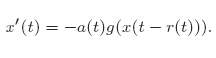
The scalar equation
 with variable delay r(t) ≥ 0 is investigated, where t−r(t) is increasing and xg(x) > 0 (x ≠ 0) in a neighbourhood of x = 0. We find conditions for r, a and g so that for a given continuous initial function ψ a mapping P for (1) can be defined on a complete metric space Cψ and in which P has a unique fixed point. The end result is not only conditions for the existence and uniqueness of solutions of (1) but also for the stability of the zero solution. We also find conditions ensuring that the zero solution is asymptotically stable by changing to an exponentially weighted metric on a closed subset of Cψ. Finally, we parlay the methods for (1) into results for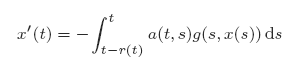
Decaying positive solutions to a system of nonlinear elliptic equations
-
- Journal:
- Proceedings of the Royal Society of Edinburgh. Section A: Mathematics / Volume 136 / Issue 2 / April 2006
- Published online by Cambridge University Press:
- 12 July 2007, pp. 301-320
- Print publication:
- April 2006
-
- Article
- Export citation
-
In this paper, the second-order nonlinear elliptic system
 with α, γ < 1 and β ≥ 1, is considered in RN, N ≥ 3. Under suitable hypotheses on functions fi, gi, hi (i = 1, 2) and P, it is shown that this system possesses an entire positive solution
 , 0 < θ < 1, such that both u and v are bounded below and above by constant multiples of |x|2−N for all |x| ≥ 1.
Uniform boundary stabilization of the dynamical von Kármán and Timoshenko equations for plates
-
- Journal:
- Proceedings of the Royal Society of Edinburgh. Section A: Mathematics / Volume 136 / Issue 2 / April 2006
- Published online by Cambridge University Press:
- 12 July 2007, pp. 385-413
- Print publication:
- April 2006
-
- Article
- Export citation
3D–2D analysis of a thin film with periodic microstructure
-
- Journal:
- Proceedings of the Royal Society of Edinburgh. Section A: Mathematics / Volume 136 / Issue 2 / April 2006
- Published online by Cambridge University Press:
- 12 July 2007, pp. 223-243
- Print publication:
- April 2006
-
- Article
- Export citation
On the asymptotic behaviour of solutions of nonlinear parabolic equations
-
- Journal:
- Proceedings of the Royal Society of Edinburgh. Section A: Mathematics / Volume 136 / Issue 2 / April 2006
- Published online by Cambridge University Press:
- 12 July 2007, pp. 365-384
- Print publication:
- April 2006
-
- Article
- Export citation
Long-time behaviour of solutions to a chemotaxis model with volume-filling effect
-
- Journal:
- Proceedings of the Royal Society of Edinburgh. Section A: Mathematics / Volume 136 / Issue 2 / April 2006
- Published online by Cambridge University Press:
- 12 July 2007, pp. 431-444
- Print publication:
- April 2006
-
- Article
- Export citation
Homogeneous sharp Sobolev inequalities on product manifolds
-
- Journal:
- Proceedings of the Royal Society of Edinburgh. Section A: Mathematics / Volume 136 / Issue 2 / April 2006
- Published online by Cambridge University Press:
- 12 July 2007, pp. 277-300
- Print publication:
- April 2006
-
- Article
- Export citation
-
Let (M, g) and (N, h) be compact Riemannian manifolds of dimensions m and n, respectively. For p-homogeneous convex functions f(s, t) on [0,∞) × [0, ∞), we study the validity and non-validity of the first-order optimal Sobolev inequality on H1, p(M × N)
 where
where and Kf = Kf (m, n, p) is the best constant of the homogeneous Sobolev inequality on D1, p (Rm+n),
 The proof of the non-validity relies on the knowledge of extremal functions associated with the Sobolev inequality above. In order to obtain such extremals we use mass transportation and convex analysis results. Since variational arguments do not work for general functions f, we investigate the validity in a uniform sense on f and argue with suitable approximations of f which are also essential in the non-validity. Homogeneous Sobolev inequalities on product manifolds are connected to elliptic problems involving a general class of operators.
Estimates for maximal singular integral operators in non-homogeneous spaces
-
- Journal:
- Proceedings of the Royal Society of Edinburgh. Section A: Mathematics / Volume 136 / Issue 2 / April 2006
- Published online by Cambridge University Press:
- 12 July 2007, pp. 351-364
- Print publication:
- April 2006
-
- Article
- Export citation
Single-valued conjugates and holomorphic extendibility
-
- Journal:
- Proceedings of the Royal Society of Edinburgh. Section A: Mathematics / Volume 136 / Issue 2 / April 2006
- Published online by Cambridge University Press:
- 12 July 2007, pp. 347-350
- Print publication:
- April 2006
-
- Article
- Export citation
On the structure of the Whittaker sublocus of the moduli space of algebraic curves
-
- Journal:
- Proceedings of the Royal Society of Edinburgh. Section A: Mathematics / Volume 136 / Issue 2 / April 2006
- Published online by Cambridge University Press:
- 12 July 2007, pp. 337-346
- Print publication:
- April 2006
-
- Article
- Export citation
A lower semi-continuity result for polyconvex functionals in SBV
-
- Journal:
- Proceedings of the Royal Society of Edinburgh. Section A: Mathematics / Volume 136 / Issue 2 / April 2006
- Published online by Cambridge University Press:
- 12 July 2007, pp. 321-336
- Print publication:
- April 2006
-
- Article
- Export citation
Heteroclinic and homoclinic solutions for a singular Hamiltonian system
-
- Journal:
- European Journal of Applied Mathematics / Volume 17 / Issue 1 / February 2006
- Published online by Cambridge University Press:
- 31 March 2006, pp. 1-32
-
- Article
- Export citation
Optimal network design for an on-demand transport system
-
- Journal:
- European Journal of Applied Mathematics / Volume 17 / Issue 2 / April 2006
- Published online by Cambridge University Press:
- 31 March 2006, pp. 129-140
-
- Article
- Export citation
