Refine search
Actions for selected content:
26079 results in Abstract analysis
Self-similar boundary blow-up for higher-order quasilinear parabolic equations
-
- Journal:
- Proceedings of the Royal Society of Edinburgh. Section A: Mathematics / Volume 135 / Issue 6 / December 2005
- Published online by Cambridge University Press:
- 12 July 2007, pp. 1195-1227
- Print publication:
- December 2005
-
- Article
- Export citation
Weighted inequalities for Cesàro maximal operators in Orlicz spaces
-
- Journal:
- Proceedings of the Royal Society of Edinburgh. Section A: Mathematics / Volume 135 / Issue 6 / December 2005
- Published online by Cambridge University Press:
- 12 July 2007, pp. 1287-1308
- Print publication:
- December 2005
-
- Article
- Export citation
-
Let 0 < α ≤ 1 and let M+α be the Cesàro maximal operator of order α defined by
 In this work we characterize the pairs of measurable, positive and locally integrable functions (u, v) for which there exists a constant C > 0 such that the inequality
 holds for all λ > 0 and every f in the Orlicz space LΦ(v).We also characterize the measurable, positive and locally integrable functions w such that the integral inequality
 holds for every f ∈ LΦ(w).The discrete versions of this results allow us, by techniques of transference, to prove weighted inequalities for the Cesàro maximal ergodic operator
 associated with an invertible measurable transformation, T, which preserves the measure.
Finally, we give sufficient conditions on w for the convergence of the sequence of Cesàro-α ergodic averages for all functions in the weighted Orlicz space LΦ(w).
Quantitative Illumination of Convex Bodies and Vertex Degrees of Geometric Steiner Minimal Trees
- Part of
-
- Journal:
- Mathematika / Volume 52 / Issue 1-2 / December 2005
- Published online by Cambridge University Press:
- 21 December 2009, pp. 47-52
- Print publication:
- December 2005
-
- Article
- Export citation
Integers Divisible by the Sum of their Prime Factors
- Part of
-
- Journal:
- Mathematika / Volume 52 / Issue 1-2 / December 2005
- Published online by Cambridge University Press:
- 21 December 2009, pp. 69-77
- Print publication:
- December 2005
-
- Article
- Export citation
-
For each integer n ≥ 2, let β(n) be the sum of the distinct prime divisors of n and let
 (x) stand for the set of composite integers n ≤ x such that n is a multiple of β(n). Upper and lower bounds are obtained for the cardinality of (x).
 (x) stand for the set of composite integers n ≤ x such that n is a multiple of β(n). Upper and lower bounds are obtained for the cardinality of
 Rikitake system: analytic and Darbouxian integrals
-
- Journal:
- Proceedings of the Royal Society of Edinburgh. Section A: Mathematics / Volume 135 / Issue 6 / December 2005
- Published online by Cambridge University Press:
- 12 July 2007, pp. 1309-1326
- Print publication:
- December 2005
-
- Article
- Export citation
Existence, uniqueness and non-uniqueness of weak solutions of parabolic initial-value problems with discontinuous nonlinearities
-
- Journal:
- Proceedings of the Royal Society of Edinburgh. Section A: Mathematics / Volume 135 / Issue 6 / December 2005
- Published online by Cambridge University Press:
- 12 July 2007, pp. 1139-1167
- Print publication:
- December 2005
-
- Article
- Export citation
A note on the monotonicity of the Maslov-type index of linear Hamiltonian systems with applications
-
- Journal:
- Proceedings of the Royal Society of Edinburgh. Section A: Mathematics / Volume 135 / Issue 6 / December 2005
- Published online by Cambridge University Press:
- 12 July 2007, pp. 1263-1277
- Print publication:
- December 2005
-
- Article
- Export citation
On Units and Class Numbers of Pure Cubic Fields
- Part of
-
- Journal:
- Mathematika / Volume 52 / Issue 1-2 / December 2005
- Published online by Cambridge University Press:
- 21 December 2009, pp. 87-91
- Print publication:
- December 2005
-
- Article
- Export citation
A Groshev Theorem for Small Linear Forms
- Part of
-
- Journal:
- Mathematika / Volume 52 / Issue 1-2 / December 2005
- Published online by Cambridge University Press:
- 21 December 2009, pp. 79-85
- Print publication:
- December 2005
-
- Article
- Export citation
Landau–Ginzburg-type equations on the half-line in the critical case
-
- Journal:
- Proceedings of the Royal Society of Edinburgh. Section A: Mathematics / Volume 135 / Issue 6 / December 2005
- Published online by Cambridge University Press:
- 12 July 2007, pp. 1241-1262
- Print publication:
- December 2005
-
- Article
- Export citation
-
We study nonlinear Landau–Ginzburg-type equations on the half-line in the critical case
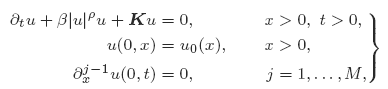 where β ∈ C, ρ > 2. The linear operator K is a pseudodifferential operator defined by the inverse Laplace transform with dissipative symbol K(p) = αpρ, M = [1/2ρ]. The aim of this paper is to prove the global existence of solutions to the initial–boundary-value problem and to find the main term of the asymptotic representation of solutions in the critical case, when the time decay of the nonlinearity has the same rate as that of the linear part of the equation.
Ehrhart Polynomials and Successive Minima
- Part of
-
- Journal:
- Mathematika / Volume 52 / Issue 1-2 / December 2005
- Published online by Cambridge University Press:
- 21 December 2009, pp. 1-16
- Print publication:
- December 2005
-
- Article
- Export citation
On the Quadratic Twists of a Family of Elliptic Curves
- Part of
-
- Journal:
- Mathematika / Volume 52 / Issue 1-2 / December 2005
- Published online by Cambridge University Press:
- 21 December 2009, pp. 139-154
- Print publication:
- December 2005
-
- Article
- Export citation
Boundedness of pseudodifferential operators of a C*-algebra-valued symbol
-
- Journal:
- Proceedings of the Royal Society of Edinburgh. Section A: Mathematics / Volume 135 / Issue 6 / December 2005
- Published online by Cambridge University Press:
- 12 July 2007, pp. 1279-1286
- Print publication:
- December 2005
-
- Article
- Export citation
An Improvement of a Large Sieve Inequality in High Dimensions
- Part of
-
- Journal:
- Mathematika / Volume 52 / Issue 1-2 / December 2005
- Published online by Cambridge University Press:
- 21 December 2009, pp. 93-100
- Print publication:
- December 2005
-
- Article
- Export citation
On Contractive Families and a Fixed-Point Question of Stein
- Part of
-
- Journal:
- Mathematika / Volume 52 / Issue 1-2 / December 2005
- Published online by Cambridge University Press:
- 21 December 2009, pp. 115-129
- Print publication:
- December 2005
-
- Article
- Export citation
Composition operators on Bloch-type spaces
-
- Journal:
- Proceedings of the Royal Society of Edinburgh. Section A: Mathematics / Volume 135 / Issue 6 / December 2005
- Published online by Cambridge University Press:
- 12 July 2007, pp. 1229-1239
- Print publication:
- December 2005
-
- Article
- Export citation
-
We characterize those holomorphic symbols ϕ: D → D for which the induced composition operator Cϕ: Bω → Bμ (respectively, Bω,0 → Bμ,0) is bounded or compact, where D is the unit disc in the complex plane C, ω is a normal function on [0, 1) and μ is a non-negative function on [0, 1) with μ(tn) > 0 for some sequence
satisfying limn→∞ tn= 1.
The Geometry of an Equifacetal Simplex
- Part of
-
- Journal:
- Mathematika / Volume 52 / Issue 1-2 / December 2005
- Published online by Cambridge University Press:
- 21 December 2009, pp. 31-45
- Print publication:
- December 2005
-
- Article
- Export citation
Feedback Instability in a Boundary-Layer Flow Over Roughness
- Part of
-
- Journal:
- Mathematika / Volume 52 / Issue 1-2 / December 2005
- Published online by Cambridge University Press:
- 21 December 2009, pp. 161-168
- Print publication:
- December 2005
-
- Article
- Export citation
Conical shock waves for an isentropic Euler system
-
- Journal:
- Proceedings of the Royal Society of Edinburgh. Section A: Mathematics / Volume 135 / Issue 6 / December 2005
- Published online by Cambridge University Press:
- 12 July 2007, pp. 1109-1127
- Print publication:
- December 2005
-
- Article
- Export citation
Finite Lattice Packings and the Wulff-Shape
- Part of
-
- Journal:
- Mathematika / Volume 52 / Issue 1-2 / December 2005
- Published online by Cambridge University Press:
- 21 December 2009, pp. 17-29
- Print publication:
- December 2005
-
- Article
- Export citation
