Refine search
Actions for selected content:
26079 results in Abstract analysis
Existence of solutions of the prescribed mean-curvature equation on unbounded domains
-
- Journal:
- Proceedings of the Royal Society of Edinburgh. Section A: Mathematics / Volume 136 / Issue 1 / February 2006
- Published online by Cambridge University Press:
- 12 July 2007, pp. 157-179
- Print publication:
- February 2006
-
- Article
- Export citation
Non-homogeneous elliptic equations in exterior domains
-
- Journal:
- Proceedings of the Royal Society of Edinburgh. Section A: Mathematics / Volume 136 / Issue 1 / February 2006
- Published online by Cambridge University Press:
- 12 July 2007, pp. 139-147
- Print publication:
- February 2006
-
- Article
- Export citation
-
We study the existence and multiplicity of positive solutions of the non-homogeneous elliptic equation
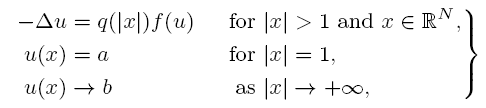 where N ≥ 3, the nonlinearity f is superlinear at both zero and infinity, q is a non-trivial, non-negative function, and a and b are non-negative parameters. A typical model is given by f(u) = up, with p ≥ 1.
On Hilbert and quaternionic cusp forms
-
- Journal:
- Proceedings of the Royal Society of Edinburgh. Section A: Mathematics / Volume 136 / Issue 1 / February 2006
- Published online by Cambridge University Press:
- 12 July 2007, pp. 1-6
- Print publication:
- February 2006
-
- Article
- Export citation
Introduction
-
- Book:
- Analytic Tomography
- Published online:
- 24 October 2009
- Print publication:
- 23 January 2006, pp 1-5
-
- Chapter
- Export citation
5 - Generalizations and Variants of the Radon Transform
-
- Book:
- Analytic Tomography
- Published online:
- 24 October 2009
- Print publication:
- 23 January 2006, pp 278-362
-
- Chapter
- Export citation
Frontmatter
-
- Book:
- Analytic Tomography
- Published online:
- 24 October 2009
- Print publication:
- 23 January 2006, pp i-vi
-
- Chapter
- Export citation
Index of Notations and Symbols
-
- Book:
- Analytic Tomography
- Published online:
- 24 October 2009
- Print publication:
- 23 January 2006, pp 393-394
-
- Chapter
- Export citation
2 - The Radon Transform
-
- Book:
- Analytic Tomography
- Published online:
- 24 October 2009
- Print publication:
- 23 January 2006, pp 58-126
-
- Chapter
- Export citation
Contents
-
- Book:
- Analytic Tomography
- Published online:
- 24 October 2009
- Print publication:
- 23 January 2006, pp vii-viii
-
- Chapter
- Export citation
Index
-
- Book:
- Analytic Tomography
- Published online:
- 24 October 2009
- Print publication:
- 23 January 2006, pp 395-400
-
- Chapter
- Export citation
4 - Range Differential Equations
-
- Book:
- Analytic Tomography
- Published online:
- 24 October 2009
- Print publication:
- 23 January 2006, pp 238-277
-
- Chapter
- Export citation
3 - The k-Plane Transform, the Radon–John Transform
-
- Book:
- Analytic Tomography
- Published online:
- 24 October 2009
- Print publication:
- 23 January 2006, pp 127-237
-
- Chapter
- Export citation
1 - Computerized Tomography, X-rays, and the Radon Transform
-
- Book:
- Analytic Tomography
- Published online:
- 24 October 2009
- Print publication:
- 23 January 2006, pp 6-57
-
- Chapter
- Export citation
Bibliography
-
- Book:
- Analytic Tomography
- Published online:
- 24 October 2009
- Print publication:
- 23 January 2006, pp 363-392
-
- Chapter
- Export citation
A HAAGERUP INEQUALITY, DEFORMATION OF TRIANGLES AND AFFINE BUILDINGS
-
- Journal:
- Journal of the Institute of Mathematics of Jussieu / Volume 5 / Issue 2 / April 2006
- Published online by Cambridge University Press:
- 18 January 2006, pp. 187-227
- Print publication:
- April 2006
-
- Article
- Export citation
ON THE FINE SPECTRAL EXPANSION OF JACQUET’S RELATIVE TRACE FORMULA
-
- Journal:
- Journal of the Institute of Mathematics of Jussieu / Volume 5 / Issue 2 / April 2006
- Published online by Cambridge University Press:
- 18 January 2006, pp. 263-308
- Print publication:
- April 2006
-
- Article
- Export citation
Infinite regular electrical networks
-
- Journal:
- European Journal of Applied Mathematics / Volume 16 / Issue 5 / October 2005
- Published online by Cambridge University Press:
- 11 January 2006, pp. 555-567
-
- Article
- Export citation
A Tale of Three Couplings: Poisson–Dirichlet and GEM Approximations for Random Permutations
-
- Journal:
- Combinatorics, Probability and Computing / Volume 15 / Issue 1-2 / January 2006
- Published online by Cambridge University Press:
- 03 January 2006, pp. 31-62
-
- Article
- Export citation
Odd Independent Transversals are Odd
-
- Journal:
- Combinatorics, Probability and Computing / Volume 15 / Issue 1-2 / January 2006
- Published online by Cambridge University Press:
- 03 January 2006, pp. 193-211
-
- Article
- Export citation
Solving Sparse Random Instances of Max Cut and Max 2-CSP in Linear Expected Time
-
- Journal:
- Combinatorics, Probability and Computing / Volume 15 / Issue 1-2 / January 2006
- Published online by Cambridge University Press:
- 03 January 2006, pp. 281-315
-
- Article
- Export citation
