Refine search
Actions for selected content:
26079 results in Abstract analysis
Sparse Parity-Check Matrices over ${GF(q)}$
-
- Journal:
- Combinatorics, Probability and Computing / Volume 14 / Issue 1-2 / January 2005
- Published online by Cambridge University Press:
- 15 February 2005, pp. 147-169
-
- Article
- Export citation
RADIAL AND TANGENTIAL GROWTH OF CLOSE-TO-CONVEX FUNCTIONS
-
- Journal:
- Proceedings of the Edinburgh Mathematical Society / Volume 48 / Issue 1 / February 2005
- Published online by Cambridge University Press:
- 15 February 2005, pp. 231-240
-
- Article
-
- You have access
- Export citation
Zigzag Structures of Simple Two-Faced Polyhedra
-
- Journal:
- Combinatorics, Probability and Computing / Volume 14 / Issue 1-2 / January 2005
- Published online by Cambridge University Press:
- 15 February 2005, pp. 31-57
-
- Article
- Export citation
Global existence for the heat equation with nonlinear dynamical boundary conditions
-
- Journal:
- Proceedings of the Royal Society of Edinburgh. Section A: Mathematics / Volume 135 / Issue 1 / February 2005
- Published online by Cambridge University Press:
- 12 July 2007, pp. 175-207
- Print publication:
- February 2005
-
- Article
- Export citation
-
This paper deals with local and global existence for the solutions of the heat equation in bounded domains with nonlinear boundary damping and source terms. The typical problem studied is
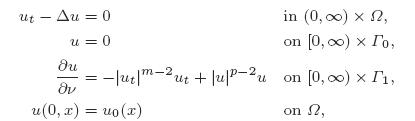 where Ω ⊂ Rn (n ≥ 1) is a regular and bounded domain, ∂Ω = Γ0 ∪ Γ1, m > 1, 2 ≤ p < r, where r = 2(n − 1)/(n − 2) when n ≥ 3, r = ∞ when n = 1, 2 and u0 ∈ H1(Ω), u0 = 0 on Γ0. We prove local existence of the solutions in H1(Ω) when m > r/(r + 1−p) or n = 1, 2 and global existence when p ≤ m or the initial datum is inside the potential well associated to the stationary problem.
Mumford–Shah-type functionals associated with doubling metric measures
-
- Journal:
- Proceedings of the Royal Society of Edinburgh. Section A: Mathematics / Volume 135 / Issue 1 / February 2005
- Published online by Cambridge University Press:
- 12 July 2007, pp. 1-23
- Print publication:
- February 2005
-
- Article
- Export citation
Multi-parameter bifurcation and asymptotics for the singular Lane–Emden–Fowler equation with a convection term
-
- Journal:
- Proceedings of the Royal Society of Edinburgh. Section A: Mathematics / Volume 135 / Issue 1 / February 2005
- Published online by Cambridge University Press:
- 12 July 2007, pp. 61-83
- Print publication:
- February 2005
-
- Article
-
- You have access
- Export citation
Optimal bounds for bifurcation values of a superlinear periodic problem
-
- Journal:
- Proceedings of the Royal Society of Edinburgh. Section A: Mathematics / Volume 135 / Issue 1 / February 2005
- Published online by Cambridge University Press:
- 12 July 2007, pp. 119-132
- Print publication:
- February 2005
-
- Article
- Export citation
On Fredholm properties of Lu = u′ − A(t)u for paths of sectorial operators
-
- Journal:
- Proceedings of the Royal Society of Edinburgh. Section A: Mathematics / Volume 135 / Issue 1 / February 2005
- Published online by Cambridge University Press:
- 12 July 2007, pp. 39-60
- Print publication:
- February 2005
-
- Article
- Export citation
Morse functions on Grassmann manifolds
-
- Journal:
- Proceedings of the Royal Society of Edinburgh. Section A: Mathematics / Volume 135 / Issue 1 / February 2005
- Published online by Cambridge University Press:
- 12 July 2007, pp. 209-221
- Print publication:
- February 2005
-
- Article
- Export citation
Oscillation and variation for the Gaussian Riesz transforms and Poisson integral
-
- Journal:
- Proceedings of the Royal Society of Edinburgh. Section A: Mathematics / Volume 135 / Issue 1 / February 2005
- Published online by Cambridge University Press:
- 12 July 2007, pp. 85-104
- Print publication:
- February 2005
-
- Article
- Export citation
Multiple positive solutions for a nonlinear Dirichlet problem with non-convex vector-valued response
-
- Journal:
- Proceedings of the Royal Society of Edinburgh. Section A: Mathematics / Volume 135 / Issue 1 / February 2005
- Published online by Cambridge University Press:
- 12 July 2007, pp. 105-117
- Print publication:
- February 2005
-
- Article
- Export citation
-
In this paper we establish the existence of many positive solutions to
 with Vx a vector-valued nonlinearity.
A sharp Hölder estimate for elliptic equations in two variables
-
- Journal:
- Proceedings of the Royal Society of Edinburgh. Section A: Mathematics / Volume 135 / Issue 1 / February 2005
- Published online by Cambridge University Press:
- 12 July 2007, pp. 165-173
- Print publication:
- February 2005
-
- Article
- Export citation
Geometric two-scale convergence on forms and its applications to Maxwell's equations
-
- Journal:
- Proceedings of the Royal Society of Edinburgh. Section A: Mathematics / Volume 135 / Issue 1 / February 2005
- Published online by Cambridge University Press:
- 12 July 2007, pp. 133-147
- Print publication:
- February 2005
-
- Article
- Export citation
-
We develop the geometric two-scale convergence on forms in order to describe the homogenization of partial differential equations with random variables on non-flat domain. We prove the compactness theorem and some two-scale behaviours for differential forms. For its applications, we investigate the limiting equations of the n-dimensional Maxwell equations with random coefficients,
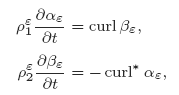 with given initial and boundary conditions, where
 are symmetric positive-definite matrices for x ∈ M, and M is an n-dimensional compact oriented Riemannian manifold with smooth boundary. The limiting system of n-dimensional Maxwell equations turns out to be degenerate and it is proven to be well-posed. The homogenized coefficients affected by the geometry of the domain are presented, and compared with the homogenized coefficient of the second order elliptic equation. We present the convergence theorem in order to explain the convergence of the solutions of Maxwell system as a parabolic partial differential equation.
Multiplicity of non-radial solutions of critical elliptic problems in an annulus
-
- Journal:
- Proceedings of the Royal Society of Edinburgh. Section A: Mathematics / Volume 135 / Issue 1 / February 2005
- Published online by Cambridge University Press:
- 12 July 2007, pp. 25-37
- Print publication:
- February 2005
-
- Article
- Export citation
-
By looking for critical points of functionals defined in some subspaces of
 where 2* − 1 := (N + 2)/(N − 2) (N ≥ 4), the domain is an annulus
 and f : R+ × R+ → R is a C1 function, which is a subcritical perturbation.
Positive steady states of the Holling–Tanner prey–predator model with diffusion
-
- Journal:
- Proceedings of the Royal Society of Edinburgh. Section A: Mathematics / Volume 135 / Issue 1 / February 2005
- Published online by Cambridge University Press:
- 12 July 2007, pp. 149-164
- Print publication:
- February 2005
-
- Article
- Export citation
SOME CONNECTIONS BETWEEN AN OPERATOR AND ITS ALUTHGE TRANSFORM
-
- Journal:
- Glasgow Mathematical Journal / Volume 47 / Issue 1 / January 2005
- Published online by Cambridge University Press:
- 31 January 2005, pp. 167-175
-
- Article
-
- You have access
- Export citation
ON THE EXISTENCE OF SOLUTIONS WITH PRESCRIBED ASYMPTOTIC BEHAVIOUR FOR PERTURBED NONLINEAR DIFFERENTIAL EQUATIONS OF SECOND ORDER
-
- Journal:
- Glasgow Mathematical Journal / Volume 47 / Issue 1 / January 2005
- Published online by Cambridge University Press:
- 31 January 2005, pp. 177-185
-
- Article
-
- You have access
- Export citation
ON NONABELIAN TENSOR ANALOGUES OF 2-ENGEL CONDITIONS
-
- Journal:
- Glasgow Mathematical Journal / Volume 47 / Issue 1 / January 2005
- Published online by Cambridge University Press:
- 31 January 2005, pp. 77-86
-
- Article
-
- You have access
- Export citation
ON ALMOST SEMI-FREDHOLM LINEAR RELATIONS IN NORMED SPACES
-
- Journal:
- Glasgow Mathematical Journal / Volume 47 / Issue 1 / January 2005
- Published online by Cambridge University Press:
- 31 January 2005, pp. 187-193
-
- Article
-
- You have access
- Export citation
PRIME DIVISORS OF SEQUENCES ASSOCIATED TO ELLIPTIC CURVES
-
- Journal:
- Glasgow Mathematical Journal / Volume 47 / Issue 1 / January 2005
- Published online by Cambridge University Press:
- 31 January 2005, pp. 115-122
-
- Article
-
- You have access
- Export citation
