Refine search
Actions for selected content:
37207 results in Algebra

Locally Flat Embeddings of 3-Manifolds in S4
- Coming soon
-
- Expected online publication date:
- May 2026
- Print publication:
- 31 May 2026
-
- Book
- Export citation
7 - Polynomial Rings
-
- Book:
- Introductory Ring Theory
- Published online:
- 07 April 2026
- Print publication:
- 30 April 2026, pp 129-148
-
- Chapter
- Export citation
4 - Integral Domains
-
- Book:
- Introductory Ring Theory
- Published online:
- 07 April 2026
- Print publication:
- 30 April 2026, pp 55-72
-
- Chapter
- Export citation
8 - Factorization of Polynomials
-
- Book:
- Introductory Ring Theory
- Published online:
- 07 April 2026
- Print publication:
- 30 April 2026, pp 149-168
-
- Chapter
- Export citation
2 - Introduction to Rings
-
- Book:
- Introductory Ring Theory
- Published online:
- 07 April 2026
- Print publication:
- 30 April 2026, pp 11-36
-
- Chapter
- Export citation
6 - Ring Homomorphism
-
- Book:
- Introductory Ring Theory
- Published online:
- 07 April 2026
- Print publication:
- 30 April 2026, pp 97-128
-
- Chapter
- Export citation
9 - Divisibility in Integral Domains
-
- Book:
- Introductory Ring Theory
- Published online:
- 07 April 2026
- Print publication:
- 30 April 2026, pp 169-190
-
- Chapter
- Export citation
1 - Preliminaries
-
- Book:
- Introductory Ring Theory
- Published online:
- 07 April 2026
- Print publication:
- 30 April 2026, pp 1-10
-
- Chapter
- Export citation
Index
-
- Book:
- Introductory Ring Theory
- Published online:
- 07 April 2026
- Print publication:
- 30 April 2026, pp 191-192
-
- Chapter
- Export citation
Frontmatter
-
- Book:
- Introductory Ring Theory
- Published online:
- 07 April 2026
- Print publication:
- 30 April 2026, pp i-iv
-
- Chapter
- Export citation
3 - Subrings
-
- Book:
- Introductory Ring Theory
- Published online:
- 07 April 2026
- Print publication:
- 30 April 2026, pp 37-54
-
- Chapter
- Export citation
Preface
-
- Book:
- Introductory Ring Theory
- Published online:
- 07 April 2026
- Print publication:
- 30 April 2026, pp vii-x
-
- Chapter
- Export citation
Contents
-
- Book:
- Introductory Ring Theory
- Published online:
- 07 April 2026
- Print publication:
- 30 April 2026, pp v-vi
-
- Chapter
- Export citation
5 - Ideals and Factor Rings
-
- Book:
- Introductory Ring Theory
- Published online:
- 07 April 2026
- Print publication:
- 30 April 2026, pp 73-96
-
- Chapter
- Export citation

Multifunctorial Equivariant Algebraic K-Theory
- Coming soon
-
- Expected online publication date:
- April 2026
- Print publication:
- 30 April 2026
-
- Book
- Export citation
PEM series 2 volume 69 issue 2 Cover and Front matter
-
- Journal:
- Proceedings of the Edinburgh Mathematical Society / Volume 69 / Issue 2 / May 2026
- Published online by Cambridge University Press:
- 14 April 2026, pp. f1-f2
-
- Article
-
- You have access
- Export citation
PEM series 2 volume 69 issue 2 Cover and Back matter
-
- Journal:
- Proceedings of the Edinburgh Mathematical Society / Volume 69 / Issue 2 / May 2026
- Published online by Cambridge University Press:
- 14 April 2026, pp. b1-b2
-
- Article
-
- You have access
- Export citation
KRONECKER CLASSES AND CLIQUES IN DERANGEMENT GRAPHS
- Part of
-
- Journal:
- Journal of the Australian Mathematical Society , First View
- Published online by Cambridge University Press:
- 13 April 2026, pp. 1-29
-
- Article
-
- You have access
- Open access
- HTML
- Export citation
-
Given a permutation group G, the derangement graph of G is defined with vertex set G, where two elements x and y are adjacent if and only if $xy^{-1}$ is a derangement. We establish that if G is transitive with degree exceeding 30, then the derangement graph of G contains a complete subgraph with four vertices. In the process, we determine all transitive groups whose derangement graph does not contain a complete subgraph on four vertices. As a consequence, if G is a normal subgroup of A such that $|A : G| = 3$ and U is a subgroup of G satisfying $G = \bigcup _{a \in A} U^a$, then $|G : U| \leq 10$. This provides support for a conjecture by Neumann and Praeger concerning Kronecker classes.


FRACTAL UNCERTAINTY PRINCIPLE FOR RANDOM CANTOR SETS
- Part of
-
- Journal:
- Journal of the Australian Mathematical Society , First View
- Published online by Cambridge University Press:
- 13 April 2026, pp. 1-22
-
- Article
- Export citation
-
We continue our investigation of the fractal uncertainty principle (FUP) for random fractal sets. In the prequel Eswarathasan and Han [‘Fractal uncertainty principle for discrete Cantor sets with random alphabet’, Math. Res. Lett. 30(6) (2023), 1657–1679], we considered the Cantor sets in the discrete setting with alphabets randomly chosen from a base of digits so the dimension $\delta \in (0,\frac 23)$. We proved that, with overwhelming probability, the FUP with an exponent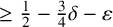 $\ge \frac 12-\frac 34\delta -\varepsilon $ holds for these discrete Cantor sets with random alphabets. In this paper, we construct random Cantor sets with dimension $\delta \in (0,\frac 23)$ in $\mathbb {R}$ via a different random procedure from the previous one used in Eswarathasan and Han [‘Fractal uncertainty principle for discrete Cantor sets with random alphabet’, Math. Res. Lett. 30(6) (2023), 1657–1679]. We prove that, with overwhelming probability, the FUP with an exponent $\ge \frac 12-\frac 34\delta -\varepsilon $ holds. The proof follows from establishing a Fourier decay estimate of the corresponding random Cantor measures, which is in turn based on a concentration of measure phenomenon in an appropriate probability space for the random Cantor sets.


ON THE GROWTH OF TATE–SHAFAREVICH GROUPS OF $\boldsymbol {p}$-SUPERSINGULAR ABELIAN VARIETIES OF $\textbf {GL}_{\textbf {2}}$-TYPE OVER $\boldsymbol {\mathbb {Z}}_{\boldsymbol {p}}$-EXTENSIONS OF NUMBER FIELDS
- Part of
-
- Journal:
- Journal of the Australian Mathematical Society , First View
- Published online by Cambridge University Press:
- 13 April 2026, pp. 1-29
-
- Article
- Export citation
-
We study the boundedness of the Mordell–Weil rank and the growth of the v-primary part of the Tate–Shafarevich group of p-supersingular abelian varieties of $\mathrm {GL}_2$-type with real multiplication over $\mathbb Z_p$-extensions of number fields, where v is a prime lying above p. Building on the work of Iovita and Pollack in the case of elliptic curves, under precise ramification and splitting conditions on p, we construct explicit systems of local points using the theory of Lubin–Tate formal groups. We then define signed Coleman maps, which in turn allow us to formulate and analyse signed Selmer groups. Assuming these Selmer groups are cotorsion, we prove that the Mordell–Weil groups are bounded over any subextensions of the ${\mathbb Z}_p$-extension and provide an asymptotic formula for the growth of the v-primary part of the Tate–Shafarevich groups. Our results extend those of Kobayashi, Pollack, and Sprung on p-supersingular elliptic curves.


