Refine search
Actions for selected content:
37211 results in Algebra
PEM series 2 volume 69 issue 2 Cover and Back matter
-
- Journal:
- Proceedings of the Edinburgh Mathematical Society / Volume 69 / Issue 2 / May 2026
- Published online by Cambridge University Press:
- 14 April 2026, pp. b1-b2
-
- Article
-
- You have access
- Export citation
KRONECKER CLASSES AND CLIQUES IN DERANGEMENT GRAPHS
- Part of
-
- Journal:
- Journal of the Australian Mathematical Society , First View
- Published online by Cambridge University Press:
- 13 April 2026, pp. 1-29
-
- Article
-
- You have access
- Open access
- HTML
- Export citation
-
Given a permutation group G, the derangement graph of G is defined with vertex set G, where two elements x and y are adjacent if and only if $xy^{-1}$ is a derangement. We establish that if G is transitive with degree exceeding 30, then the derangement graph of G contains a complete subgraph with four vertices. In the process, we determine all transitive groups whose derangement graph does not contain a complete subgraph on four vertices. As a consequence, if G is a normal subgroup of A such that $|A : G| = 3$ and U is a subgroup of G satisfying $G = \bigcup _{a \in A} U^a$, then $|G : U| \leq 10$. This provides support for a conjecture by Neumann and Praeger concerning Kronecker classes.


FRACTAL UNCERTAINTY PRINCIPLE FOR RANDOM CANTOR SETS
- Part of
-
- Journal:
- Journal of the Australian Mathematical Society , First View
- Published online by Cambridge University Press:
- 13 April 2026, pp. 1-22
-
- Article
- Export citation
-
We continue our investigation of the fractal uncertainty principle (FUP) for random fractal sets. In the prequel Eswarathasan and Han [‘Fractal uncertainty principle for discrete Cantor sets with random alphabet’, Math. Res. Lett. 30(6) (2023), 1657–1679], we considered the Cantor sets in the discrete setting with alphabets randomly chosen from a base of digits so the dimension $\delta \in (0,\frac 23)$. We proved that, with overwhelming probability, the FUP with an exponent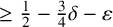 $\ge \frac 12-\frac 34\delta -\varepsilon $ holds for these discrete Cantor sets with random alphabets. In this paper, we construct random Cantor sets with dimension $\delta \in (0,\frac 23)$ in $\mathbb {R}$ via a different random procedure from the previous one used in Eswarathasan and Han [‘Fractal uncertainty principle for discrete Cantor sets with random alphabet’, Math. Res. Lett. 30(6) (2023), 1657–1679]. We prove that, with overwhelming probability, the FUP with an exponent $\ge \frac 12-\frac 34\delta -\varepsilon $ holds. The proof follows from establishing a Fourier decay estimate of the corresponding random Cantor measures, which is in turn based on a concentration of measure phenomenon in an appropriate probability space for the random Cantor sets.


ON THE GROWTH OF TATE–SHAFAREVICH GROUPS OF $\boldsymbol {p}$-SUPERSINGULAR ABELIAN VARIETIES OF $\textbf {GL}_{\textbf {2}}$-TYPE OVER $\boldsymbol {\mathbb {Z}}_{\boldsymbol {p}}$-EXTENSIONS OF NUMBER FIELDS
- Part of
-
- Journal:
- Journal of the Australian Mathematical Society , First View
- Published online by Cambridge University Press:
- 13 April 2026, pp. 1-29
-
- Article
- Export citation
-
We study the boundedness of the Mordell–Weil rank and the growth of the v-primary part of the Tate–Shafarevich group of p-supersingular abelian varieties of $\mathrm {GL}_2$-type with real multiplication over $\mathbb Z_p$-extensions of number fields, where v is a prime lying above p. Building on the work of Iovita and Pollack in the case of elliptic curves, under precise ramification and splitting conditions on p, we construct explicit systems of local points using the theory of Lubin–Tate formal groups. We then define signed Coleman maps, which in turn allow us to formulate and analyse signed Selmer groups. Assuming these Selmer groups are cotorsion, we prove that the Mordell–Weil groups are bounded over any subextensions of the ${\mathbb Z}_p$-extension and provide an asymptotic formula for the growth of the v-primary part of the Tate–Shafarevich groups. Our results extend those of Kobayashi, Pollack, and Sprung on p-supersingular elliptic curves.


Free boundary minimal annuli in $S^2_+\times S^1$
- Part of
-
- Journal:
- Proceedings of the Edinburgh Mathematical Society , First View
- Published online by Cambridge University Press:
- 13 April 2026, pp. 1-4
-
- Article
- Export citation
-
Let M be a compact three-dimensional Riemannian manifold with non-negative Ricci curvature and a non-empty boundary $\partial M$. Fraser and Li [2] established a compactness theorem for the space of compact, properly embedded minimal surfaces of fixed topological type in M with a free boundary on $\partial M$, assuming that $\partial M$ is strictly convex with respect to the inward unit normal. In this paper, we show that the strict convexity condition on $\partial M$ cannot be relaxed.


Tropical Tevelev degrees
- Part of
-
- Journal:
- Mathematical Proceedings of the Cambridge Philosophical Society , First View
- Published online by Cambridge University Press:
- 13 April 2026, pp. 1-30
-
- Article
-
- You have access
- Open access
- HTML
- Export citation
-
We define the tropical Tevelev degrees, ${\mathsf{Tev}}_g^{\mathtt{trop}}$, as the degree of a natural finite morphism between certain tropical moduli spaces, in analogy to the algebraic case. We develop an explicit combinatorial construction that computes ${\mathsf{Tev}}_g^{\mathtt{trop}} = 2^g$. We prove that these tropical enumerative invariants agree with their algebraic counterparts, giving an independent tropical computation of the algebraic degrees ${\mathsf{Tev}}_g$.


Tamagawa numbers and positive rank of elliptic curves
- Part of
-
- Journal:
- Mathematical Proceedings of the Cambridge Philosophical Society , First View
- Published online by Cambridge University Press:
- 13 April 2026, pp. 1-45
-
- Article
-
- You have access
- Open access
- HTML
- Export citation
THE CATEGORIES OF LUBIN-TATE AND DRINFELD BUNDLES
- Part of
-
- Journal:
- Journal of the Institute of Mathematics of Jussieu , First View
- Published online by Cambridge University Press:
- 10 April 2026, pp. 1-38
-
- Article
-
- You have access
- Open access
- HTML
- Export citation
-
For a finite extension F of ${\mathbb Q}_p$ and $n \geq 1$, we show that the category of Lubin-Tate bundles on the $(n-1)$-dimensional Drinfeld symmetric space is equivalent to the category of finite-dimensional smooth representations of the group of units of the division algebra of invariant $1/n$ over F.


FLOWS ON UNIFORM ROE ALGEBRAS
- Part of
-
- Journal:
- Journal of the Institute of Mathematics of Jussieu , First View
- Published online by Cambridge University Press:
- 10 April 2026, pp. 1-47
-
- Article
- Export citation
-
For a uniformly locally finite metric space $(X, d)$, we investigate coarse flows on its uniform Roe algebra $\mathrm {C}^*_u(X)$, defined as one-parameter groups of automorphisms whose differentiable elements include all partial isometries arising from partial translations on X. We first show that any flow $\sigma $ on $\mathrm {C}^*_u(X)$ corresponds to a (possibly unbounded) self-adjoint operator h on $\ell _2(X)$ such that $\sigma _t(a) = e^{ith} a e^{-ith}$ for all $t \in \mathbb {R}$, allowing us to focus on operators h that generate flows on $\mathrm {C}^*_u(X)$.
Assuming Yu’s property A, we prove that a self-adjoint operator h on $\ell _2(X)$ induces a coarse flow on $\mathrm {C}^*_u(X)$ if and only if h can be expressed as $h = a + d$, where $a \in \mathrm {C}^*_u(X)$ and d is a diagonal operator with entries forming a coarse function on X. We further study cocycle equivalence and cocycle perturbations of coarse flows, showing that, under property A, any coarse flow is a cocycle perturbation of a diagonal flow. Finally, for self-adjoint operators h and k that induce coarse flows on $\mathrm {C}^*_u(X)$, we characterize conditions under which the associated flows are either cocycle perturbations of each other or cocycle conjugate to each other. In particular, if $h - k$ is bounded, then the flow induced by h is a cocycle perturbation of the flow induced by k.


Part II: - Topics in Transfinite Algebra
-
- Book:
- Sets and Transfinite Algebra
- Published online:
- 02 April 2026
- Print publication:
- 09 April 2026, pp 76-76
-
- Chapter
- Export citation
Part I: - Set Theory
-
- Book:
- Sets and Transfinite Algebra
- Published online:
- 02 April 2026
- Print publication:
- 09 April 2026, pp 1-2
-
- Chapter
- Export citation
§10. - Subdirect decomposition of algebras
- from Part II: - Topics in Transfinite Algebra
-
- Book:
- Sets and Transfinite Algebra
- Published online:
- 02 April 2026
- Print publication:
- 09 April 2026, pp 88-102
-
- Chapter
- Export citation
§14. - Artin’s solution of Hilbert’s 17th problem
- from Part II: - Topics in Transfinite Algebra
-
- Book:
- Sets and Transfinite Algebra
- Published online:
- 02 April 2026
- Print publication:
- 09 April 2026, pp 142-153
-
- Chapter
- Export citation
§13. - The Jacobson radical of a ring
- from Part II: - Topics in Transfinite Algebra
-
- Book:
- Sets and Transfinite Algebra
- Published online:
- 02 April 2026
- Print publication:
- 09 April 2026, pp 129-141
-
- Chapter
- Export citation
§0. - Preface
-
- Book:
- Sets and Transfinite Algebra
- Published online:
- 02 April 2026
- Print publication:
- 09 April 2026, pp vii-viii
-
- Chapter
- Export citation
§4. - Around the axiom of choice
- from Part I: - Set Theory
-
- Book:
- Sets and Transfinite Algebra
- Published online:
- 02 April 2026
- Print publication:
- 09 April 2026, pp 33-45
-
- Chapter
- Export citation
§8. - Group and ring structures on non-empty sets
- from Part II: - Topics in Transfinite Algebra
-
- Book:
- Sets and Transfinite Algebra
- Published online:
- 02 April 2026
- Print publication:
- 09 April 2026, pp 77-82
-
- Chapter
- Export citation
§12. - Semi-simple and injective modules
- from Part II: - Topics in Transfinite Algebra
-
- Book:
- Sets and Transfinite Algebra
- Published online:
- 02 April 2026
- Print publication:
- 09 April 2026, pp 116-128
-
- Chapter
- Export citation
Appendix: - Solutions to exercises
-
- Book:
- Sets and Transfinite Algebra
- Published online:
- 02 April 2026
- Print publication:
- 09 April 2026, pp 154-200
-
- Chapter
- Export citation
§3. - Ordered sets
- from Part I: - Set Theory
-
- Book:
- Sets and Transfinite Algebra
- Published online:
- 02 April 2026
- Print publication:
- 09 April 2026, pp 22-32
-
- Chapter
- Export citation
