Refine search
Actions for selected content:
37226 results in Algebra
Note on a Theorem of Lommel
-
- Journal:
- Proceedings of the Edinburgh Mathematical Society / Volume 22 / February 1903
- Published online by Cambridge University Press:
- 20 January 2009, pp. 80-85
-
- Article
-
- You have access
- Export citation
-
Among the many formulæ which show special relations existing between the circular functions and the Bessel-Function Jn(x), when n is half an odd integer, there is one due to Lommel

Conditions for the Reality of the Roots of an n-ic
-
- Journal:
- Proceedings of the Edinburgh Mathematical Society / Volume 24 / February 1905
- Published online by Cambridge University Press:
- 20 January 2009, pp. 56-58
-
- Article
-
- You have access
- Export citation
Sets of Semi-Commutative Matrices: Part II1
-
- Journal:
- Proceedings of the Edinburgh Mathematical Society / Volume 3 / Issue 4 / August 1933
- Published online by Cambridge University Press:
- 20 January 2009, pp. 231-240
-
- Article
-
- You have access
- Export citation
-
In this section we extend the definition of an E-set, so that it includes sets of the type

where the only restriction on the Ei is that they be non-singular. We now consider matrices of the type

where each ei takes independently the values 0, 1, …, n − 1, while the a(ei) are either complex numbers or else matrices of order r, the product a(ei) E(ei), in the latter case, being interpreted as the direct product of the two matrices a(ei) and E(ei).
S. D. Eidel'man, Parabolic Systems (North-Holland, Wolters-Nordhoff, 1969), v + 469pp., £7·60.
-
- Journal:
- Proceedings of the Edinburgh Mathematical Society / Volume 17 / Issue 4 / December 1971
- Published online by Cambridge University Press:
- 20 January 2009, p. 371
-
- Article
-
- You have access
- Export citation
G. E. Sacks, Degrees of Unsolvability (Annals of Mathematics Studies, No. 55, Princeton University Press, London: Oxford University Press, 1963), ix + 174 pp., 28s.
-
- Journal:
- Proceedings of the Edinburgh Mathematical Society / Volume 14 / Issue 2 / December 1964
- Published online by Cambridge University Press:
- 20 January 2009, p. 170
-
- Article
-
- You have access
- Export citation
Office-Bearers
-
- Journal:
- Proceedings of the Edinburgh Mathematical Society / Volume 38 / February 1919
- Published online by Cambridge University Press:
- 20 January 2009, p. 1
-
- Article
-
- You have access
- Export citation
H. H. Schaefer, Banach Lattices and Positive Operators (Springer-Verlag, 1974), xi + 376 pp., DM 98.00, $42.70.
-
- Journal:
- Proceedings of the Edinburgh Mathematical Society / Volume 20 / Issue 3 / March 1977
- Published online by Cambridge University Press:
- 20 January 2009, p. 271
-
- Article
-
- You have access
- Export citation
Centrobaric Spherical Surface Distribution
-
- Journal:
- Proceedings of the Edinburgh Mathematical Society / Volume 17 / February 1898
- Published online by Cambridge University Press:
- 20 January 2009, pp. 68-69
-
- Article
-
- You have access
- Export citation
Geometrical Constructions for Refraction and Reflection in a Prism
-
- Journal:
- Proceedings of the Edinburgh Mathematical Society / Volume 31 / February 1912
- Published online by Cambridge University Press:
- 20 January 2009, pp. 101-104
-
- Article
-
- You have access
- Export citation
HIGHER CONJUGATION COHOMOLOGY IN COMMUTATIVE HOPF ALGEBRAS
-
- Journal:
- Proceedings of the Edinburgh Mathematical Society / Volume 44 / Issue 1 / February 2001
- Published online by Cambridge University Press:
- 20 January 2009, pp. 19-26
-
- Article
-
- You have access
- Export citation
PEM volume 7 issue 3 Cover and Front matter
-
- Journal:
- Proceedings of the Edinburgh Mathematical Society / Volume 7 / Issue 3 / February 1946
- Published online by Cambridge University Press:
- 20 January 2009, pp. f1-f2
-
- Article
-
- You have access
- Export citation
F. Kasch Modules and rings (translated by D. A. R. Wallace) (Academic Press, London1982), xiii + 372 pp. £33.80.
-
- Journal:
- Proceedings of the Edinburgh Mathematical Society / Volume 26 / Issue 2 / June 1983
- Published online by Cambridge University Press:
- 20 January 2009, pp. 286-287
-
- Article
-
- You have access
- Export citation
On functions and equations in distributive lattices
-
- Journal:
- Proceedings of the Edinburgh Mathematical Society / Volume 16 / Issue 1 / June 1968
- Published online by Cambridge University Press:
- 20 January 2009, pp. 49-54
-
- Article
-
- You have access
- Export citation
Special train algebras arising in genetics II
-
- Journal:
- Proceedings of the Edinburgh Mathematical Society / Volume 14 / Issue 4 / December 1965
- Published online by Cambridge University Press:
- 20 January 2009, pp. 333-338
-
- Article
-
- You have access
- Export citation
Note on Topics of regions separated by boundaries
-
- Journal:
- Proceedings of the Edinburgh Mathematical Society / Volume 43 / February 1924
- Published online by Cambridge University Press:
- 20 January 2009, pp. 111-114
-
- Article
-
- You have access
- Export citation
R. Zurmühl, Matrizen und ihre technischen Anwendung, 3rd edition (Springer-Verlag, Berlin, Berlin, 1961), 459 pp., DM 36.
-
- Journal:
- Proceedings of the Edinburgh Mathematical Society / Volume 13 / Issue 2 / December 1962
- Published online by Cambridge University Press:
- 20 January 2009, p. 199
-
- Article
-
- You have access
- Export citation
On the relations between the numbers of standard tableaux
-
- Journal:
- Proceedings of the Edinburgh Mathematical Society / Volume 7 / Issue 1 / October 1942
- Published online by Cambridge University Press:
- 20 January 2009, pp. 51-54
-
- Article
-
- You have access
- Export citation
-
§ 1. Corresponding to any partition

which we denote by [a1, . …, ak] or briefly by [a], of the integer n, we can construct a shape which has a1 spaces in the first row, a2 in the second row, . …, ak in the kth and last row. Thus the shape corresponding to the partition [5, 3, 3, 2] of 13 has the form:

Edwin M. Hemmerling, Fundamentals of College Geometry (John Wiley & Sons, 1964).
-
- Journal:
- Proceedings of the Edinburgh Mathematical Society / Volume 15 / Issue 1 / June 1966
- Published online by Cambridge University Press:
- 20 January 2009, p. 84
-
- Article
-
- You have access
- Export citation
Note on M. Collignon's Paper on the Integration of ancosa da and an sina da
-
- Journal:
- Proceedings of the Edinburgh Mathematical Society / Volume 22 / February 1903
- Published online by Cambridge University Press:
- 20 January 2009, p. 11
-
- Article
-
- You have access
- Export citation
-
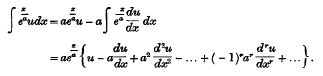
The properties of the functions Pn, Qn may also be determined very briefly as follows:—
Let u be a function of x; then by integration by parts we have
PEM volume 1 Front matter and Errata
-
- Journal:
- Proceedings of the Edinburgh Mathematical Society / Volume 1 / February 1883
- Published online by Cambridge University Press:
- 20 January 2009, pp. f1-f4
-
- Article
-
- You have access
- Export citation
