Refine search
Actions for selected content:
9085 results in Discrete Mathematics, Information Theory and Coding
Part III - Cartesian decompositions: Applications
-
- Book:
- Permutation Groups and Cartesian Decompositions
- Published online:
- 08 June 2018
- Print publication:
- 03 May 2018, pp 243-244
-
- Chapter
- Export citation
1 - Introduction
-
- Book:
- Permutation Groups and Cartesian Decompositions
- Published online:
- 08 June 2018
- Print publication:
- 03 May 2018, pp 1-14
-
- Chapter
- Export citation
2 - Group actions and permutation groups
-
- Book:
- Permutation Groups and Cartesian Decompositions
- Published online:
- 08 June 2018
- Print publication:
- 03 May 2018, pp 17-44
-
- Chapter
- Export citation
Frontmatter
-
- Book:
- Permutation Groups and Cartesian Decompositions
- Published online:
- 08 June 2018
- Print publication:
- 03 May 2018, pp i-iv
-
- Chapter
- Export citation
11 - Applications in permutation group theory
-
- Book:
- Permutation Groups and Cartesian Decompositions
- Published online:
- 08 June 2018
- Print publication:
- 03 May 2018, pp 245-266
-
- Chapter
- Export citation
Preface
-
- Book:
- Permutation Groups and Cartesian Decompositions
- Published online:
- 08 June 2018
- Print publication:
- 03 May 2018, pp xi-xiv
-
- Chapter
- Export citation
5 - Wreath products
-
- Book:
- Permutation Groups and Cartesian Decompositions
- Published online:
- 08 June 2018
- Print publication:
- 03 May 2018, pp 104-131
-
- Chapter
- Export citation
3 - Minimal normal subgroups of transitive permutation groups
-
- Book:
- Permutation Groups and Cartesian Decompositions
- Published online:
- 08 June 2018
- Print publication:
- 03 May 2018, pp 45-69
-
- Chapter
- Export citation
12 - Applications to graph theory
-
- Book:
- Permutation Groups and Cartesian Decompositions
- Published online:
- 08 June 2018
- Print publication:
- 03 May 2018, pp 267-299
-
- Chapter
- Export citation
Index
-
- Book:
- Permutation Groups and Cartesian Decompositions
- Published online:
- 08 June 2018
- Print publication:
- 03 May 2018, pp 318-323
-
- Chapter
- Export citation
Appendix - Factorisations of simple and characteristically simple groups
-
- Book:
- Permutation Groups and Cartesian Decompositions
- Published online:
- 08 June 2018
- Print publication:
- 03 May 2018, pp 300-304
-
- Chapter
- Export citation
Part I - Permutation groups: Fundamentals
-
- Book:
- Permutation Groups and Cartesian Decompositions
- Published online:
- 08 June 2018
- Print publication:
- 03 May 2018, pp 15-16
-
- Chapter
- Export citation
Part II - Innately transitive groups: Factorisations and cartesian decompositions
-
- Book:
- Permutation Groups and Cartesian Decompositions
- Published online:
- 08 June 2018
- Print publication:
- 03 May 2018, pp 173-174
-
- Chapter
- Export citation
10 - Intransitive cartesian decompositions
-
- Book:
- Permutation Groups and Cartesian Decompositions
- Published online:
- 08 June 2018
- Print publication:
- 03 May 2018, pp 225-242
-
- Chapter
- Export citation
6 - Twisted wreath products
-
- Book:
- Permutation Groups and Cartesian Decompositions
- Published online:
- 08 June 2018
- Print publication:
- 03 May 2018, pp 132-150
-
- Chapter
- Export citation
Contents
-
- Book:
- Permutation Groups and Cartesian Decompositions
- Published online:
- 08 June 2018
- Print publication:
- 03 May 2018, pp vii-x
-
- Chapter
- Export citation
Density of Chromatic Roots in Minor-Closed Graph Families
- Part of
-
- Journal:
- Combinatorics, Probability and Computing / Volume 27 / Issue 6 / November 2018
- Published online by Cambridge University Press:
- 22 April 2018, pp. 988-998
-
- Article
- Export citation
Multicolour Sunflowers
- Part of
-
- Journal:
- Combinatorics, Probability and Computing / Volume 27 / Issue 6 / November 2018
- Published online by Cambridge University Press:
- 22 April 2018, pp. 974-987
-
- Article
- Export citation
-
A sunflower is a collection of distinct sets such that the intersection of any two of them is the same as the common intersection C of all of them, and |C| is smaller than each of the sets. A longstanding conjecture due to Erdős and Szemerédi (solved recently in [7, 9]; see also [22]) was that the maximum size of a family of subsets of [n] that contains no sunflower of fixed size k > 2 is exponentially smaller than 2n as n → ∞. We consider the problems of determining the maximum sum and product of k families of subsets of [n] that contain no sunflower of size k with one set from each family. For the sum, we prove that the maximum is
for all n ⩾ k ⩾ 3, and for the k = 3 case of the product, we prove that the maximum is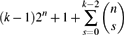 $$(k-1)2^n+1+\sum_{s=0}^{k-2}\binom{n}{s}$$We conjecture that for all fixed k ⩾ 3, the maximum product is (1/8+o(1))2kn.
 $$\biggl(\ffrac{1}{8}+o(1)\biggr)2^{3n}.$$

4 - Quantum Fields
-
- Book:
- Quantum Fields and Processes
- Published online:
- 23 March 2018
- Print publication:
- 12 April 2018, pp 74-88
-
- Chapter
- Export citation
5 - Combinatorial Species
-
- Book:
- Quantum Fields and Processes
- Published online:
- 23 March 2018
- Print publication:
- 12 April 2018, pp 89-98
-
- Chapter
- Export citation
