To save content items to your account,
please confirm that you agree to abide by our usage policies.
If this is the first time you use this feature, you will be asked to authorise Cambridge Core to connect with your account.
Find out more about saving content to .
To save content items to your Kindle, first ensure no-reply@cambridge.org
is added to your Approved Personal Document E-mail List under your Personal Document Settings
on the Manage Your Content and Devices page of your Amazon account. Then enter the ‘name’ part
of your Kindle email address below.
Find out more about saving to your Kindle.
Note you can select to save to either the @free.kindle.com or @kindle.com variations.
‘@free.kindle.com’ emails are free but can only be saved to your device when it is connected to wi-fi.
‘@kindle.com’ emails can be delivered even when you are not connected to wi-fi, but note that service fees apply.
This article is devoted to the presentation of a new contact algorithm for bodies undergoing finite deformations.We only address the kinematic aspect of the contact problem, that is the numerical treatment of the non-intersection constraint. In consequence, mechanical aspects like friction, adhesion or wear are not investigatedand we restrict our analysis to the simplest frictionless case. On the other hand, our method allows us to treat contacts and self-contacts, thin or non-thin structures in a single setting.
Finding and interpreting the solutions of differential equations is a central and essential part of applied mathematics. This book aims to enable the reader to develop the required skills needed for a thorough understanding of the subject. The authors focus on the business of constructing solutions analytically, and interpreting their meaning, using rigorous analysis where needed. MATLAB is used extensively to illustrate the material. There are many worked examples based on interesting and unusual real world problems. A large selection of exercises is provided, including several lengthier projects, some of which involve the use of MATLAB. The coverage is broad, ranging from basic second-order ODEs and PDEs, through to techniques for nonlinear differential equations, chaos, asymptotics and control theory. This broad coverage, the authors' clear presentation and the fact that the book has been thoroughly class-tested will increase its attraction to undergraduates at each stage of their studies.
This book provides a clear and concise summary of the fluid dynamics of the locomotion of living organisms. The biological phenomena described in detail range from the swimming of bacteria and fish to the flying of insects and birds. The breadth of treatment requires the study of two basic fluid-dynamical regimes. In the first case, that of small organisms, the viscosity of the fluid is paramount in deciding the most effective swimming strategy. However, for larger insects, birds, and most fish, the viscosity of the air or water may be treated as if it were zero, and resulting mechanisms of propulsion are very different. Both these types are studied, with emphasis on the unsteady character of natural movements. Written for the advanced student, this volume assumes familiarity with basic fluid mechanics, although some elementary topics are included. It will be readily accessible to students of applied mathematics and biologists who have engineering or physics backgrounds.
The Hilbert transform has many uses, including solving problems in aerodynamics, condensed matter physics, optics, fluids, and engineering. Written in a style that will suit a wide audience (including the physical sciences), this book will become the reference of choice on the topic, whatever the subject background of the reader. It explains all the common Hilbert transforms, mathematical techniques for evaluating them, and has detailed discussions of their application. Especially useful for researchers are the tabulation of analytically evaluated Hilbert transforms, and an atlas that immediately illustrates how the Hilbert transform alters a function. A collection of exercises helps the reader to test their understanding of the material in each chapter. The bibliography is a wide-ranging collection of references both to the classical mathematical papers, and to a diverse array of applications.
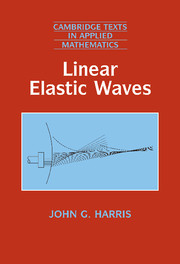
Wave propagation and scattering are among the most fundamental processes that we use to comprehend the world around us. While these processes are often very complex, one way to begin to understand them is to study wave propagation in the linear approximation. This is a book describing such propagation using, as a context, the equations of elasticity. Two unifying themes are used. The first is that an understanding of plane wave interactions is fundamental to understanding more complex wave interactions. The second is that waves are best understood in an asymptotic approximation where they are free of the complications of their excitation and are governed primarily by their propagation environments. The topics covered include reflection, refraction, the propagation of interfacial waves, integral representations, radiation and diffraction, and propagation in closed and open waveguides. Linear Elastic Waves is an advanced level textbook directed at applied mathematicians, seismologists, and engineers.
The emergence of observing systems such as acoustically-tracked floats in the deep ocean, and surface drifters navigating by satellite has seen renewed interest in Lagrangian fluid dynamics. Starting from the foundations of elementary kinematics and assuming some familiarity of Eulerian fluid dynamics, this 2006 book reviews the classical and new exact solutions of the Lagrangian framework, and then addresses the general solvability of the resulting general equations of motion. A unified account of turbulent diffusion and dispersion is offered, with applications among others to plankton patchiness in the ocean. Written at graduate level, the book provides the first detailed and comprehensive analytical development of the Lagrangian formulation of fluid dynamics, of interest not only to applied mathematicians but also oceanographers, meteorologists, mechanical engineers, astrophysicists and indeed all investigators of the dynamics of fluids.
Mathematical modelling of physiological systems promises to advance our understanding of complex biological phenomena and pathophysiology of diseases. In this book, the authors adopt a mathematical approach to characterize and explain the functioning of the gastrointestinal system. Using the mathematical foundations of thin shell theory, the authors patiently and comprehensively guide the reader through the fundamental theoretical concepts, via step-by-step derivations and mathematical exercises, from basic theory to complex physiological models. Applications to nonlinear problems related to the biomechanics of abdominal viscera and the theoretical limitations are discussed. Special attention is given to questions of complex geometry of organs, effects of boundary conditions on pellet propulsion, as well as to clinical conditions, e.g. functional dyspepsia, intestinal dysrhythmias and the effect of drugs to treat motility disorders. With end of chapter problems, this book is ideal for bioengineers and applied mathematicians.
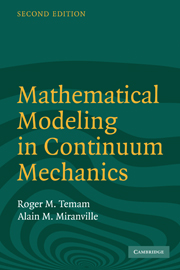
Temam and Miranville present core topics within the general themes of fluid and solid mechanics. The brisk style allows the text to cover a wide range of topics including viscous flow, magnetohydrodynamics, atmospheric flows, shock equations, turbulence, nonlinear solid mechanics, solitons, and the nonlinear Schrödinger equation. This second edition will be a unique resource for those studying continuum mechanics at the advanced undergraduate and beginning graduate level whether in engineering, mathematics, physics or the applied sciences. Exercises and hints for solutions have been added to the majority of chapters, and the final part on solid mechanics has been substantially expanded. These additions have now made it appropriate for use as a textbook, but it also remains an ideal reference book for students and anyone interested in continuum mechanics.
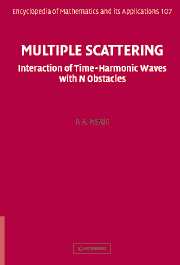
The interaction of waves with obstacles is an everyday phenomenon in science and engineering, arising for example in acoustics, electromagnetism, seismology and hydrodynamics. The mathematical theory and technology needed to understand the phenomenon is known as multiple scattering, and this book is the first devoted to the subject. The author covers a variety of techniques, describing first the single-obstacle methods and then extending them to the multiple-obstacle case. A key ingredient in many of these extensions is an appropriate addition theorem: a coherent, thorough exposition of these theorems is given, and computational and numerical issues around them are explored. The application of these methods to different types of problems is also explained; in particular, sound waves, electromagnetic radiation, waves in solids and water waves. A comprehensive bibliography of some 1400 items rounds off the book, which will be an essential reference on the topic for applied mathematicians, physicists and engineers.
In this paper, we continue the study of the Raman amplification in plasmas that we initiated in [Colin and Colin, Diff. Int. Eqs.17 (2004) 297–330; Colin and Colin, J. Comput. Appl. Math.193 (2006) 535–562]. We point out that the Raman instability gives rise to three components. The first one is collinear to the incident laser pulse and counter propagates. In 2-D, the two other ones make a non-zero angle with the initial pulse and propagate forward. Furthermore they are symmetric with respect to the direction of propagation of the incident pulse. We construct a non-linear system taking into account all these components and perform some 2-D numerical simulations.
Random walk – the stochastic process formed by successive summation of independent, identically distributed random variables – is one of the most basic and well-studied topics in probability theory. For random walks on the integer lattice ℤd, the main reference is the classic book by Spitzer (1976). This text considers only a subset of such walks, namely those corresponding to increment distributions with zero mean and finite variance. In this case, one can summarize the main result very quickly: the central limit theorem implies that under appropriate rescaling the limiting distribution is normal, and the functional central limit theorem implies that the distribution of the corresponding path-valued process (after standard rescaling of time and space) approaches that of Brownian motion.
Researchers who work with perturbations of random walks, or with particle systems and other models that use random walks as a basic ingredient, often need more precise information on random walk behavior than that provided by the central limit theorems. In particular, it is important to understand the size of the error resulting from the approximation of random walk by Brownian motion. For this reason, there is need for more detailed analysis. This book is an introduction to the random walk theory with an emphasis on the error estimates. Although “mean zero, finite variance” assumption is both necessary and sufficient for normal convergence, one typically needs to make stronger assumptions on the increments of the walk in order to obtain good bounds on the error terms.