To save content items to your account,
please confirm that you agree to abide by our usage policies.
If this is the first time you use this feature, you will be asked to authorise Cambridge Core to connect with your account.
Find out more about saving content to .
To save content items to your Kindle, first ensure no-reply@cambridge.org
is added to your Approved Personal Document E-mail List under your Personal Document Settings
on the Manage Your Content and Devices page of your Amazon account. Then enter the ‘name’ part
of your Kindle email address below.
Find out more about saving to your Kindle.
Note you can select to save to either the @free.kindle.com or @kindle.com variations.
‘@free.kindle.com’ emails are free but can only be saved to your device when it is connected to wi-fi.
‘@kindle.com’ emails can be delivered even when you are not connected to wi-fi, but note that service fees apply.
To organize appropriate and comprehensive services for older individuals with schizophrenia, understanding their specific needs is a prerequisite. This includes evaluating the patient´s own perspective and acknowledging needs with a more subjective or existential character. This may highlight needs that go undetected or are underestimated by staff or families. Changes associated with aging may generate new care needs or modify existing ones. In the limited research into the needs of older schizophrenia patients, a pattern emerges that resembles findings in younger populations, with psychological and social needs being highly prevalent and frequently unmet. Mental health services clearly have a role in meeting these needs. Interventions with different scopes and intensities are currently available, one of which is exemplified in this chapter, the case of The New Club, a novel Dutch facility that provides a non-demanding social environment for older individuals with severe mental illnesses. Due to the wide science-to-service gap, many patients are missing out on these types of service. A broader effort is needed that calls upon political commitment to promote social inclusion of older individuals with schizophrenia.
The psychopharmacological treatment of schizophrenia and psychosis in older adults is challenging because of age-related pharmacokinetic and pharmacodynamic changes, comorbidities, concurrent medications, and increased potential for drug-drug and drug-disease interactions and adverse effects. The treatment of psychosis associated with dementia in the elderly is complicated by the lack of approved pharmacological agents, the potential for increased mortality and morbidity with antipsychotic agents, legal consequences of using antipsychotics for off-label indications, the US Food and Drug Administration (FDA) black box warnings for their use in dementia, and the state and federal regulations regarding their use in nursing homes. The psychopharmacological treatment of psychoses has evolved over the past couple of decades. Selection of appropriate medications based on the patient’s clinical profile, discussion and documentation of risks, benefits, and alternatives of treatment with patient and family, use of minimum required dose and gradual dose reductions as needed, and behavioral interventions will assist the physician in achieving an optimal outcome.
The number of older adults living with schizophrenia is increasing and includes those who have had the illness since an early age and those who developed it later in life. Cognitive dysfunction is a core dimension of schizophrenia. Current literature suggests that older adults with schizophrenia who have been chronically institutionalized experience accelerated cognitive decline. In contrast, those living in the community seem to experience a relatively stable course of cognition. However, given that most of the community-based studies were short in duration or small in size, a more heterogeneous and fluctuating course of cognition consistent with a dynamic clinical course late in life cannot be ruled out. To date there is no evidence to support cognitive enhancement intervention, pharmacological or not. There is, however, evidence to support the use of psychosocial interventions to enhance functional abilities directly. Thus, larger and longer studies that could characterize the heterogeneity in cognitive trajectories are needed. They will also identify the factors that moderate these trajectories and could be targeted using cognitive enhancement interventions.
This chapter reviews epidemiological findings concerning medical comorbidity and mortality in older adults with schizophrenia (OAS). Several key points emerged from this review: (1) There are inconsistencies in the prevalence of various medical disorders among OAS. (2) There is a 2.0 to 2.5 times increase in all-cause mortality in OAS compared to their age peers, although it is lower than their younger counterparts. (3) The risk of suicide trends downward in OAS patients after the age of 60. (4) A higher prevalence of respiratory diseases has not been demonstrated consistently; however, there is increased mortality for respiratory disease versus age peers, but reduced compared to younger counterparts. (5) There has been no demonstrated increase in mortality or prevalence of diabetes in OAS versus age peers. (6) OAS have declining mortality rates from cardiovascular disease compared to younger counterparts, but still elevated compared to age peers. (7) There have been inconsistent findings regarding the incidence of cancer compared to age peers; however, the cancer mortality rate is higher. (8) A healthcare utilization gap exists for OAS. Novel care strategies include self-management, peer support groups, integrated care models, and greater use of telehealth and mobile technologies.
Outcome is an unsettled area of debate in psychiatry that has varied historically and across investigative sites. It has included symptoms as well as social indices. This chapter examines various outcome dimensions in older adults with schizophrenia (OAS) as well as the associations between them and various predictor variables. Based on cross-sectional and longitudinal data from a community sample of OAS living in New York City, contrary to earlier views of a quiescent end stage in later life, heterogeneity in course persists into later life. Because of the fluidity of outcome and the various combinations of favorable outcomes, “recovering” remains a viable conceptual framework in later life. Although the outcome indices are largely independent of each other, provisional data suggest that, over time, alleviation of depressive symptoms is associated with improved community integration, which in turn is associated with higher rates of remission; improved cognitive function may also augment remission. There were few other predictors of the various outcome indices suggesting that clinical strategies need to target the specific clinical or social domain. Because of the various combinations of outcome and the high independence among outcome dimensions, an individualized care approach can achieve the optimal outcome.
This chapter examines the types and prevalence of psychotic symptoms and disorders in older adults, and offers insight into distinguishing between the disorders and guidelines for treatment. Psychotic disorders are very common (lifetime prevalence 25%) with risk increasing with age. Prevalence rates have ranged from 1-13.4%. Psychotic disorders can be divided into “primary” (40%), due to the direct effect of a psychiatric disorder and “secondary” (60%), caused by a non-psychiatric condition. Dementia is the most common cause of psychoses. The mnemonic “6 Ds” can be used to remember the principal causes of psychotic disorders: Disease, Delirium, Drugs, Dementia, Depression and mania, and Delusions and schizophrenia spectrum disorders. There are no pathognomonic signs to differentiate psychosis caused by psychiatric illness from that caused by another condition, although there are some characteristics that may serve to distinguish them. There are few controlled treatment studies and most guidelines have been developed through expert consensus panels. It is recommended that psychosocial interventions should be tried initially and medication should be used only when the former has failed or when symptoms present a danger to the patient or caregiver.
Most older individuals with schizophrenia reside in the community. Their social achievements are well behind those of their healthy age-peers. At the same time, there is no room for a stereotype of older patients with schizophrenia, as heterogeneity characterizes their social functioning. The social spectrum ranges from socially isolated, severely incapacitated patients to societally integrated, near-normal functioning individuals. While many ageing-associated changes (e.g., reduced mobility) impact negatively on social functioning, others (e.g., more extravert coping styles) may partially compensate. Importantly, with time, a substantial number of patients can improve their social functioning and may experience a higher subjective quality of life. Various psychosocial interventions have shown promising results, but most older individuals still miss out. To move forward, defeatism in professionals about the ability of patients to profit from these treatments should be overcome. In addition, there is a strong case for the development of day care services that offer a hospitable and non-demanding social environment to older community-living persons with schizophrenia. Residential and nursing homes need to offer more specialized facilities for older people with severe mental illnesses, given the rapid growth in their numbers.
Many people with schizophrenia live well into later life and, with demographic shifts, this population will continue to grow. The needs of older persons with schizophrenia are complex and include treatment of comorbid physical and mental conditions; we describe patterns of service use. Inpatient care in both general and psychiatric hospitals has substantially declined, but hospitalizations still account for more than half of Medicare spending for people with schizophrenia. The rapid decline in inpatient care without appropriate community support continues to drive inappropriate placement in nursing homes. Persons with schizophrenia are at greater risk of being admitted to nursing homes than the general population, even with low levels of disability. Because of their dependence on public insurance, these patients are more likely to be admitted to poorer-quality nursing homes. There are promising developments in health policy that may increase access to care, such as expansion of public insurance programs, mental health parity and models of integrated care. However, there continue to be gaps in service use and underutilization of mental health services, even among Medicare recipients.
This chapter examines differences between early-onset schizophrenia (referring to those who develop schizophrenia before the age of 40) and late-onset schizophrenia (referring to individuals who develop schizophrenia after age 40). Furthermore, it identifies the subcategories of late-onset schizophrenia advanced by the Late-Onset Schizophrenia Group in their 2000 consensus statement: late-onset schizophrenia (those who develop schizophrenia between 40 and 60 years of age) and very-late-onset schizophrenia-like-psychosis (those who develop schizophrenia after age 60). Differences between these groups in the areas of demographics, clinical presentation, cognition, neuroimaging findings, heritability, etiology, and treatment are critically assessed with insights into important limitations in findings and the overall scarcity of knowledge in this area.
Epidemiological studies of late-life psychosis pose several methodological challenges and there are few high-quality studies regarding risk factors and prognosis. In the first section we describe some of these challenges: outcome definitions and measurements, overlapping symptoms across various psychiatric outcomes, age of exposure or onset of outcome, timing of exposure in relation to outcome (e.g., mid-life vs late-life exposure), exposure level (”load”), duration and persistence, survival factors, birth cohort effects, study design and analytic strategies, multiple comorbidities, and use of biomarkers. The second section is a review of epidemiological studies of psychosis. Among the key findings: (1) Reports on the prevalence of late-life psychosis are highly variable. (2) Risk factors associated with late-life psychosis include sensory impairment, social isolation, paranoid personality, structural brain abnormalities, cognitive dysfunction, poor physical health, and negative life events. (3) Patients with late-life psychosis have markedly higher mortality rates than the general aging population. (4) New-onset psychotic symptoms in older adults without dementia confers a greater risk for the subsequent development of dementia, but the proportion at risk varies considerably between studies.
Age-related biological changes in schizophrenia are of great interest as a growing number of individuals with chronic mental illness are now reaching the age where medical comorbidities and neurodegenerative changes become more likely. Dramatic changes have occurred in the range and types of antipsychotic medications available, which has resulted in some benefits for older persons with schizophrenia as well as some new challenges in chronic treatment. This chapter will review findings from neuroimaging studies that have examined brain morphology, as well as functional imaging changes with age in persons with schizophrenia. It will also discuss advances in the understanding of the genetics of cognitive aging in schizophrenia and related biomarkers. The biologic effects of long-term use of antipsychotic medications in terms of dopamine reception function and movement disorders, as well as the effect on the development of the metabolic syndrome with age will be discussed.
Depression is a common cause of comorbidity in the older population with schizophrenia. The treatment of older patients with schizophrenia and depressive symptoms poses many challenges. The goal of this chapter is to review the impact of depression in patients with schizophrenia and the available treatment modalities. Comorbid depression impacts negatively on quality of life, functioning, overall psychopathology and comorbid medical conditions. Conversely, in these individuals it is important to ensure symptoms are not due to a comorbid condition, metabolic problems or medications. Elderly patients with schizophrenia can also often have cognitive deficits that make the diagnosis of depression more difficult. Detection and management of depressive symptoms in patients with schizophrenia has an important role in management of this population. We will focus on the various forms of depression that clinicians encounter in patients with schizophrenia.
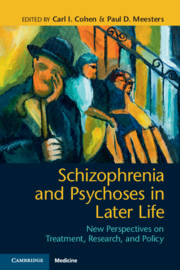
By 2050, the number of people aged sixty years and older with schizophrenia is expected to double and affect about 10 million people worldwide. Psychoses are among the most common experiences in later life, with a lifetime risk of 23 percent. As a result, there is a looming crisis in mental health care. Schizophrenia and Psychoses in Later Life is the first major multidisciplinary reference on these important disorders. The book provides guidelines for clinical care, research and policy that are consistent with the emerging paradigmatic changes occurring with respect to schizophrenia in later life. This book features multidisciplinary contributions from experts in the fields of biological psychiatry, social psychiatry, sociology, anthropology, social work, psychology, and neuropsychology that will help professionals to integrate services and attain the best outcomes. The text will guide psychiatrists, psychologists, gerontologists, policymakers, and social scientists in creating innovative new programs to help this underserved and growing population.