To save content items to your account,
please confirm that you agree to abide by our usage policies.
If this is the first time you use this feature, you will be asked to authorise Cambridge Core to connect with your account.
Find out more about saving content to .
To save content items to your Kindle, first ensure no-reply@cambridge.org
is added to your Approved Personal Document E-mail List under your Personal Document Settings
on the Manage Your Content and Devices page of your Amazon account. Then enter the ‘name’ part
of your Kindle email address below.
Find out more about saving to your Kindle.
Note you can select to save to either the @free.kindle.com or @kindle.com variations.
‘@free.kindle.com’ emails are free but can only be saved to your device when it is connected to wi-fi.
‘@kindle.com’ emails can be delivered even when you are not connected to wi-fi, but note that service fees apply.
In 1941, in the midst of the Blitz, the director of Britain’s Building Research Station (BRS) received a letter from Basil Cameron, chair of the London Symphony Orchestral Society. London’s Queen’s Hall had been destroyed by an incendiary bomb just ten days earlier. Orchestral music was expected to relocate to the Royal Albert Hall, where the acoustics were known to be capricious. Cameron’s letter contained an impassioned plea to address the problematic acoustics as a matter of urgency in order to ‘ensure the continuance of orchestral music in London’. Significantly, the request was granted, despite the fact that government work related to the acoustics of buildings was officially in hiatus at the time, having been suspended for the duration of the war. Three further exceptions were permitted with respect to the wartime suspension of work in architectural acoustics – at St Paul’s Cathedral, Gloucester Cathedral, and the Royal Exchange – all on the grounds that the work was experimental and would meet a societal need. This chapter examines the social and cultural significance attached to those architectural ‘exceptions’. The recognition given to the acoustic condition was significant, and so too was the approach to intervening in that condition. While optimising resources and experimenting with what was available, mutability of the acoustic context was explored in all four buildings. This chapter takes these buildings as a lens through which to examine the conceptualisation of architecture as both a musical and a scientific instrument, and the broader implications of that approach for philosophies of design subsequent to the war.
The Prologue, focusing on 1951, opens with two high-profile acoustic experiments undertaken in London that year. The first – conducted at night in the interior of St Paul’s Cathedral – involved pistol fire from the pulpit and made the international news. The second was the inauguration and architectural ‘tuning’ of Royal Festival Hall that took place earlier that same year. Beginning with this architectural manifestation of acoustic experiments in the immediate post-war era, and their national as well as international reception, the Prologue establishes a context for exploring the path of development and intertwining of disciplines that led up to that point. It introduces some of the book’s core themes: articulating the concept of designing for musical tone that came most prominently to public attention in the design and inauguration of Royal Festival Hall; introducing the role of the press in catalysing acoustic work in architecture throughout the previous half-century; and aligning objective with subjective modes of design, as well as exploring how both formal and informal modes of enquiry pushed one another forward. Ultimately the Prologue establishes the book as a narrative of people and buildings.
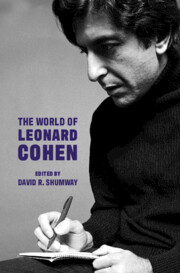
Leonard Cohen's artistic career is unique. Most poets and novelists do not become rock stars. No other rock star's career peaked in their eighth decade as Leonard Cohen's did. Cohen's popularity is still growing following his death. In The World of Leonard Cohen, a team of international scholars and writers explore the various dimensions of the artist's life, work, persona, and legacy to offer an authoritative and accessible summation of Cohen's extraordinary career. His relation to key themes and topics – Judaism, Buddhism, Christianity, Zen and the East, the Folk tradition, Rock & Roll, Canadian and world literature, film – are all addressed. The World of Leonard Cohen offers a comprehensive, uniquely informed and wholly fresh account of this iconic songwriter and artist, whose singular voice has permanently altered our cultural landscape.
Ruefrex were one of Northern Ireland’s most popular and uncompromising punk rock bands. Emerging from the Belfast street-gang culture of the late-1970s, the group, inspired by The Clash, enjoyed a turbulent, decade-long career. They played for millions on CNN and Channel 4, toured with The Pogues and recorded the controversial ‘The Wild Colonial Boy’, which attacked American donations to Northern Irish terrorist organisations. Throughout it all, founder member, songwriter and spokesperson Thomas Paul Burgess ensured the band remained faithful to their Protestant, working-class origins. This candid memoir takes us on a journey from the streets of Belfast to encounters with U2, Shane MacGowan, The Cure, The Fall and Seamus Heaney. From strife-torn 1970s Belfast to bohemian London, Wild colonial boys tells the story of a punk band who refused to give up and stayed true to their punk roots.
Recent developments in spatial audio and immersive technologies have expanded creative possibilities for composers and sound artists. This article presents a novel prototype of a spherical microphone with an ellipsoid casing and ten motorised condenser capsules, each capable of real-time adjustment of orientation and polar pattern. Unlike fixed-pattern or conventional ambisonic arrays, this design enables dynamic control over spatial coverage and directivity, offering new opportunities for multichannel recording, live performance and interactive sound art. While software-based spatialisation offers some flexibility, physical reconfiguration of capsules provides superior responsiveness and avoids latency, phase artefacts or resolution loss. This is especially critical in performance contexts where immediate acoustic adaptation is required. The system allows direct manipulation of capsule parameters during rehearsal or installation, effectively transforming the microphone into a performative instrument. The article compares the prototype with existing commercial ambisonic microphones, highlighting its distinctive advantages in workflow and compositional strategy. Use-case scenarios demonstrate how real-time control over spatial parameters enhances both technical precision and artistic expressiveness. The article concludes with a discussion of future directions, including collaborative testing with practitioners and integration into creative environments where spatial transparency, fidelity and interactivity are essential.
By 1984, Ruefrex had reached what seemed like an insurmountable impasse. Martin J. Galvin was an Irish American lawyer and activist notable for his role in the formation and promotion of NORAID (the Irish Northern Aid Committee). The organisation became known for raising funds for the Provisional IRA and other nationalist groups during the Troubles. Although banned from Northern Ireland for espousing terrorism, Galvin entered the country in 1984, attending high-profile gatherings, flouting his presence to the security forces and providing Sinn Féin with a press coup. This flurry of activity provided the catalyst for Ruefrex to record and release a song that they had finished a year earlier. ‘The Wild Colonial Boy’ tells the story of Jack Duggan, an Irish rebel and native of Castlemaine, County Kerry, who became a convict, then a bushranger in nineteenth-century Australia.
Cohen was first known as a poet, and on the basis of his first volume of poetry he was described as Canada’s leading poet. As the 1965 documentary Ladies and Gentleman, Mr. Leonard Cohen attests, he became a celebrity in Canada on the basis of his poetry even before he had recorded an album. He continued to publish poetry throughout his career, and the relationship of the poems to the lyrics is interesting and complicated. Cohen’s early poetry is more modernist, largely eschewing rhyme or regular rhythm, while his later poems are often similar to his lyrics. Poetry inhabits both novels in various ways. Lawrence Breavman enjoys a first name that nods to and withdraws Lawrentian possibilities, and the strategies of the poet are all over Beautiful Losers: repetition, anaphora, listing, grammatical and syntactical dislocation, a variety of forms, symbolism, making strange, surrealism. Sometimes, Cohen publishes his song lyrics as poems, sometimes verbatim, sometimes in a different form. Other poems are quite different from his songs set to music, yet he seems to have thought of his poems and lyrics collectively as “songs.”
The author relates how he booked his passage home on the Liverpool ferry after a painful resurrection of the band. Under the coke influence and in possession, he had somehow driven past the turn-off for the M56, and found himself on the wrong side of the Pennines. Thatcher’s government had just announced that the Harland and Wolff shipyard was to be privatised, and the IRA had just planted a booby-trap bomb on a school bus in an attempt to kill the driver, a member of the Ulster Defence Regiment (UDR). The driver and some school children – one of them Arlene Foster who would go on to lead the Democratic Unionist Party and become First Minister in later years – were injured in the explosion. Ruefrex had reared up for a short while in anger and defiance, but they had been slowly bleeding out from the wound left by TC’s exit.
Ruefrex are everything that punk should be in ‘85. No preaching, just ably cropped verbals digging at Americans who ‘kill from far away’ with donations to terrorist causes. They were on the daytime Radio One heavy rotation playlist. The author relates how Ruefrex performed in the Live Aid gig at Wembley stadium, London Music of all kinds provided an almost 24/7 soundtrack. For the author, it was the beginning of a serious schooling in bands that he had not previously heard but would come to love. His new home saw an unrelenting stream of visitors, mostly post-punk pretenders to the throne, and all were music fans and knew of Ruefrex from what they had achieved till then in the indie scene.
There were a few good reasons – far removed from triumphalism and monarchy – why a young man in Northern Ireland might want to join an Orange marching band. They were tough young women, waving their mini Union Jacks and, in tartan trousers, swaying in time to the beat. The author relates how he became a side drummer for the Pride of Ardoyne Flute Band, which always enjoyed a particular place in the hearts of the Loyalist crowds. At parades, it invariably drew applause as it passed. This was largely because Ardoyne is recognised as a PIRA/Republican/Nationalist stronghold in Belfast. Award-winning flute and brass ensembles kept their musical notations on stands mounted on their instruments. The best drummers were unfailingly in pipe bands. Unfortunately, most of them have abandoned the Belfast circuit, preferring to parade in rural areas and at the demonstration at Rossnowlagh (Donegal) in the Republic of Ireland.