To save content items to your account,
please confirm that you agree to abide by our usage policies.
If this is the first time you use this feature, you will be asked to authorise Cambridge Core to connect with your account.
Find out more about saving content to .
To save content items to your Kindle, first ensure no-reply@cambridge.org
is added to your Approved Personal Document E-mail List under your Personal Document Settings
on the Manage Your Content and Devices page of your Amazon account. Then enter the ‘name’ part
of your Kindle email address below.
Find out more about saving to your Kindle.
Note you can select to save to either the @free.kindle.com or @kindle.com variations.
‘@free.kindle.com’ emails are free but can only be saved to your device when it is connected to wi-fi.
‘@kindle.com’ emails can be delivered even when you are not connected to wi-fi, but note that service fees apply.
Nun aber genug! Gegen die Vermännlichung der Frau.
[Now that is enough! Against the Masculinization of Woman.]
—Berliner Illustrirte Zeitung, March 29, 1925
Geschwitz. (in einem sehr männlich anmutendem Kostüm)
[Geschwitz. (in a very masculine-looking costume)]
—Alban Berg, stage directions in Lulu (ca. 1929)
Geschwitz. “Sie ist Anders.”
[Geschwitz. “She is different.”]
—Alban Berg, autograph sketch for Lulu
In the conclusion of Lulu the audience is left with the dying Geschwitz, a lesbian character whose devoted, self-sacrificing love for Lulu and eventual decision to pursue a law degree and fight for women's rights is cut short by her fateful encounter with Jack the Ripper. Perhaps the most significant aspect of this ending is that Berg places Lulu's death offstage; the only victim onstage, and therefore seen and heard by the audience, is Geschwitz. Berg even considered, at some point during the compositional process, leaving Lulu alive, making Geschwitz the only fatal victim of Jack the Ripper. This subtle change from Frank Wedekind's Die Büchse der Pandora, in which Jack's intended target is Lulu and Geschwitz is murdered simply because she gets in the way, complicates the meaning of her death in the opera. Because Geschwitz is left alone onstage and sings a soliloquy similar to those reserved for operatic heroines, it is not Lulu's but Geschwitz's death that is supposed to receive emotional and sympathetic responses from audiences and scholars alike.
This prattling on about the “Schönberg pupil” must stop.
—Theodor Adorno to Alban Berg, November 23, 1925
The image of Alban Berg as a member of the Second Viennese School and a devoted student of Arnold Schoenberg, even in his mature years, pervades our understanding of the composer. This image is derived, as Joseph Auner has demonstrated, from a historical narrative that turned the notion of a Second Viennese School of composers into a concept—a concept in which important critics such as René Leibowitz went so far as rendering Schoenberg as the sole leading genius, leaving Berg and Webern as mere derivatives whose existence as composers would have been “inconceivable” without Schoenberg's teaching. Obviously, we have no way of knowing what kind of composer Berg would have been without Schoenberg's mentoring, although he had considered studying composition with Hans Pfitzner before he started taking lessons with Schoenberg. Leibowitz's argument may be justified nonetheless by Berg's own accounts of the teacher-student relationship, attesting that long after his apprenticeship—which started in 1904 and extended to 1911—he identified himself with Schoenberg and followed every major turning point in Schoenberg's musical language, from the emancipation of dissonance to the development of serial methods in the 1920s. To define Berg as a mere follower of Schoenberg, however, runs the risk of misrepresenting the eclectic character of his music as well as the relational aspects of his identity as a composer.
[The] modernization of Wedekind [from the “fin de siècle” atmosphere of the 1890s to the 1920s] can only be understood as an act of self-identification, deep down in Berg's subconscious, with the character of Alwa.
—Hans Ferdinand Redlich
In fact it is not Lulu who is the self out of whose perspective the music comes, but rather Alwa, who loves her. That affects the point of view of the music to its literary subject. Berg pays scarcely any attention to the cynical aspect of the text: he approaches Wedekind the way Schumann approached Heine's poems.
—Theodor Adorno
Berg's fixation on constructing narratives of identity is reflected most overtly in his rendering of the character of Alwa, who is transformed into an opera composer, the “Wozzeck Komponist” (composer of Wozzeck), from the original playwright in Wedekind's play. This sort of self-identification was not unusual within his Viennese circle of friends; perhaps the closest model is Schoenberg's identification with Moses in his opera Moses und Aron.” Yet Berg complicates his self-identification with Alwa because, as Patricia Hall has rightly argued, “many sketches for the Rondo suggest that on some level Berg associated the character of Alwa with Tristan from Wagner's opera.” This conflation of Alwa and Tristan completely changes the dramatic plot in the opera and also affects Berg's musical choices, particularly the formal plan for the exposition of the rondo in the first scene of act 2.
Berg's fascination with Wagner, Tristan in particular, complicates our understanding of his music because it underlies not only his creative identity and actions but also some principles behind his musical compositions. In his writings, Adorno often tries to draw a distinction between Berg and Wagner, but his explanations, while illuminating, only contribute to the problem. In his reevaluation of Berg, written about twenty years after Berg's death, Adorno recognizes the “autonomy” of Berg's works but points to a peculiar sort of metaphysics in which Berg's music would emerge from underneath the music drama. In other words, Adorno draws a distinction between essence and appearance:
In contrast to Wagner, [Berg] was the first to introduce into the opera the truly dramatic feature of Viennese classicism, its variegated dialectic [durchbrochene Arbeit]. In his works, and perhaps in them alone, we can see the outlines of a kind of autonomous operatic music emerging from beneath the cloak of the music drama. It is music that follows its own impulses right through the end instead of exhausting itself in an ascetic rejection of empathy, and it derives its autonomy from its own internal relationships. Opera of this type fulfills itself musically, satisfying the logic of its own musical laws, for it does not just run alongside drama, but follows the contours of its own impulses, developments, contrasts, and tensions. The music is absorbed intothe drama more than ever before, and as a direct result it is articulated downto the last note and achieves the autonomy denied in the old style, tonepaintingmusical drama.
To a large extent, in fact, the identity of a person or a community is made up of [a set of acquired] identifications with values, norms, ideals, models, and heroes, in which the person or community recognizes itself. Recognizing oneself in contributes to recognizing oneself by. The identification with heroic figures clearly displays this otherness assumed as one's own, but this is already latent in the identification with values which make us place a “cause” above our own survival.
—Paul Ricoeur
By establishing a principle of identity between Berg and Wagner, this chapter is bound to cause suspicion, as it could rightly be argued that a person's identity is formed by a multitude of factors—including the appropriation of historical or fictional narratives—by which the individual and collective identities are in a constant process of reconfiguration. To single out one element as the most important factor in the formation of one's identity would seem to establish a rather rigid category that overlooks other relational properties in identity formation. To be sure, as is well-known, Berg identified himself overtly with an array of individuals, including Schoenberg and Webern but also Peter Altenberg, Karl Kraus, and Gustav Mahler, among others. The evidence for Berg's identification with these individuals is all too apparent in his music and writing: Berg's adoption of the twelve-tone technique and his obsession with the logic behind musical structures, while they may have been latent traits in his personality, were certainly intensified by his long association with Schoenberg.
Prostitution is as inseparable from our present marriage customs as the shadow from the substance. They are two sides of the same shield.
—Mona Caird
Bordell ist Ehe [Brothel is Marriage]
—Alban Berg
When Berg explained his progress with composing Lulu in a letter to Schoenberg on August 7, 1930, he had already set his mind on one of the most important distinctions between his new opera and the plays by Frank Wedekind on which the libretto was based: namely, the return of Lulu's “victims” (her husbands) as her clients in the final scene. After describing the role of the orchestral interlude between the first and second scenes of act 2 as the “focal point for the whole tragedy,” Berg added this parenthetical comment: “(Incidentally: the 4 men [actually three] who visit Lulu in her attic room are to be portrayed in the opera by the same singers who fall victim to her in the first half of the opera. In reverse order, however).” Although he originally planned to bring them back in reverse order to establish a large-scale palin-dromic structure, he later opted to retain the same order as their presentation in the original play. In the final version, Lulu's first husband, Dr. Goll, whose death occurs in the first scene of act 1, returns as the Silent Professor; the Painter, who commits suicide in the second scene, returns as the Negro; and Dr. Schön, who is killed in the first scene of act 2, returns as Lulu's final client, Jack the Ripper.
The search for identity is tied to the received past, but requires the past to be given a configuration with a stamp of ownership. Our fragmented storied past must be given a configuration that will have the power to refigure our experience in the construction of my personal and our collective identities.
—Henry Isaac Venema
As is well-known and has been discussed in previous chapters, Karl Kraus's introductory lecture to the 1905 private performance of Frank Wedekind's Die Büchse der Pandora in Vienna left a lasting impression on Berg. This impression lay dormant until 1928, when he settled on Wedekind's Lulu plays, Erdgeist and Die Büchse der Pandora, for his second opera after considering and eventually rejecting Gerhart Hauptmann's Und Pippa tanzt! Kraus's lecture was extensive and addressed several issues, including the perception of womanhood and the typological roles of some characters, all of which he related to the moral message of the play. The passage that addresses Lulu's portrait had the most profound influence on Berg's conception of the portrait's role in the formation of Lulu's identity in the opera: “It is more clearly evident than earlier on [i.e., in Erdgeist] that the tragic heroine of the drama is in fact [Lulu's] beauty: her portrait, the picture of her painted when at the height of her beauty, plays a more important role than Lulu herself.”
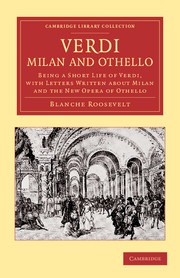
The premiere of Otello, Giuseppe Verdi's only new opera for over a decade, was a much-anticipated event in Milan in February 1887, and musical talents from all over Europe had vied for the chance to be part of it. An American author and former opera singer, Blanche Roosevelt (1853–98) took an assignment as a special correspondent in Milan during the weeks surrounding the opera's premiere at La Scala. She was well connected in the artistic community and personally acquainted with Verdi himself, and her dispatches paint an informed and vivid picture of the city and its musical and literary scene in the late 1880s. Published in 1887, along with a short biography of Verdi, anecdotes, illustrations, and reminiscences of conversations with the composer, these writings will appeal to both music scholars and opera lovers.
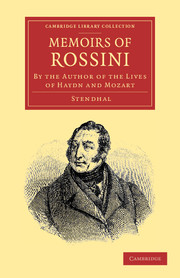
Marie-Henri Beyle (1783–1842), better known by his pen name Stendhal, is remembered today for such novels as Le Rouge et le Noir. Over the course of his life, he wrote in a variety of literary genres and under a multitude of names, or anonymously. Reissued here is the 1824 English translation of his Vie de Rossini of the same year, which was accused of being partly plagiarised from Giuseppe Carpani's Le Rossiniane, following similar claims regarding his biographies of Haydn and Mozart (which are also reissued together in translation in this series). Best known for William Tell and The Barber of Seville, Gioachino Rossini (1792–1868) was by far the most popular opera composer of his day, adored by his public. Colourful, vigorous and forthright, Stendhal's brilliant though somewhat unreliable biography offers an opinionated contemporary critique of 'Signor Crescendo'.
Wagner’s vaunted model of artistic synthesis persists in scholarly assessments of his work. But at its centre, the composer argued that the media of voice and orchestra do not mix: they retain their identities as separate channels of sound that can neither duplicate nor substitute for one another. Taking as a starting point Wagner’s claims for the non-adaptability of media, this article addresses the adaptation of Wagner’s music to the modern digital technologies of HD cinema and video game. Drawing on a wide circle of writers, from Schiller and Žižek to Bakhtin, Augé, Baudrillard and second-generation media theorists, it interrogates the concept of ‘reality’ within live acoustic performance, both historically, as a discursive concept, and technologically, via the sensory realism of digital simulcasting and telepresence. The philosophical opposition of appearance and reality fails when reality is defined by the intimate simulation of a sensory event as it is registered on the body. And by contrasting the traditions of high fidelity in (classical) sound recording with that of rendering sound in cinema, I suggest ways in which unmixable media appear to have an afterlife in modern technologies. This raises questions – in a post-Benjamin, post-McLuhan context – about our definition of ‘liveness’, the concept of authenticity within mediatised and acoustic sounds, and our vulnerability to the technological effects of media.
Shakespeare’s The Merry Wives of Windsor contains several features that make it unusual within his dramatic output and that thus render problematic the idea of a unified ‘Shakespearean’ canon. Until very recently, literary criticism has either largely ignored or denigrated the play, with a sustained interest in its portrayal of female agency, family life and the natural world only consolidating in the early twenty-first century. However, earlier operatic adaptations, such as Salieri and Defranceschi’s Falstaff, ossia Le tre burle, demonstrate an engagement with those issues which literary criticism has only lately addressed. While approaches to adaptations of The Merry Wives often focus primarily on the character of Falstaff, Salieri and Defranceschi’s opera’s engagement with the play’s issues beyond Falstaff suggests it might give added weight to a growing awareness of a positive alternative reception history of the play beyond literary criticism. At the same time, a consideration of the opera’s engagement with the play’s themes of female agency, family life and the natural world might shed light on Falstaff, ossia Le tre burle beyond the shadow cast by Verdi’s central character.
During the 1780s a cellist in the orchestra of the Opéra, known only as Monsieur Hivart, served the Russian Count Nicholas Sheremetev as an operatic agent, sending scores, librettos, costume designs, stage designs and other materials related to opera in Paris, and advising the count on the production of French operas in Russia. Hivart was in contact with such composers as Grétry, Sacchini and Piccinni, and the stage machinist and ballet master of the Opéra, and from his place in the orchestra he could watch their work take shape on stage. This gives his letters to Sheremetev (published in Russian translation in 1944 but largely unknown in the West) significant value for historians of opera in eighteenth-century Paris. Especially extensive are Hivart’s reports on the first production of Salieri’s Les Danaïdes, which contain much information about the first production available nowhere else.
This article traces the Italian reception of Jean-Jacques Rousseau and Horace Coignet’s Pygmalion (1770), ultimately arguing that the influence of early melodrama (and not the better-remembered Viennese reform) was behind the emergence of a style of speech-like singing and gestural mirroring in Italian opera in the decades immediately around 1800. Rousseauian melodrama was one of a few related projects subsuming the spoken word within the domain of music during the 1770s and 1780s; another was Joshua Steele’s Prosodia rationalis, which proposed a system of modified music notation in order to preserve and transmit the spoken word. This article suggests (contra most recent historians of melodrama) that such projects were inflected by a kind of twilight classicism, in which the revived object was made to show signs of decay. The revivalist strain in the first melodrama was particularly important for its Italian reception. Rousseau’s ideal of an ancient, onomatopoeic language collapsing meaning and medium was naturalised into the rhetoric of Italian opera reform during the 1770s and 1780s by the Jesuit theorists Antonio Eximeno and Stefano Arteaga. By way of a coda, this article traces the emergence of a ‘melodramatic’ style of Italian opera, first in all-sung adaptations of Pygmalion, thence into Venetian opera of the 1790s more broadly, and finally into Donizetti’s techniques of gestural mirroring and what was called the ‘canto filosofico’ of Bellini’s early operas.