To save content items to your account,
please confirm that you agree to abide by our usage policies.
If this is the first time you use this feature, you will be asked to authorise Cambridge Core to connect with your account.
Find out more about saving content to .
To save content items to your Kindle, first ensure no-reply@cambridge.org
is added to your Approved Personal Document E-mail List under your Personal Document Settings
on the Manage Your Content and Devices page of your Amazon account. Then enter the ‘name’ part
of your Kindle email address below.
Find out more about saving to your Kindle.
Note you can select to save to either the @free.kindle.com or @kindle.com variations.
‘@free.kindle.com’ emails are free but can only be saved to your device when it is connected to wi-fi.
‘@kindle.com’ emails can be delivered even when you are not connected to wi-fi, but note that service fees apply.
Most current work in epistemology deals with the evaluation and justification of information already acquired. In this book, Jaakko Hintikka instead discusses the more important problem of how knowledge is acquired in the first place. His model of information-seeking is the old Socratic method of questioning, which has been generalized and brought up-to-date through the logical theory of questions and answers that he has developed. Hintikka also argues that philosophers' quest for a definition of knowledge is ill-conceived and that the entire notion of knowledge should be replaced by the concept of information. He offers an analysis of the different meanings of the concept of information and of their interrelations. The result is a new and illuminating approach to the field of epistemology.
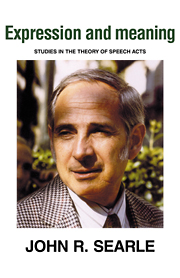
John Searle's Speech Acts made a highly original contribution to work in the philosophy of language. Expression and Meaning is a direct successor, concerned to develop and refine the account presented in Searle's earlier work, and to extend its application to other modes of discourse such as metaphor, fiction, reference, and indirect speech arts. Searle also presents a rational taxonomy of types of speech acts and explores the relation between the meanings of sentences and the contexts of their utterance. The book points forward to a larger theme implicit in these problems - the basis certain features of speech have in the intentionality of mind, and even more generally, the relation of the philosophy of language to the philosophy of mind.
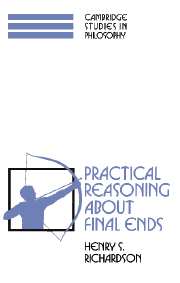
Henry Richardson argues that we can determine our ends rationally. He constructs a rich and original theory of how we can reason about our final goals. Richardson defuses the counter-arguments for the limits of rational deliberation, and develops interesting ideas about how his model might be extended to interpersonal deliberation of ends, taking him to the borders of political theory. Along the way Richardson offers illuminating discussions of, inter alia, Aristotle, Aquinas, Sidgwick, and Dewey, as well as the work of several contemporary philosophers.
The attention of philosophers. linguists and literary theorists has been converging on the diverse and intriguing phenomena of analogy of meaning:the different though related meanings of the same word, running from simple equivocation to paronymy, metaphor and figurative language. So far, however, their attempts at explanation have been piecemeal and inconclusive and no new and comprehensive theory of analogy has emerged. This is what James Ross offers here. In the first full treatment of the subject since the fifteenth century, he argues that analogy is a systematic and universal feature of natural languages, with identifiable and law-like characteristics which explain how the meanings of words in a sentence are interdependent. Throughout he contrasts his with classical and medieval views.
This book continues from where the authors' previous book, Structural Proof Theory, ended. It presents an extension of the methods of analysis of proofs in pure logic to elementary axiomatic systems and to what is known as philosophical logic. A self-contained brief introduction to the proof theory of pure logic is included that serves both the mathematically and philosophically oriented reader. The method is built up gradually, with examples drawn from theories of order, lattice theory and elementary geometry. The aim is, in each of the examples, to help the reader grasp the combinatorial behaviour of an axiom system, which typically leads to decidability results. The last part presents, as an application and extension of all that precedes it, a proof-theoretical approach to the Kripke semantics of modal and related logics, with a great number of new results, providing essential reading for mathematical and philosophical logicians.
This book develops a view of logic as a theory of information-driven agency and intelligent interaction between many agents - with conversation, argumentation and games as guiding examples. It provides one uniform account of dynamic logics for acts of inference, observation, questions and communication, that can handle both update of knowledge and revision of beliefs. It then extends the dynamic style of analysis to include changing preferences and goals, temporal processes, group action and strategic interaction in games. Throughout, the book develops a mathematical theory unifying all these systems, and positioning them at the interface of logic, philosophy, computer science and game theory. A series of further chapters explores repercussions of the 'dynamic stance' for these areas, as well as cognitive science.
This collection of papers from various areas of mathematical logic showcases the remarkable breadth and richness of the field. Leading authors reveal how contemporary technical results touch upon foundational questions about the nature of mathematics. Highlights of the volume include: a history of Tennenbaum's theorem in arithmetic; a number of papers on Tennenbaum phenomena in weak arithmetics as well as on other aspects of arithmetics, such as interpretability; the transcript of Gödel's previously unpublished 1972–1975 conversations with Sue Toledo, along with an appreciation of the same by Curtis Franks; Hugh Woodin's paper arguing against the generic multiverse view; Anne Troelstra's history of intuitionism through 1991; and Aki Kanamori's history of the Suslin problem in set theory. The book provides a historical and philosophical treatment of particular theorems in arithmetic and set theory, and is ideal for researchers and graduate students in mathematical logic and philosophy of mathematics.
So far, we have developed dynamic logics that deal with knowledge, inference, and questions, all based on information and truth. Now we want to look at another pervasive attitude that agents have toward information, namely, their beliefs. This chapter will show how belief change fits well with our dynamic framework, and develop some of its logical theory. This puts one more crucial aspect of rational agents in place: not their being right about everything, but their being wrong, and acts of self-correction.
From knowledge to belief as a trigger for actions
While knowledge is important to agency, our actions are often driven by fallible beliefs. I am riding my bicycle this evening because I believe it will get me home, even though my epistemic range includes worlds where the San Andreas Earthquake strikes. Decision theory is about choice and action on the basis of beliefs, as knowledge may not be available. Thus, our next step in the logical dynamics of rational agency is the study of beliefs, viewed as concretely as possible. Think of our scenarios in Chapter 3. The cards have been dealt. I know that there are 52 of them, and I know their colours. But I have more fleeting beliefs about who holds which card, or about how the other agents will play.
This book has presented a logical theory of agents that receive and exchange information. It shows how the programme of Logical Dynamics can deal with inference, observation, questions, communication, and other informational powers in one uniform methodology, putting the relevant actions and processes explicitly in the logic, and making use of all major kinds of information: semantic and syntactic. The agents involved in all this have knowledge, beliefs, and preferences – and thus, our systems incorporated knowledge update by observation and inference, varieties of belief revision and learning, and even acts of evaluation and preference change providing a richer motivating dynamics behind the pure kinematics of information. Moreover, from the start, a focus on single agents was not enough: interaction with others is of the essence in argumentation, communication, or games. Our logics dealt with multi-agent scenarios that led to longer-term interaction over time in larger groups, linking up eventually with temporal logic, game theory, and social choice theory. The resulting systems are perspicuous in design, and the dynamic stance also raises many new problems for technical research and philosophical reflection.
More concretely, this book contains a coherent series of technical results on logics of agency, and it generates many further open problems now that the basic theory is in place. Many of these problems are enumerated at the end of chapters. Some are just interesting further paths where readers might stroll, while others represent more urgent tasks given the current limitations of the framework. Of the latter, I would mention dynamic logics over neighbourhood models as more fine-grained representations of information, predicate-logical versions of our propositional dynamic logics that can deal with objects, and also, the logical dynamics of changing languages and concepts. But also, there are challenges in building further bridges between dynamic-epistemic logic and mathematical logic, as well as areas of mathematics like probability theory and dynamical systems. A final challenge is putting together our separate systems for informational and evaluative actions into richer logical models for cognitive agents. Questions and inference were natural companions right at the start of this book, inference and corrective acts of belief revision were another natural pair, and we studied even more complex kinds of entanglement adding preference and action, in the setting of games. But we are far from understanding the total behaviour of the appropriate combined systems and of the factors that determine complexity as subsystems are linked.
The public announcements or observations !P studied in Chapter 3 are an easily described way of conveying information. The only difficulty may be finding good static epistemic models for the initial situation where updates start. But information flow gets much more challenging once we give up the uniformity in this scenario. In conversation, in games, or at work, agents need not have the same access to the events currently taking place. When I take a new card from the stack in our current game, I see which one I get, but you do not. When I overhear what you are telling your friend, you may not know that I am getting that information. At the website of your bank, you have an encrypted private conversation which as few people as possible should learn about. The most enjoyable games are all about different information for different players, and so on. In all these cases, the dynamics itself poses a challenge, and elimination of worlds is definitely not the right mechanism. This chapter is about a significant extension of PAL that can deal with partially private information, reflecting different observational access of agents to the event taking place. We will present motivating examples, develop the system DEL, and explore some of its technical properties. As usual, the chapter ends with a number of further directions and open problems, from practical and philosophical to more mathematical. DEL is the true paradigm of dynamic-epistemic logic, and its ideas will return over and over again in this book.
So far, we have shown how logical dynamics deals with agents' knowledge and beliefs, and informational events that change these. But as we noted in Chapter 1, agency also involves a second major system, not of information but of evaluation. It is values mixed with information that provide the driving force for rational action – and the colour of life. The barest record of evaluation are agents' preferences between worlds or actions. Thus, the next task in this book is dealing with preferences, and how they change under triggers like suggestions or commands. While this topic seems different in flavour from earlier ones, properly viewed, it yields to the same techniques as in Chapters 3, 7. Therefore, we will present our dynamic logics with a lighter touch, while emphasizing further interesting features of preference that make it special from a logical perspective.
The themes in this book paint a more realistic picture than traditional views of logic as a study of abstract consequence relations. Agency, information flow, and interaction seem close to human life, suggesting links between logical dynamics and empirical cognitive science. But how much of this is genuine? Our systems are still mathematical in nature, and they do not question the normative stance of logic toward inference: they rather extend it to observations, questions, and other informational acts. Still, many logicians today are intrigued and inspired by empirical facts about cognition: pure normativity may be grand, but it can be lonely, and even worse: boring. In this chapter, we therefore present a few thoughts on the interface of logical dynamics and cognitive science.
Self-imposed borders
Logic has two historical sources: argumentation in the dialectical tradition, and axiom-based proof patterns organizing scientific inquiry. Over the centuries, the discipline turned mathematical. Is logic still about human reasoning? Or is it, as Kant and Bolzano said, an abstraction in the realm of pure ideas? Then logical consequence is an eternal relationship between propositions, firmly cleansed of any stains, smells, or sounds that human inferences might have – and hence also of their colours, and tantalizing twists and kinks. Do empirical facts about human reasoning matter to logic, or should we just study proof patterns, and their armies called formal systems, in an eternal realm where the sun of Pure Reason never sets? Most logicians think the latter. Universities should just hire logicians: in Tennyson's words, ‘theirs not to reason why’. If pressed, philosophers might say that logic is normative; it describes correct reasoning. People would be wise to follow its advice – but so much the worse for them, if they do not. The butler Gabriel Betteredge said it all (Wilkie Collins, The Moonstone, 1868):
‘Facts?’ he repeated. ‘Take a drop more grog, Mr. Franklin, and you'll get over the weakness of believing in facts! Foul play, sir!’
This chapter gives, first, the calculus of natural deduction, together with its basic structural properties such as the normalization of derivations and the subformula property of normal derivations. Next, the calculus is extended by mathematical rules, and it is shown that normalization works also in such extensions. The theory of equality is treated in detail, as a first example. Finally, predicate logic with an equality relation is studied. It is presented as an extension of predicate logic without equality, and therefore normalization of derivations applies. The question of the derivability of an atomic formula from given atomic formulas, i.e., the word problem for predicate logic with equality, is solved by a proof-theoretical algorithm.
Natural deduction with general elimination rules
Gentzen's rules of natural deduction for intuitionistic logic have proved to be remarkably stable. There has been variation in the way the closing of assumptions is handled. In 1984, Peter Schroeder-Heister changed the rule of conjunction elimination so that it admitted an arbitrary consequence similarly to the disjunction elimination rule. We shall do the same for the rest of the elimination rules and prove normalization for natural deduction with general elimination rules.
Natural deduction is based on the idea that proving begins in practice with the making of assumptions from which consequences are then drawn. Thus, the first rule of natural deduction is that any formula A can be assumed. Formally, by writing
A
we construct the simplest possible derivation tree, that of the conclusion of A from the assumption A.
We shall discuss the organization of an axiomatic system first through an example, namely Hilbert's famous axiomatization of elementary geometry. Hilbert tried to organize the axioms into groups that stem from the division of the basic concepts of geometry such as incidence, order, etc. Next, detailed axiomatizations of plane projective geometry and lattice theory are presented, based on the use of geometric constructions and lattice operations, respectively. An alternative organization of an axiomatic system uses existential axioms in place of such constructions and operations. It is discussed, again through the examples of projective geometry and lattice theory, in Section 3.2.
Organization of an axiomatization
(a) Background to axiomatization. To define an axiomatic system, a language and a system of proof is needed. The language will direct somewhat the construction of an axiomatic system that is added onto the rules of proof: there will be, typically, a domain of individuals, i.e., the objects the axioms talk about, and some basic relations between these objects.
When an axiomatic system is developed in every detail, it becomes a formal system. Expressions in the language of the systems are defined inductively, and so are formal proofs. The latter form a sequence that can be produced algorithmically, one after the other.
The idea of a formal axiomatic system is recent, only a hundred years old. Axiomatic systems appeared for the first time in Greek geometry, as known from Euclid's famous book.
We shall discuss the notion of proof and then present an introductory example of the analysis of the structure of proofs. The contents of the book are outlined in the third and last section of this chapter.
The idea of a proof
A proof in logic and mathematics is, traditionally, a deductive argument from some given assumptions to a conclusion. Proofs are meant to present conclusive evidence in the sense that the truth of the conclusion should follow necessarily from the truth of the assumptions. Proofs must be, in principle, communicable in every detail, so that their correctness can be checked. Detailed proofs are a means of presentation that need not follow in anyway the steps in finding things out. Still, it would be useful if there was a natural way from the latter steps to a proof, and equally useful if proofs also suggested the way the truths behind them were discovered.
The presentation of proofs as deductive arguments began in ancient Greek axiomatic geometry. It took Gottlob Frege in 1879 to realize that mere axioms and definitions are not enough, but that also the logical steps that combine axioms into a proof have to be made, and indeed can be made, explicit. To this purpose, Frege formulated logic itself as an axiomatic discipline, completed with just two rules of inference for combining logical axioms.
We present in this chapter, first, the theory of partial order. One formulation is based on a weak partial order a ≤ b and another one on a strict partial order a < b. The latter theory is problematic because of the absence of any easy definition of equality. Next, we present lattice theory and give a short, self-contained proof of the subterm property. By this property, we get a solution of the word problem for finitely generated lattices. It also follows that lattice theory is conservative over partial order for the problem of derivability of an atom from given atoms.
In Section 4.3, the most basic structure of algebra, namely a set with an equality and a binary operation, is treated. The proof of the subterm property for such groupoids is complicated by the existence of a unit of the operation. The treatment can be generalized to operations with any finite number of terms.
It is possible to modify the rules of lattice theory so that they contain eigenvariables. The number of rules drops down to four instead of six (plus the two of partial order). Moreover, the subterm property has an almost immediate proof. We consider also a formulation of strict order with eigenvariable rules, which permits the introduction (in a literal sense) of a relation of equality. A normal form for derivations and some of its consequences such as the conservativity of strict order with equality over the strict partial order fragment and the subterm property are shown.