To save content items to your account,
please confirm that you agree to abide by our usage policies.
If this is the first time you use this feature, you will be asked to authorise Cambridge Core to connect with your account.
Find out more about saving content to .
To save content items to your Kindle, first ensure no-reply@cambridge.org
is added to your Approved Personal Document E-mail List under your Personal Document Settings
on the Manage Your Content and Devices page of your Amazon account. Then enter the ‘name’ part
of your Kindle email address below.
Find out more about saving to your Kindle.
Note you can select to save to either the @free.kindle.com or @kindle.com variations.
‘@free.kindle.com’ emails are free but can only be saved to your device when it is connected to wi-fi.
‘@kindle.com’ emails can be delivered even when you are not connected to wi-fi, but note that service fees apply.
Chapters 1–5 constitute Part I of the book, entitled “Free Will,” about the principal theories of free will from the 1220s–1320s and their background in Aristotle and earlier medieval thinkers. Chapter 1 gives an overview of the accounts of free will by Anselm of Canterbury, Bernard of Clairvaux, and Peter Lombard. Then it sketches the history of the reception of Aristotle’s action theory and offers an account of the principal Aristotelian doctrines that are relevant to later medieval theories of free will.
Chapters 6–7 constitute Part II, entitled “Whence Evil?” Chapter 6 studies theories of the first cause of evil in Augustine and Pseudo-Dionysius. Assuming that moral evil came about in a world created good, Augustine faces the question of what first causes evil. If one assumes that evil has a cause, one is faced with the dilemma that moral evil is caused by either a good will or an evil will; but a good will cannot cause moral evil at all, and an evil will cannot cause the first moral evil. So Augustine argues that evil does not have an efficient cause, but only a deficient cause, which means that evil ultimately lacks an explanation. Augustine holds that evil originated in something good, but cannot be caused by something good. Pseudo-Dionysius agrees with Augustine that evil lacks an efficient cause and adds that evil cannot be a final cause: no one acts for the sake of evil.
Chapter 10 studies theories of demonic obstinacy, the state in which the fallen angels or demons are unable to avoid sinning and have a limited ability to do good. The external cause of obstinacy is God’s refusal to offer them the grace of repentance and of justification. Beginning with Aquinas, theologians searched in addition for an internal, psychological cause of their obstinacy – a great challenge, given their shared belief that the angels’ will is by nature oriented to the good. Aquinas traces their obstinacy to the fixity of their cognition, and Henry of Ghent to the forcefulness of their will. Certain Franciscan thinkers explain the demons’ obstinacy by means of a divine intervention, binding their will to evil (Olivi), causing their immoderate self-love (Scotus), causing in them a habit of wickedness (Auriol), or even causing in them hatred of God (Ockham). Durand of St. Pourçain returns to the standard account prior to Aquinas, which explains the demons’ obstinacy by a divine decision, with no reference to their psychological condition. In addition to the cause of obstinacy, theologians discussed whether the demons, though necessarily obstinate, are nevertheless free.
Chapter 4 studies three theories of free will of the late thirteenth century: two that are midway between intellectualism and voluntarism, and one that is strictly intellectualist. Giles of Rome starts from the intellectualist assumption that the cognized object causes the will’s act, but makes a voluntarist concession in assuming that the will controls which aspects of the object end up moving the will. John of Morrovalle (also known as John of Murro) starts from the idea that the will moves itself, but makes the intellectualist concession that the cognized object causes a disposition in the will that predisposes the will in making a choice. Godfrey of Fontaines rejects both solutions and argues that the cognized object alone causes the will’s act. While Giles and Morrovalle grant the will some direct control of its choices, Godfrey considers control necessarily mediated by practical deliberation. In the last analysis, Godfrey leaves the question of how we control our deliberation unanswered.
Chapters 8–10 constitute Part III, entitled “Angelic Sin,” which raises the issue of how rational agents can do evil under ideal psychological conditions. Chapter 8 is about intellectualist accounts of angelic sin. Since according to these accounts, the will acts as the intellect judges best, evil acts presuppose some cognitive deficiency: either an outright error, or some occurrent nonconsideration that keeps the intellect from making the correct judgment. Thus one difficulty faced by intellectualist thinkers is how the cognitive deficiency can come about – especially since most thinkers here discussed assume that angels are infallible prior to making an evil choice. Another difficulty concerns control of the act. It is assumed that while the angels’ good or evil choice was up to them, the content of their knowledge was not up to them. Aquinas’s solution is that knowledge does not predetermine the use of that knowledge, which is up to the will. By contrast, Godfrey of Fontaines argues that the choice of the angels is caused by the cognized object; he fails to explain, however, how his theory avoids cognitive determinism.
Chapter 5 concerns the free will debate in the early fourteenth century. It thoroughly discusses the Franciscans Duns Scotus and William of Ockham, who make a sharp distinction between will and nature, that is, between a free power or cause that controls its act and one whose act is determined by external circumstances. Scotus and Ockham make the will more independent from a cognized good than previous thinkers. Using unedited texts, the chapter also presents what may well be the strongest statement of intellectualism at the time, by John of Pouilly, who builds on Godfrey of Fontaines to explain why, although our choices are moved by the cognized object, we control our choices. More briefly, the Dominicans Hervaeus Natalis and Durand of St. Pourçain are considered, whose general approach resembles Pouilly’s. As a thinker developing an intermediary theory, the chapter studies Peter Auriol, according to whom the will controls directly which judgment considered during deliberation becomes the final judgment that causes one’s choice. The dividing issue among these thinkers is, at bottom, whether the will controls its acts directly or only by means of deliberation.
Chapter 9 examines explanations of the angelic fall by voluntarists and thinkers holding an intermediary theory of free will. These nonintellectualist accounts agree – contrary to intellectualists – that there was deficient willing before there was deficient cognition. For some voluntarists, the discussion of angelic sin serves above all as confirmation of their own theories of free will (e.g., Henry of Ghent) or as proof that their adversaries are wrong (e.g., John Pecham). Others go further and try to give a plausible account of how the evil angels could intentionally make their choice (Peter Olivi), and to explain how their will could be defective while their cognition was unflawed (Duns Scotus). Among thinkers professing an intermediary theory of free will, the chapter considers Giles of Rome, whose account of angelic sin fits nicely with his general theory of the relation of ignorance and evil, and Peter Auriol, whose explanation of angelic sin does not sit comfortably with his theory of free will.
Chapter 3 is about late thirteenth-century voluntarist theories. It discusses three ecclesiastical condemnations of philosophical propositions, one in 1270 and two in 1277. Among the censured propositions are some that express intellectualist views about intellect and will. The chief part of the chapter gives a comprehensive account of Henry of Ghent’s theory of free will, the most influential theory at the time. At its core is the belief that the intellect does not control its act, so all control of a person’s acts must be traced to the will. For Henry, the fact that only the will, but not the intellect, controls its acts implies that the will can choose even contrary to the intellect’s judgment of what is best to choose. The will’s relative independence from the intellect, in turn, implies for Henry that the will moves itself to its act, while the cognized object (the desirable object presented by the intellect) is no more than a presupposition for the will’s act – a so-called “causa sine qua non.” The chapter also examines in some detail Peter Olivi’s theory of free will, which resembles Henry’s on many points. It ends with a brief mention of other voluntarist thinkers.
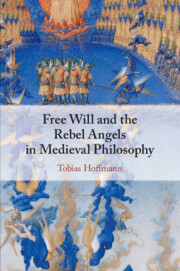
In this book Tobias Hoffmann studies the medieval free will debate during its liveliest period, from the 1220s to the 1320s, and clarifies its background in Aristotle, Augustine, and earlier medieval thinkers. Among the wide range of authors he examines are not only well-known thinkers such as Thomas Aquinas, Duns Scotus, and William of Ockham, but also a number of authors who were just as important in their time and deserve to be rediscovered today. To shed further light on their theories of free will, Hoffmann also explores their competing philosophical explanations of the fall of the angels, that is, the hypothesis of an evil choice made by rational beings under optimal psychological conditions. As he shows, this test case imposed limits on tracing free choices to cognition. His book provides a comprehensive account of a debate that was central to medieval philosophy and continues to occupy philosophers today.
This monumental, line-by-line commentary makes Thomas Aquinas's classic Treatise on Happiness and Ultimate Purpose accessible to all readers. Budziszewski illuminates arguments that even specialists find challenging: What is happiness? Is it something that we have, feel, or do? Does it lie in such things as wealth, power, fame, having friends, or knowing God? Can it actually be attained? This book's luminous prose makes Aquinas's treatise transparent, bringing to light profound underlying issues concerning knowledge, meaning, human psychology, and even the nature of reality.
Throughout his writings, Thomas Aquinas exhibited a remarkable stability of thought. However, in some areas such as his theology of grace, his thought underwent titanic developments. In this book, Justin M. Anderson traces both those developments in grace and their causes. After introducing the various meanings of virtue Aquinas utilized, including 'virtue in its fullest sense' and various forms of 'qualified virtue', he explores the historical context that conditioned that account. Through a close analysis of his writings, Anderson unearths Aquinas's own discoveries and analyses that would propel his understanding of human experience, divine action, and supernatural grace in new directions. In the end, we discover an account of virtue that is inextricably linked to his developed understanding of sin, grace and divine action in human life. As such, Anderson challenges the received understanding of Aquinas's account of virtue, as well as his relationship to contemporary virtue ethics.