To save content items to your account,
please confirm that you agree to abide by our usage policies.
If this is the first time you use this feature, you will be asked to authorise Cambridge Core to connect with your account.
Find out more about saving content to .
To save content items to your Kindle, first ensure no-reply@cambridge.org
is added to your Approved Personal Document E-mail List under your Personal Document Settings
on the Manage Your Content and Devices page of your Amazon account. Then enter the ‘name’ part
of your Kindle email address below.
Find out more about saving to your Kindle.
Note you can select to save to either the @free.kindle.com or @kindle.com variations.
‘@free.kindle.com’ emails are free but can only be saved to your device when it is connected to wi-fi.
‘@kindle.com’ emails can be delivered even when you are not connected to wi-fi, but note that service fees apply.
Ralph Cudworth (1617–1688) deserves recognition as one of the most important English seventeenth-century philosophers after Hobbes and Locke. In opposition to Hobbes, Cudworth proposes an innatist theory of knowledge which may be contrasted with the empirical position of his younger contemporary Locke, and in moral philosophy he anticipates the ethical rationalists of the eighteenth century. A Treatise Concerning Eternal and Immutable Morality is his most important work, and this volume makes it available, together with his shorter Treatise of Freewill, with a historical introduction, a chronology of his life, and an essay on further reading.
This volume presents the first complete translation of Fichte Studies, a powerful, creative and sustained critique of Fichtean philosophy by the young philosopher-poet Friedrich von Hardenberg, who under the pen-name Novalis went on to become the most well-known and beloved of the early German Romantic writers. Anyone interested in the fate of German philosophy and literature immediately after Kant will find this collection of notes and aphorisms a treasure-trove of original contributions on the nature of self-consciousness, the relation of art to philosophy, and the nature of philosophical inquiry. There are also the beginnings of a strikingly contemporary-sounding semiotic theory. The text is translated by Jane Kneller, who also provides an introduction situating the Fichte Studies in the context of Novalis' life and work.
A classic of modern religious thought, Schleiermacher's On Religion: Speeches to its Cultured Despisers is here presented in Richard Crouter's acclaimed English translation of the 1799 edition, originally published in Cambridge Texts in German Philosophy. Written when its youthful author was deeply involved in German Romanticism and the critique of Kant's moral and religious philosophy, it is a masterly expression of Protestant Christian apologetics of the modern period, which powerfully displays the tensions between the Romantic and Enlightenment accounts of religion. Unlike the revised versions of 1806 and 1821, which modify the language of feeling and intuition and translate the argument into more traditional academic and Christian categories, the 1799 text more fully reveals its original audience's literary and social world. Richard Crouter's introduction places the work in the milieu of early German Romanticism, Kant criticism, the revival of Spinoza and Plato studies, and theories of literary criticism and of the physical sciences, and his fully annotated edition also includes a chronology and notes on further reading.
Philip Melanchthon (1497–1560), humanist and colleague of Martin Luther, is best known for his educational reforms, for which he earned the title Praeceptor Germaniae (the Teacher of Germany). His most influential form of philosophical writing was the academic oration, and this volume, first published in 1999, presents a large and wide-ranging selection of his orations and textbook prefaces translated into English. They set out his views on the distinction between faith and reason, the role of philosophy in education, moral philosophy, natural philosophy, astronomy and astrology, and the importance of philosophy to a true Christian, as well as his views on Classical philosophical authorities such as Plato and Aristotle and on contemporaries such as Erasmus and Luther. Powerfully influential in their time, inspiring many Protestant students to study philosophy, mathematics and natural philosophy, they illuminate the relationship between Renaissance and Reformation thought.
This anthology of philosophical texts by Greek and Roman authors brings together works from the late fifth century BC to the sixth century AD that comment on major aesthetic issues such as the perception of beauty and harmony in music and the visual arts, structure and style in literature, and aesthetic judgement. It includes important texts by Plato and Aristotle on the status and the role of the arts in society and in education, and Longinus' reflections on the sublime in literature, in addition to less well-known writings by Philodemus, Cicero, Seneca, Plotinus, Augustine and Proclus. Most of the texts have been newly translated for this volume, and some are available in English for the first time. A detailed introduction traces the development of classical aesthetics from its roots in Platonism and Aristotelianism to its ultimate form in late Antiquity.
The Critique of Practical Reason is the second of Kant's three Critiques, one of his three major treatises on moral theory, and a seminal text in the history of moral philosophy. Originally published three years after his Groundwork to the Metaphysics of Morals, the Critique provides further elaboration of the basic themes of Kant's moral theory, gives the most complete statement of his highly original theory of freedom of the will, and develops his practical metaphysics. This new edition of Kant's Critique of Practical Reason – prepared by an acclaimed translator and scholar of Kant's practical philosophy – presents the first new translation of this work to appear for some years. A substantial and lucid introduction by Andrews Reath places the main themes of the Critique in the context of Kant's moral theory and his critical system.
Medieval Jewish intellectuals living in Muslim and Christian lands were strongly concerned to recover what they regarded as a 'lost' Jewish philosophical tradition. As part of this project they transmitted and produced many philosophical and scientific works and commentaries, as well as philosophical commentary on scripture, in Judaeo-Arabic and Hebrew, the principal literary languages of medieval Jewry. This volume presents translations of seven prominent medieval Jewish rationalists: Saadia Gaon, Solomon ibn Gabirol, Moses Maimonides, Isaac Albalag, Moses of Narbonne, Levi Gersonides, Hasdai Crescas and Joseph Albo - including, for the first time in English, the complete Falaquera abridgement of Gabirol's Source of Life. These works range over topics that are both theological (e.g. the creation of the world) and philosophical (e.g. determinism and free choice), but they are characterized by two overarching principles: the unity of truth, and its accessibility to human reason.
Gotthold Ephraim Lessing (1729–81), thinker, dramatist and controversialist of many-sided interests, is the most representative figure of the German Enlightenment. His defence of Spinoza, who had traditionally been condemned as an atheist, provoked a major controversy in philosophy, and his publication of H. S. Reimarus' radical assault on Christianity led to fundamental changes in Protestant theology. This volume presents the most comprehensive collection to date in English of Lessing's philosophical and theological writings, several of which are here translated for the first time. They are edited and translated by H. B. Nisbet, who also provides an introduction that sets them in their historical and philosophical contexts.
The eagerly-awaited second volume of The Cambridge Translations of Medieval Philosophical Texts will allow scholars and students access for the first time in English to major texts in ethics and political thought from one of the most fruitful periods of speculation and analysis in the history of western thought. Beginning with Albert the Great, who introduced the Latin west to the challenging moral philosophy and natural science of Aristotle, and concluding with the first substantial presentation in English of the revolutionary ideas on property and political power of John Wyclif, the seventeen texts in this anthology offer late medieval treatments of fundamental issues in human conduct that are both conceptually subtle and of direct practical import. Special features of this volume include copious editorial introductions, an analytical index, and suggestions for further reading. This is an important resource for scholars and students of medieval philosophy, history, political science, theology and literature.
Sir Isaac Newton (1642–1727) left a voluminous legacy of writings. Despite his influence on the early modern period, his correspondence, manuscripts, and publications in natural philosophy remain scattered throughout many disparate editions. In this volume, Newton's principal philosophical writings are for the first time collected in a single place. They include excerpts from the Principia and the Opticks, his famous correspondence with Boyle and with Bentley, and his equally significant correspondence with Leibniz, which is often ignored in favor of Leibniz's later debate with Samuel Clarke. Newton's exchanges with Leibniz place their different understandings of natural philosophy in sharp relief. The volume also includes 'De Gravitatione', offered here in a corrected translation, which is crucial for understanding Newton's relation to his great predecessor Descartes. In a historical and philosophical introduction, Andrew Janiak examines Newton's philosophical positions and his relations to canonical figures in early modern philosophy.
Antoine Arnauld and Pierre Nicole were philosophers and theologians associated with Port-Royal Abbey, a centre of the Catholic Jansenist movement in seventeenth-century France. Their enormously influential Logic or the Art of Thinking, which went through five editions in their lifetimes, treats topics in logic, language, theory of knowledge and metaphysics, and also articulates the response of 'heretical' Jansenist Catholicism to orthodox Catholic and Protestant views on grace, free will and the sacraments. In attempting to combine the categorical theory of the proposition with a Cartesian account of knowledge, their Logic represents the classical view of judgment which inspired the modern transformation in logic and semantic theory by Frege, Russell, Wittgenstein and recent philosophers. This edition presents a new translation of the text, together with a historical introduction and suggestions for further reading.
Immanuel Kant's Groundwork of the Metaphysics of Morals ranks alongside Plato's Republic and Aristotle's Nicomachean Ethics as one of the most profound and influential works in moral philosophy ever written. In Kant's own words its aim is to search for and establish the supreme principle of morality, the categorical imperative. Kant argues that every human being is an end in himself or herself, never to be used as a means by others, and that moral obligation is an expression of the human capacity for autonomy or self-government. This edition presents the acclaimed translation of the text by Mary Gregor, together with an introduction by Christine M. Korsgaard that examines and explains Kant's argument.
This volume presents a colourful and entertaining overview of German intellectual history by a central figure in its development. Heinrich Heine (1797–1856), famous poet, journalist, and political exile, studied with Hegel and was personally acquainted with the leading figures of the most important generation of German writers and philosophers. In his groundbreaking History he discusses the history of religion, philosophy, and literature in Germany up to his time, seen through his own highly opinionated, politically aware, philosophically astute, and always ironic perspective. This work, and other writings focussing especially on Heine's rethinking of Hegel's philosophy, are presented here in a new translation by Howard Pollack-Milgate. The volume also includes an introduction by Terry Pinkard which examines Heine both in relation to Hegel and Nietzsche and as a thinker in his own right.
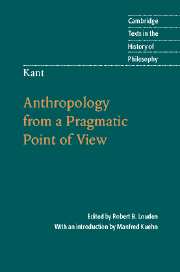
Anthropology from a Pragmatic Point of View essentially reflects the last lectures Kant gave for his annual course in anthropology, which he taught from 1772 until his retirement in 1796. The lectures were published in 1798, with the largest first printing of any of Kant's works. Intended for a broad audience, they reveal not only Kant's unique contribution to the newly emerging discipline of anthropology, but also his desire to offer students a practical view of the world and of humanity's place in it. With its focus on what the human being 'as a free-acting being makes of himself or can and should make of himself,' the Anthropology also offers readers an application of some central elements of Kant's philosophy. This volume offers an annotated translation of the text by Robert B. Louden, together with an introduction by Manfred Kuehn that explores the context and themes of the lectures.
An appropriate motto for Augustine's great work On the Trinity is 'faith in search of understanding'. In this treatise Augustine offers a part-theological, part-philosophical account of how God might be understood in analogy to the human mind. On the Trinity can be fairly described as the first modern philosophy of mind: it is the first work in philosophy to recognize the 'problem of other minds', and the first to offer the 'argument from analogy' as a response to that problem. Other subjects that it discusses include the nature of the mind and the nature of the body, the doctrine of 'illumination', and thinking as inner speech. This volume presents the philosophical section of the work, and in a historical and philosophical introduction Gareth Matthews places Augustine's arguments in context and assesses their influence on later thinkers.
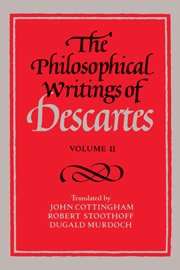
These two volumes provide a translation of the philosophical works of Descartes, based on the best available Latin and French texts. They are intended to replace the only reasonably comprehensive selection of his works in English, by Haldane and Ross, first published in 1911. All the works included in that edition are translated here, together with a number of additional texts crucial for an understanding of Cartesian philosophy, including important material from Descartes' scientific writings. The result should meet the widespread demand for an accurate and authoritative edition of Descartes' philosophical writings in clear and readable modern English.
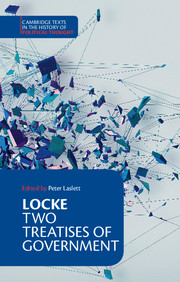
This is the revised version of Peter Laslett's acclaimed edition of Two Treatises of Government, which is widely recognised as one of the classic pieces of recent scholarship in the history of ideas, read and used by students of political theory throughout the world. This 1988 edition revises Dr Laslett's second edition (1970) and includes an updated bibliography, a guide to further reading and a fully reset and revised introduction which surveys advances in Locke scholarship since publication of the second edition. In the introduction, Dr Laslett shows that the Two Treatises were not a rationalisation of the events of 1688 but rather a call for a revolution yet to come.
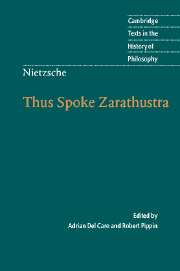
Nietzsche regarded 'Thus Spoke Zarathustra' as his most important work, and his story of the wandering Zarathustra has had enormous influence on subsequent culture. Nietzsche uses a mixture of homilies, parables, epigrams and dreams to introduce some of his most striking doctrines, including the Overman, nihilism, and the eternal return of the same. This edition offers a new translation by Adrian Del Caro which restores the original versification of Nietzsche's text and captures its poetic brilliance. Robert Pippin's introduction discusses many of the most important interpretative issues raised by the work, including who is Zarathustra and what kind of 'hero' is he and what is the philosophical significance of the work's literary form? The volume will appeal to all readers interested in one of the most original and inventive works of modern philosophy.
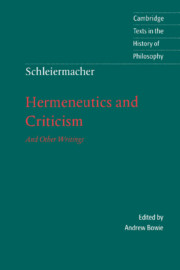
The founding text of modern hermeneutics. Written by the philosopher and theologian Friedrich Schleiermacher as a method for the interpretation and textual criticism of the New Testament, it develops ideas about language and the interpretation of texts that are in many respects still unsurpassed and are becoming current in the contemporary philosophy of language. Contrary to the traditional view of Schleiermacher as a theorist of empathetic interpretation, in this text he offers a view of understanding that acknowledges both the structurally and historically determined aspects of language and the need to take account of the activity of the individual subject in the constitution of meaning. This volume offers the text in a new translation by Andrew Bowie, together with related writings on secular hermeneutics and on language, and an introduction that places the texts in the context of Schleiermacher's philosophy as a whole.
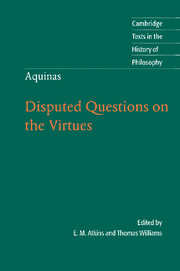
The great medieval philosopher Thomas Aquinas (1224/6-1274) was Dominican regent master in theology at the University of Paris, where he presided over a series of questions - academic debates - on ethical topics. This volume offers translations of disputed questions on the nature of virtues in general, the fundamental or 'cardinal' virtues of practical wisdom, justice, courage, and temperateness, the divinely bestowed virtues of hope and charity, and the practical question of how, when and why one should rebuke a 'brother' for wrongdoing. The introduction explains how Aquinas's theory of virtue fits into his ethics as a whole, and it illuminates Aquinas's views by explaining the institutional and intellectual context in which these disputed questions were debated.