To save content items to your account,
please confirm that you agree to abide by our usage policies.
If this is the first time you use this feature, you will be asked to authorise Cambridge Core to connect with your account.
Find out more about saving content to .
To save content items to your Kindle, first ensure no-reply@cambridge.org
is added to your Approved Personal Document E-mail List under your Personal Document Settings
on the Manage Your Content and Devices page of your Amazon account. Then enter the ‘name’ part
of your Kindle email address below.
Find out more about saving to your Kindle.
Note you can select to save to either the @free.kindle.com or @kindle.com variations.
‘@free.kindle.com’ emails are free but can only be saved to your device when it is connected to wi-fi.
‘@kindle.com’ emails can be delivered even when you are not connected to wi-fi, but note that service fees apply.
George Berkeley (1685–1753) was a university teacher, a missionary, and later a Church of Ireland bishop. The over-riding objective of his long philosophical career was to counteract objections to religious belief that resulted from new philosophies associated with the Scientific Revolution. Accordingly, he argued against scepticism and atheism in the Principles and the Three Dialogues; he rejected theories of force in the Essay on Motion; he offered a new theory of meaning for religious language in Alciphron; and he modified his earlier immaterialism in Siris by speculating about the body's influence on the soul. His radical empiricism and scientific instrumentalism, which rejected the claims of the sciences to provide a realistic interpretation of phenomena, are still influential today. This edition provides texts from the full range of Berkeley's contributions to philosophy, together with an introduction by Desmond M. Clarke that sets them in their historical and philosophical contexts.
Condillac's Essay on the Origin of Human Knowledge, first published in French in 1746 and offered here in a new translation, represented in its time a radical departure from the dominant conception of the mind as a reservoir of innately given ideas. Descartes had held that knowledge must rest on ideas; Condillac turned this upside down by arguing that speech and words are the origin of mental life and knowledge. He argued, further, that language has its origin in human interaction and in our natural capacity to react spontaneously and instinctively to the expression of emotions and states of mind in others. The importance of this pointedly anti-Cartesian view, and its relevance to both aesthetics and epistemology, were quickly understood, and Condillac's work influenced many later philosophers including Herder, Rousseau, and Adam Smith. His conception also anticipated Wittgenstein's view of language, its usage, and its relation to mind and thought.
In the New Essays on Human Understanding, Leibniz argues chapter by chapter with John Locke's Essay Concerning Human Understanding, challenging his views about knowledge, personal identity, God, morality, mind and matter, nature versus nurture, logic and language, and a host of other topics. The work is a series of sharp, deep discussions by one great philosopher of the work of another. Leibniz's references to his contemporaries and his discussions of the ideas and institutions of the age make this a fascinating and valuable document in the history of ideas. The work was originally written in French, and the version by Peter Remnant and Jonathan Bennett, based on the only reliable French edition (published in 1962), first appeared in 1981 and has become the standard English translation. It has been thoroughly revised for this series and provided with a new and longer introduction, a chronology on Leibniz's life and career and a guide to further reading.
John Locke's Letter Concerning Toleration (1689) is one of the most widely-read texts in the political theory of toleration, and a key text for the liberal tradition. However, Locke also defended toleration more extensively in three subsequent Letters, which he wrote in response to criticism by an Anglican cleric, Jonas Proast. This edition, which includes a new translation of the original Letter, by Michael Silverthorne, enables readers to assess John Locke's theory of toleration by studying both his classic work and essential extracts from the later Letters. An introduction by Richard Vernon sets Locke's theory in its historical context and examines the key questions for contemporary political theorists which arise from this major work in the history of political thought.
Leibniz's political and ethical writing long has been neglected, and with this new edition Professor Riley makes available the most representative pieces from Leibniz's political theory. This new edition, specially prepared for this series, is the first to make a considerable number of Leibniz's writings available in English, and includes three previously unpublished manuscripts, a selection of political letters, an introduction, notes, and a critical biography.
The First New Science gives a clear account of Vico's mature philosophy: the belief that certain functions which are necessary for the maintenance of human society and culture, including philosophy, also condition them historically. This challenges the traditional view that philosophy can lay claim to an historically independent viewpoint, thus bringing into question the legitimacy of the claims of universal prescriptive political theories as against the de facto political beliefs of particular historical societies. This is the first of Vico's later major books in which he wrote in Italian in order not merely to expound but to demonstrate in practice, his conception of the philosophical importance of etymology. This 2002 Cambridge Texts edition is the first complete English translation of the 1725 text. Accompanied by a glossary, bibliography, chronology of Vico's life and expository introduction, it makes this important work accessible to students for the first time.
This volume is the first ever English translation of Kant's last major work, the so-called Opus Postumum, a work Kant himself described as his 'chef d'oeuvre' and as the keystone of his entire philosophical system. It occupied him for more than the last decade of his life. Begun with the intention of providing a 'transition from the metaphysical foundations of natural science to physics,' Kant's reflections take him far beyond the problem he initially set out to solve. In fact, he reassesses a whole series of fundamental topics of transcendental philosophy: the thing in itself, the nature of space and time, the concept of the self and its agency, the idea of God, and the unity of theoretical and practical reason. Though never completed, the text reaches a logical albeit not fully developed, conclusion.
The works translated here deal with two major themes in the thinking of St Augustine (354–430): free will and divine grace. On the one hand, free will enables human beings to make their own choices; on the other hand, God's grace is required for these choices to be efficacious. 'On the Free Choice of the Will', 'On Grace and Free Choice', 'On Reprimand and Grace' and 'On the Gift of Perseverance' set out Augustine's theory of human responsibility, and sketch a subtle reconciliation of will and grace. This volume is the first to bring together Augustine's early and later writings on these two themes, in a new translation by Peter King, enabling the reader to see what Augustine regarded as the crowning achievement of his work. The volume also includes a clear and accessible introduction that analyzes Augustine's key philosophical lines of thought.
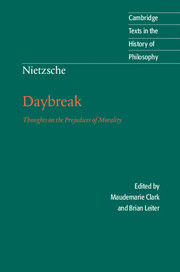
Daybreak marks the arrival of Nietzsche's 'mature' philosophy and is indispensable for an understanding of his critique of morality and 'revaluation of all values'. This volume presents the distinguished translation by R. J. Hollingdale, with a new introduction that argues for a dramatic change in Nietzsche's views from Human, All Too Human to Daybreak, and shows how this change, in turn, presages the main themes of Nietzsche's later and better-known works such as On the Genealogy of Morality. The main themes of Daybreak are located in their intellectual and philosophical contexts: in Nietzsche's training as a classical philologist and his fascination with the Sophists and Thucydides; in the moral philosophies of Kant and Schopenhauer, which are the central foci of Nietzsche's critique of morality; and in the German Materialist movement of the 1850s and after, which shaped Nietzsche's conception of persons. The edition is completed by a chronology, notes and a guide to further reading.
Ancient Greek philosophy was divided into three sciences: physics, ethics, and logic. This division is perfectly suitable to the nature of the matter, and there is no need to amend it, except perhaps just to add its principle, partly so as to assure oneself in this way of its completeness, partly to be able to determine correctly the necessary subdivisions.
All rational cognition is either material and considers some object, or formal and occupied merely with the form of the understanding and of reason itself, and with the universal rules of thinking as such, regardless of differences among its objects. Formal philosophy is called logic, whereas material philosophy, which has to do with determinate objects and the laws to which they are subject, is once again twofold. For these laws are either laws of nature, or of freedom. The science of the first is called physics, that of the other is ethics; the former is also called doctrine of nature, the latter doctrine of morals.
If so far we have drawn our concept of duty from the common use of our practical reason, it is by no means to be inferred from this that we have treated it as an experiential concept. Rather, if we attend to our experience of the behavior of human beings we meet frequent and, as we ourselves concede, just complaints that no reliable example can be cited of the disposition to act from pure duty; that, though much may be done that conforms with what duty commands, still it is always doubtful whether it is actually done from duty and thus has a moral worth. That is why there have been philosophers in every age who have absolutely denied the actuality of this disposition in human actions, and attributed everything to a more or less refined self-love, without however calling into doubt the correctness of the concept of morality because of this; rather, with intimate regret they made mention of the frailty and impurity of a human nature that is indeed noble enough to take an idea so worthy of respect as its prescription, but at the same time too weak to follow it, and that uses reason, which should serve it for legislation, only to take care of the interest of inclinations, whether singly or, at most, in their greatest compatibility with one another.
In fact, it is absolutely impossible by means of experience to make out with complete certainty a single case in which the maxim of an action that otherwise conforms with duty did rest solely on moral grounds and on the representation of one’s duty. For at times it is indeed the case that with the acutest self-examination we find nothing whatsoever that – besides the moral ground of duty – could have been powerful enough to move us to this or that good action and so great a sacrifice; but from this it cannot be inferred with certainty that the real determining cause of the will was not actually a covert impulse of self-love under the mere pretense of that idea; for which we then gladly flatter ourselves with the false presumption of a nobler motive, whereas in fact we can never, even by the most strenuous examination, get entirely behind our covert incentives, because when moral worth is at issue what counts is not the actions, which one sees, but their inner principles, which one does not see.
A life devoted to the pursuit of philosophical inquiry may be inwardly asfull of drama and event – of obstacle and overcoming, battle and victory,challenge and conquest – as that of any general, politician, or explorer,and yet be outwardly so quiet and routine as to defy biographical narration.Immanuel Kant was born in 1724 in Königsberg, East Prussia, to aPietist family of modest means. Encouraged by his mother and the familypastor to pursue the career marked out by his intellectual gifts, Kantattended the University of Königsberg, and then worked for a time as aprivate tutor in the homes of various families in the neighborhood, whilepursuing his researches in natural science. Later he got a position as a Privatdozent, an unsalaried lecturer who is paid by student fees, at theUniversity. There Kant lectured on logic, metaphysics, ethics, geography,anthropology, mathematics, the foundations of natural science, andphysics. In 1770, he finally obtained a regular professorship, the Chair ofLogic and Metaphysics, at Königsberg. Destined by limited means anduneven health never to marry or travel, Kant remained in the Königsbergarea, a quiet, hardworking scholar and teacher, until his death in 1804.
The translation of this new edition of Immanuel Kant’s Groundwork of theMetaphysics of Morals first appeared in my German–English edition(Cambridge, 2011). It is based on Mary Gregor’s English version, firstpublished by Cambridge University Press in 1996 and subsequentlyreprinted in the Cambridge Texts in the History of Philosophy.
Throughout the revision process, care was taken to preserve thefamiliar feel of Gregor’s work. While there were many changes in mattersof detail, explained in the introduction and notes to the bilingual edition,the principles of her approach – combining a high degree of faithfulnessto Kant’s German with readability and fluency – naturally remainedintact.
The Groundwork was first published in 1785. The translation followsthe German text of the German–English volume, which is based on thesecond original edition of 1786. All major departures of the secondoriginal edition from the first are documented in the footnotes of thisvolume.
The concept of freedom is the key to the explanation of the autonomy of the will
A will is a kind of causality of living beings in so far as they are rational, and freedom would be that property of such a causality, as it can be efficient independently of alien causes determining it; just as natural necessity is the property of the causality of all non-rational beings to be determined to activity by the influence of alien causes.
The explication of freedom stated above is negative and therefore unfruitful for gaining insight into its essence; but there flows from it a positive concept of freedom, which is so much the richer and more fruitful. Since the concept of causality carries with it that of laws according to which, by something that we call a cause, something else, namely the consequence, must be posited: freedom, though it is not a property of the will according to natural laws, is not lawless because of that at all, but must rather be a causality according to immutable laws, but of a special kind; for otherwise a free will would be an absurdity. Natural necessity was a heteronomy of efficient causes; for every effect was possible only according to the law that something else determines the efficient cause to causality; what else, then, can 4:447 freedom of the will be, but autonomy, i.e. the property of the will of being a law to itself? But the proposition: the will is in all actions a law to itself, designates only the principle of acting on no maxim other than that which can also have itself as its object as a universal law. But this is just the formula of the categorical imperative and the principle of morality: thus a free will and a will under moral laws are one and the same.