To save content items to your account,
please confirm that you agree to abide by our usage policies.
If this is the first time you use this feature, you will be asked to authorise Cambridge Core to connect with your account.
Find out more about saving content to .
To save content items to your Kindle, first ensure no-reply@cambridge.org
is added to your Approved Personal Document E-mail List under your Personal Document Settings
on the Manage Your Content and Devices page of your Amazon account. Then enter the ‘name’ part
of your Kindle email address below.
Find out more about saving to your Kindle.
Note you can select to save to either the @free.kindle.com or @kindle.com variations.
‘@free.kindle.com’ emails are free but can only be saved to your device when it is connected to wi-fi.
‘@kindle.com’ emails can be delivered even when you are not connected to wi-fi, but note that service fees apply.
It is impossible to think of anything at all in the world, or indeed even beyond it, that could be taken to be good without limitation, except a good will. Understanding, wit, judgment, and whatever else the talents of the mind may be called, or confidence, resolve, and persistency of intent, as qualities of temperament, are no doubt in many respects good and desirable; but they can also be extremely evil and harmful if the will that is to make use of these gifts of nature, and whose distinctive constitution is therefore called character, is not good. It is just the same with gifts of fortune. Power, riches, honor, even health, and the entire well-being and contentment with one’s condition, under the name of happiness, inspire confidence and thereby quite often overconfidence as well, unless a good will is present to correct and make generally purposive their influence on the mind, and with it also the whole principle for acting; not to mention that a rational impartial spectator can nevermore take any delight in the sight of the uninterrupted prosperity of a being adorned with no feature of a pure and good will, and that a good will thus appears to constitute the indispensable condition even of the worthiness to be happy.
Some qualities are even conducive to this good will itself and can make its work much easier; but regardless of this they have no 4:394 inner unconditional worth, but always presuppose a good will, which limits the high esteem in which they are otherwise rightly held, and makes it impermissible to take them for good per se. Moderation in affects and passions, self-control and sober deliberation are not only good in many respects, they even appear to constitute part of the inner worth of a person; but they are far from deserving to be declared good without limitation (however unconditionally they were praised by the ancients). For without principles of a good will they can become most evil, and the cold blood of a scoundrel makes him not only far more dangerous, but also immediately more loathsome in our eyes than he would have been taken to be without it.
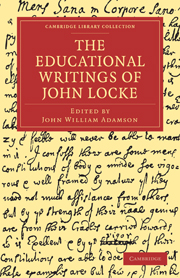
John Locke (1632–1704) is widely regarded as one of the most influential of the Enlightenment philosophers. This volume, edited by J. W. Adamson and published as a second edition in 1922, contains two of John Locke's essays concerning education; Some Thoughts Concerning Education (1693) and Of the Conduct of the Understanding (1706). Some Thoughts Concerning Education expands on Locke's pioneering theory of mind by explaining how to educate a child using three complementary methods: the development of a healthy body; the formation of a virtuous mind; and the pursuit of an academic curriculum including the emerging sciences, mathematics and languages. Of the Conduct of the Understanding continues the theme of the earlier essay by describing how to develop rational thought. For over a century after the publication of these essays, John Locke's views on education were considered authoritative, and his work was translated into almost all major European languages.
Transition from popular moral philosophy to the metaphysics of morals
If so far we have drawn our concept of duty from the common use of our practical reason, it is by no means to be inferred from this that we have treated it as an experiential concept. Rather, if we attend to our experience of the behaviour of human beings we meet frequent and, as we ourselves concede, just complaints that no reliable example can be cited of the disposition to act from pure duty; that, though much may be done that conforms with what duty commands, still it is always doubtful whether it is actually done from duty and thus has a moral worth. That is why there have been philosophers in every age who have absolutely denied the actuality of this disposition in human actions, and attributed everything to a more or less refined self-love, without however calling into doubt the correctness of the concept of morality because of this; rather, with intimate regret they made mention of the frailty and impurity of a human nature that is indeed noble enough to take an idea so worthy of respect as its prescription, but at the same time too weak to follow it, and that uses reason, which should serve it for legislation, only to take care of the interest of inclinations, whether singly or, at most, in their greatest compatibility with one another.
If people living amidst the turmoil of their practical affairs and diversions were occasionally to mix in serious moments of instructive contemplation, to which they are called by the daily display of the vanity of our intentions regarding the fate of their fellow citizens: thereby their pleasures would perhaps be less intoxicating, but their position would take up a calm serenity of the soul, by which accidents are no longer unexpected, and even the gentle melancholy, this tender feeling with which a noble heart swells up if it considers in solitary stillness the contemptibleness of that which, with us, commonly ranks as great and important, would contain more true happiness than the violent merriment of the flippant and the loud laughing of fools.
But thus the greatest crowd of human beings mixes very eagerly in the throng of those who, on the bridge that Providence has built over a piece of the abyss of eternity and that we call life, run after certain bubbles and do not trouble to take caution for the planks, who allow one after another to sink beside each other into the depths whose extent is infinity and by which they themselves, in the midst of their impetuous course, are eventually engulfed. In the portrayal of human life, a certain ancient poet brings forth a stirring breath by describing the newly born human being.
On April 22, 1764, Immanuel Kant turned 40 years old, reaching what would turn out to be the midpoint of his life. From his humble beginnings as the son of a father who was a harness maker and a mother who was a devoted Pietist, Kant had risen through school to graduate in philosophy from the University of Königsberg; and 1764 marked the year in which Kant was first offered a professorship, the highest honor of his academic guild. By the end of his life, forty years later, Kant had become the most influential philosopher in Europe. This influence was due primarily to a series of Critiques, the first of which – Kant's Critique of Pure Reason – was not published until 1781, when Kant was already 56 years old. In the wake of that “all-crushing” book, Kant developed a philosophical system to make sense of our understanding of the world and moral obligations, an a priori system within which pure reason held sway.
But in 1764 Kant was not offered a professorship in metaphysics or logic, but in rhetoric and poetry. In this year he published a short book – Observations on the Feeling of the Beautiful and the Sublime – and an essay (“Maladies”), both written in a playful and entertaining style that one would expect from a teacher of rhetoric. He also published an elegant though more analytical Inquiry Concerning the Distinctness of the Principles of Natural Theology and Morality, conceived as a potential “Prize Essay” for the Berlin Academy.
Translators of philosophical texts inevitably obscure the author's arguments. The least they can do to lift the ‘veil of translation’ is to present text and translation side by side. In this book, this is done for Kant's Grundlegung zur Metaphysik der Sitten for the first time in its English-language history. I hope that it will encourage English speakers to study the German original, and thus bridge the divide between those working on Kant's ethics in both linguistic and philosophical traditions.
As the purpose of this volume is the clear and transparent presentation of the Groundwork itself, supplementary material has been kept to a minimum. This introduction explains the principles of the edition and the translation, particularly the constitution of the German text. In addition, the book contains a full bilingual index (which can also serve as an English–German glossary), a brief critical apparatus and editorial notes that explain matters of linguistic detail. These notes rarely stray into philosophically controversial territory. They do not serve the purpose of a guide to Kant's ethical thought. Interpretative and philosophical issues are discussed in my Kant's ‘Groundwork of the Metaphysics of Morals’: A Commentary (Cambridge University Press, 2007), which in many ways complements this edition as its sister volume.
The German text on the left-hand side of the double page is taken from the second original edition of the Groundwork, published in Riga by Johann Friedrich Hartknoch in 1786.
Transition from common to philosophical moral rational cognition
It is impossible to think of anything at all in the world, or indeed even beyond it, that could be taken to be good without limitation, except a good will. Understanding, wit, judgement and whatever else the talents of the mind may be called, or confidence, resolve and persistency of intent, as qualities of temperament, are no doubt in many respects good and desirable; but they can also be extremely evil and harmful if the will that is to make use of these gifts of nature, and whose distinctive constitution is therefore called character, is not good. It is just the same with gifts of fortune. Power, riches, honour, even health, and the entire well-being and contentment with one's condition, under the name of happiness, inspire confidence and thereby quite often overconfidence as well, unless a good will is present to correct and make generally purposive their influence on the mind, and with it also the whole principle for acting; not to mention that a rational impartial spectator can nevermore take any delight in the sight of the uninterrupted prosperity of a being adorned with no feature of a pure and good will, and that a good will thus appears to constitute the indispensable condition even of the worthiness to be happy.
The simplicity and frugality of nature demands and forms only common concepts and a clumsy sincerity in human beings; artificial constraint and the luxury of a civil constitution hatches punsters and subtle reasoners, occasionally, however, also fools and swindlers, and gives birth to the wise or decent semblance by means of which one can dispense with understanding as well as integrity, if only the beautiful veil which decency spreads over the secret frailties of the head or the heart is woven close enough. Proportionately as art advances, reason and virtue will finally become the universal watchword, yet in such a way that the eagerness to speak of both can well dispense instructed and polite persons from bothering with their possession. The universal esteem which both praised properties are accorded nevertheless shows this noticeable difference that everyone is far more jealous of the advantages of the understanding than of the good properties of the will, and that in the comparison between stupidity and roguery no one would hesitate a moment to declare his preference for the latter; which is certainly well thought out because, if everything in general depends on art, fine cleverness cannot be dispensed with, but sincerity, which in such relations is only obstructive, can well be done without.
There is always a certain difficulty involved in the instruction of young people, and it is this: the knowledge one imparts to them is such that one finds oneself constrained to outstrip their years. Without waiting for their understanding to mature, one is obliged to impart knowledge to them, which, in the natural order of things, can only be understood by minds which are more practiced and experienced. It is this which is the source of the endless prejudices of the schools – prejudices which are more intractable and frequently more absurd than ordinary prejudices. And it is this, too, which is the source of that precocious prating of young thinkers, which is blinder than any other self-conceit and more incurable than ignorance. This difficulty, however, is one which cannot be entirely avoided, and the reason is this. In an epoch which is characterized by an elaborately complex social organization, a knowledge of higher things is regarded as a means to advancement and comes to be thought of as a necessity of life. Such knowledge ought by nature, however, really to be regarded merely as one of life's adornments – one of life's inessential beauties, so to speak. Nonetheless, even in this branch of instruction, it is possible to make public education more adapted to nature, even though it will not be possible to bring it into perfect harmony with it.
On the distinct objects of the feeling for the sublime and the beautiful
The different sentiments of gratification or vexation rest not so much on the constitution of the external things that arouse them as on the feeling, intrinsic to every person, of being touched by them with pleasure or displeasure. Hence arise the joys for some people in what is disgusting to others, the passion of a lover that is often a mystery to everyone else, or even the lively repugnance that one person feels in that which is completely indifferent to another. The field for observations of these peculiarities of human nature is very extensive and still conceals a rich lode for discoveries that are as charming as they are instructive. For now I will cast my glance only on several places that seem especially to stand out in this region, and even on these more with the eye of an observer than of the philosopher.
Since a human being finds himself happy only insofar as he satisfies an inclination, the feeling that makes him capable of enjoying a great gratification without requiring exceptional talents is certainly no small matter. Stout persons, whose most inspired author is their cook, and whose works of fine taste are to be found in their cellar, get just as lively a joy from vulgarities and a crude joke as that of which persons of nobler sentiment are so proud.
Being an answer to the question proposed for consideration by the Berlin Royal Academy of Sciences for the year 1763
Verum animo satis haec vestigia parva sagaci
Sunt, per quae possis cognoscere caetera tute
Introduction
The question proposed for consideration is such that, if it is appropriately answered, higher philosophy must as a result acquire a determine form. If the method for attaining the highest possible degree of certainty in this type of cognition has been established, and if the nature of this kind of conviction has been properly understood, then the following effect will be produced: the endless instability of opinions and scholarly sects will be replaced by an immutable rule which will govern didactic method and unite reflective minds in a single effort. It was in this way that, in natural science, Newton's method transformed the chaos of physical hypotheses into a secure procedure based on experience and geometry. But what method is this treatise itself to adopt, granted that it is a treatise in which metaphysics is to be shown the true degree of certainty to which it may aspire, as well as the path by which the certainty may be attained? If what is presented in this treatise is itself metaphysics, then the judgment of the treatise will be no more certain than has been that science which hopes to benefit from our inquiry by acquiring some permanence and stability; and then all our efforts will have been in vain.