Refine search
Actions for selected content:
28354 results in Astrophysics
Chemical and dynamical analysis of Open Clusters from OCCASO data. The case of NGC 6705
-
- Journal:
- Proceedings of the International Astronomical Union / Volume 13 / Issue S334 / July 2017
- Published online by Cambridge University Press:
- 02 August 2018, pp. 124-127
- Print publication:
- July 2017
-
- Article
-
- You have access
- Export citation
Star formation history and dynamical evolution of the solar neighbourhood
-
- Journal:
- Proceedings of the International Astronomical Union / Volume 13 / Issue S334 / July 2017
- Published online by Cambridge University Press:
- 02 August 2018, pp. 310-311
- Print publication:
- July 2017
-
- Article
-
- You have access
- Export citation
Dynamical Monte Carlo Simulations of 3-D Galactic Systems in Axisymmetric and Triaxial Potentials
-
- Journal:
- Publications of the Astronomical Society of Australia / Volume 34 / 2017
- Published online by Cambridge University Press:
- 13 June 2017, e024
-
- Article
-
- You have access
- HTML
- Export citation
An All-Sky Portable (ASP) Optical Catalogue
-
- Journal:
- Publications of the Astronomical Society of Australia / Volume 34 / 2017
- Published online by Cambridge University Press:
- 13 June 2017, e025
-
- Article
-
- You have access
- HTML
- Export citation
Collaborative Workspaces to Accelerate Discovery
-
- Journal:
- Publications of the Astronomical Society of Australia / Volume 34 / 2017
- Published online by Cambridge University Press:
- 09 May 2017, e023
-
- Article
-
- You have access
- HTML
- Export citation
Physical Properties of the First Quasars
- Part of
-
- Journal:
- Publications of the Astronomical Society of Australia / Volume 34 / 2017
- Published online by Cambridge University Press:
- 09 May 2017, e022
-
- Article
-
- You have access
- HTML
- Export citation
On the Dichotomy between Normal and Dwarf Ellipticals
-
- Journal:
- Publications of the Astronomical Society of Australia / Volume 34 / 2017
- Published online by Cambridge University Press:
- 02 May 2017, e016
-
- Article
-
- You have access
- HTML
- Export citation
-
Using images from the SDSS DR13 library, we examine the structural properties of 374 bright (classed E0 to E6) and dwarf ellipticals [classed dE(nN) to dE(N)]. The sample combines a multicolour sample of bright ellipticals (252 galaxies with $M_{\text{g}} < -20$ ) with a new sample of faint ellipticals (60 galaxies with $M_{\text{g}} > -20$ ) which overlaps the dwarf elliptical sample (62 galaxies) in luminosity and size. The faint ellipticals extend the linear structural correlations found for bright ellipticals into parameter space not occupied by dwarf ellipticals indicating a dichotomy exists between the two types. In particular, many faint ellipticals have significantly higher effective surface brightnesses compared to dwarf ellipticals which eliminates any connection at a set stellar mass. Template analysis of the three subsets of ellipticals demonstrates that the bright and faint ellipticals follow the same trends of profile shape (weak homology), but that dwarf ellipticals form a separate and distinct structural class with lower central surface brightnesses and extended isophotal radii.


Low-Frequency Spectral Energy Distributions of Radio Pulsars Detected with the Murchison Widefield Array
- Part of
-
- Journal:
- Publications of the Astronomical Society of Australia / Volume 34 / 2017
- Published online by Cambridge University Press:
- 26 April 2017, e020
-
- Article
-
- You have access
- HTML
- Export citation
PKS 1954–388: RadioAstron Detection on 80,000 km Baselines and Multiwavelength Observations
-
- Journal:
- Publications of the Astronomical Society of Australia / Volume 34 / 2017
- Published online by Cambridge University Press:
- 26 April 2017, e021
-
- Article
-
- You have access
- HTML
- Export citation
Thermonuclear Burst Observations for Model Comparisons: A Reference Sample
-
- Journal:
- Publications of the Astronomical Society of Australia / Volume 34 / 2017
- Published online by Cambridge University Press:
- 19 April 2017, e019
-
- Article
-
- You have access
- HTML
- Export citation
Scattering Polarisation of the d-States of Ions and Solar Magnetic Field: Effects of Isotropic Collisions
-
- Journal:
- Publications of the Astronomical Society of Australia / Volume 34 / 2017
- Published online by Cambridge University Press:
- 17 April 2017, e018
-
- Article
-
- You have access
- HTML
- Export citation
KIC 7385478: An Eclipsing Binary with a γ Doradus Component
-
- Journal:
- Publications of the Astronomical Society of Australia / Volume 34 / 2017
- Published online by Cambridge University Press:
- 09 April 2017, e017
-
- Article
-
- You have access
- HTML
- Export citation
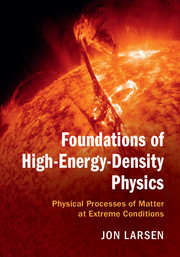
Foundations of High-Energy-Density Physics
- Physical Processes of Matter at Extreme Conditions
-
- Published online:
- 06 April 2017
- Print publication:
- 10 March 2017
The Influence of Forming Companions on the Spectral Energy Distributions of Stars with Circumstellar Discs
- Part of
-
- Journal:
- Publications of the Astronomical Society of Australia / Volume 34 / 2017
- Published online by Cambridge University Press:
- 05 April 2017, e015
-
- Article
-
- You have access
- HTML
- Export citation
Clarification of the formation process of the super massive black hole by Infrared astrometric satellite, Small-JASMINE
-
- Journal:
- Proceedings of the International Astronomical Union / Volume 12 / Issue S330 / April 2017
- Published online by Cambridge University Press:
- 07 March 2018, pp. 360-361
- Print publication:
- April 2017
-
- Article
-
- You have access
- Export citation
The relation between velocity dispersions and chemical abundances in RAVE giants
-
- Journal:
- Proceedings of the International Astronomical Union / Volume 12 / Issue S330 / April 2017
- Published online by Cambridge University Press:
- 07 March 2018, pp. 259-260
- Print publication:
- April 2017
-
- Article
-
- You have access
- Export citation
Characterisation of exoplanet host stars: A window into planet formation
-
- Journal:
- Proceedings of the International Astronomical Union / Volume 12 / Issue S330 / April 2017
- Published online by Cambridge University Press:
- 07 March 2018, pp. 369-376
- Print publication:
- April 2017
-
- Article
-
- You have access
- Export citation
Finding the stars that reionized the Universe
-
- Journal:
- Proceedings of the International Astronomical Union / Volume 12 / Issue S330 / April 2017
- Published online by Cambridge University Press:
- 07 March 2018, pp. 253-254
- Print publication:
- April 2017
-
- Article
-
- You have access
- Export citation
Modelling the Milky Way with Gaia-TGAS
-
- Journal:
- Proceedings of the International Astronomical Union / Volume 12 / Issue S330 / April 2017
- Published online by Cambridge University Press:
- 07 March 2018, pp. 222-224
- Print publication:
- April 2017
-
- Article
-
- You have access
- Export citation
Self-consistent Modelling of the Milky Way using Gaia data
-
- Journal:
- Proceedings of the International Astronomical Union / Volume 12 / Issue S330 / April 2017
- Published online by Cambridge University Press:
- 07 March 2018, pp. 152-155
- Print publication:
- April 2017
-
- Article
-
- You have access
- Export citation
