Refine search
Actions for selected content:
238153 results in Physics and Astronomy
18 - Quantum-like Modeling in Biology, Cognition, and Decision Making
- from Part VI - Further Developments
-
- Book:
- Contextual Reinterpretation of Quantum Nonlocality
- Published online:
- 28 November 2024
- Print publication:
- 05 December 2024, pp 262-276
-
- Chapter
- Export citation
Appendix J - Numerical Values of Relevant Astronomical Parameters
-
- Book:
- General Post-Newtonian Orbital Effects
- Published online:
- 28 November 2024
- Print publication:
- 05 December 2024, pp 214-216
-
- Chapter
- Export citation
10 - Modified Models of Gravity: Orbital Precessions
-
- Book:
- General Post-Newtonian Orbital Effects
- Published online:
- 28 November 2024
- Print publication:
- 05 December 2024, pp 165-176
-
- Chapter
- Export citation
Dedication
-
- Book:
- General Post-Newtonian Orbital Effects
- Published online:
- 28 November 2024
- Print publication:
- 05 December 2024, pp v-vi
-
- Chapter
- Export citation
6 - 1pN Gravitomagnetic Effects: Spin Octupole
-
- Book:
- General Post-Newtonian Orbital Effects
- Published online:
- 28 November 2024
- Print publication:
- 05 December 2024, pp 119-122
-
- Chapter
- Export citation
Atomic molecular dynamics simulation advances of de novo-designed proteins
-
- Journal:
- Quarterly Reviews of Biophysics / Volume 57 / 2024
- Published online by Cambridge University Press:
- 05 December 2024, e14
-
- Article
- Export citation
Part IV - Contextual Entanglement in Quantum and Classical Physics
-
- Book:
- Contextual Reinterpretation of Quantum Nonlocality
- Published online:
- 28 November 2024
- Print publication:
- 05 December 2024, pp 147-148
-
- Chapter
- Export citation
Frontmatter
-
- Book:
- General Post-Newtonian Orbital Effects
- Published online:
- 28 November 2024
- Print publication:
- 05 December 2024, pp i-iv
-
- Chapter
- Export citation
Part VI - Futures
-
- Book:
- From Stars to Life
- Published online:
- 22 November 2024
- Print publication:
- 05 December 2024, pp 339-340
-
- Chapter
- Export citation
14 - Technosignatures
- from Part V - Detecting Life
-
- Book:
- From Stars to Life
- Published online:
- 22 November 2024
- Print publication:
- 05 December 2024, pp 317-338
-
- Chapter
- Export citation
3 - 1pN Gravitoelectric Effects: Mass Monopole(s)
-
- Book:
- General Post-Newtonian Orbital Effects
- Published online:
- 28 November 2024
- Print publication:
- 05 December 2024, pp 54-72
-
- Chapter
- Export citation
10 - Contextual Approach to Probability and Measurement
- from Part III - Contextuality: Mathematical Modeling and Interpretation
-
- Book:
- Contextual Reinterpretation of Quantum Nonlocality
- Published online:
- 28 November 2024
- Print publication:
- 05 December 2024, pp 107-126
-
- Chapter
- Export citation
2 - Two Faces of Quantum Nonlocality and Two Interpretations of Quantum State
- from Part I - Quantum Foundations
-
- Book:
- Contextual Reinterpretation of Quantum Nonlocality
- Published online:
- 28 November 2024
- Print publication:
- 05 December 2024, pp 13-34
-
- Chapter
- Export citation
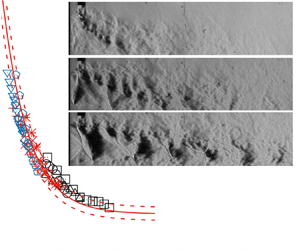
Parametric study and scaling of a minijet-manipulated supersonic jet
-
- Journal:
- Journal of Fluid Mechanics / Volume 1001 / 25 December 2024
- Published online by Cambridge University Press:
- 05 December 2024, A2
-
- Article
- Export citation
-
This work aims to perform a parametric study on a round supersonic jet with a design Mach number Md = 1.8, which is manipulated using a single steady radial minijet with a view to enhancing its mixing. Four control parameters are examined, i.e. the mass flow rate ratio Cm and diameter ratio d/D of the minijet to main jet, and exit pressure ratio Pe/Pa and fully expanded jet Mach number Mj, where Pe and Pa are the nozzle exit and atmospheric pressures, respectively. Extensive pressure and schlieren flow visualization measurements are conducted on the natural and manipulated jets. The supersonic jet core length Lc/D exhibits a strong dependence on the four control parameters. Careful scaling analysis of experimental data reveals that Lc/D = f1(Cm, d/D, Pe/Pa, Mj) may be reduced to Lc/D = f2(ξ), where f1 and f2 are different functions. The scaling factor $\xi = J({d_i}/{D_j})/(\gamma M_j^2{P_e}/{P_a})$ is physically the penetration depth of the minijet into the main jet, where $J({d_i}/{D_j})$ is the square root of the momentum ratio of the minijet to main jet (di and Dj are the fully expanded diameters of d and D, respectively), γ is the specific heat ratio and $\gamma M_j^2{P_e}/{P_a}$ is the non-dimensional exit pressure ratio. Important physical insight may be gained from this scaling law into the optimal choice of control parameters such as d/D and Pe/Pa for practical applications. It has been found for the first time that the minijet may induce a street of quasi-periodical coherent structures once Cm exceeds a certain level for a given ${P_e}/{P_a}$. Its predominant dimensionless frequency Ste (≡ feDj/Uj) scales with a factor $\zeta = J({d_i}/{D_j})\; \sqrt {\gamma M_j^2{P_e}/{P_a}} $, which is physically the ratio of the minijet momentum thrust to the ambient pressure thrust. The formation mechanism of the street and its role in enhancing jet mixing are also discussed.


Part I - Astronomical Origins
-
- Book:
- From Stars to Life
- Published online:
- 22 November 2024
- Print publication:
- 05 December 2024, pp 1-2
-
- Chapter
- Export citation
Index
-
- Book:
- Contextual Reinterpretation of Quantum Nonlocality
- Published online:
- 28 November 2024
- Print publication:
- 05 December 2024, pp 303-306
-
- Chapter
- Export citation
Part VI - Further Developments
-
- Book:
- Contextual Reinterpretation of Quantum Nonlocality
- Published online:
- 28 November 2024
- Print publication:
- 05 December 2024, pp 251-252
-
- Chapter
- Export citation
8 - Continuous Habitability
- from Part III - Habitability
-
- Book:
- From Stars to Life
- Published online:
- 22 November 2024
- Print publication:
- 05 December 2024, pp 173-200
-
- Chapter
- Export citation
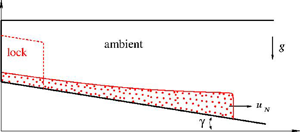
On the initial down-slope propagation of a lock-release particle-driven gravity current: shallow-water predictions and comparisons with previously published data
-
- Journal:
- Journal of Fluid Mechanics / Volume 1000 / 10 December 2024
- Published online by Cambridge University Press:
- 05 December 2024, A97
-
- Article
-
- You have access
- Open access
- HTML
- Export citation
-
We consider the initial ‘slumping phase’ of a lock-release gravity current (GC) on a down slope with focus on particle-driven (turbidity) flows, in the inertia–buoyancy (large Reynolds number) and Boussinesq regime. We use a two-layer shallow-water (SW) model for the depth-averaged variables, and compare the predictions with previously published experimental data. In particular, we analyse the empirical conclusion of Gadal et al. (J. Fluid Mech., vol. 974, 2023, A4) that the slumping displays a constant speed for a significant range of slopes and particle-sedimentation speeds. We emphasize the physical definition of the slumping phase (stage): the adjustment process during which (a) the fluid in the lock is set into motion by the dam break, then (b) forms a tail from the backwall to the nose. We focus on the question of if and when the propagation speed $u_N$ of the nose (front) of the GC is constant during this process (there is consensus that a significant deceleration of $u_N$ appears in the post-slumping stage.) The SW theory predicts correctly the adjustment of the flow field during the slumping stage, but indicates that a constant $u_N$ appears only for the classical case ( $\gamma =E=c_D=\beta =0$) where $\gamma, E, c_D, \beta$ are the slope, entrainment and drag coefficients, and the scaled particle settling speed for a particle-driven GC. However, since $\gamma, E, c_D, \beta$ are typically small, the change of $u_N$ during the slumping phase is also small in many cases of interest. The interaction between the various driving and hindering mechanisms is elucidated. We show that, in a system with a horizontal (open) top (typical laboratory experiments), the height of the ambient increases along the slope, and this compensates for buoyancy loss due to particle sedimentation. We point out the need for further experimental and simulation studies for a better understanding of the slumping phase and transition to the next phases, and further assessment/improvement of the SW predictions.


5 - Quantum Postulate as the Seed of the Complementarity Principle
- from Part I - Quantum Foundations
-
- Book:
- Contextual Reinterpretation of Quantum Nonlocality
- Published online:
- 28 November 2024
- Print publication:
- 05 December 2024, pp 52-56
-
- Chapter
- Export citation
