Refine search
Actions for selected content:
238152 results in Physics and Astronomy
Appendix H - The Coefficients of the Tidal Orbital Precessions
-
- Book:
- General Post-Newtonian Orbital Effects
- Published online:
- 28 November 2024
- Print publication:
- 05 December 2024, pp 207-211
-
- Chapter
- Export citation
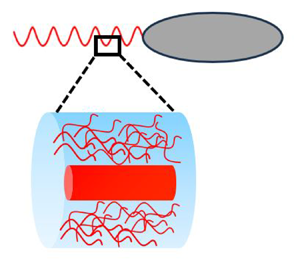
A swimming bacterium in a two-fluid model of a polymer solution
-
- Journal:
- Journal of Fluid Mechanics / Volume 1001 / 25 December 2024
- Published online by Cambridge University Press:
- 05 December 2024, A8
-
- Article
-
- You have access
- Open access
- HTML
- Export citation
-
We analyse the motion of a flagellated bacterium in a two-fluid medium using slender body theory. The two-fluid model is useful for describing a body moving through a complex fluid with a microstructure whose length scale is comparable to the characteristic scale of the body. This is true for bacterial motion in biological fluids (entangled polymer solutions), where the entanglement results in a porous microstructure with typical pore diameters comparable to or larger than the flagellar bundle diameter, but smaller than the diameter of the bacterial head. Thus, the polymer and solvent satisfy different boundary conditions on the flagellar bundle and move with different velocities close to it. This gives rise to a screening length $L_B$ within which the fluids exchange momentum and the relative velocity between the two fluids decays. In this work, both the solvent and polymer of the two-fluid medium are modelled as Newtonian fluids with different viscosities $\mu _s$ and $\mu _p$ (viscosity ratio $\lambda = \mu _p/\mu _s$), thereby capturing the effects solely introduced by the microstructure of the complex fluid. From our calculations, we observe an increased drag anisotropy for a rigid, slender flagellar bundle moving through this two-fluid medium, resulting in an enhanced swimming velocity of the organism. The results are sensitive to the interaction between the bundle and the polymer, and we discuss two physical scenarios corresponding to two types of interaction. Our model provides an explanation for the experimentally observed enhancement of swimming velocity of bacteria in entangled polymer solutions and motivates further experimental investigations.


12 - Detecting and Characterising Exoplanets
- from Part IV - Astrobiological Targets
-
- Book:
- From Stars to Life
- Published online:
- 22 November 2024
- Print publication:
- 05 December 2024, pp 266-290
-
- Chapter
- Export citation
Part II - Earth
-
- Book:
- From Stars to Life
- Published online:
- 22 November 2024
- Print publication:
- 05 December 2024, pp 73-74
-
- Chapter
- Export citation
1 - Introduction to Quantum Measurement Theory
-
- Book:
- Contextual Reinterpretation of Quantum Nonlocality
- Published online:
- 28 November 2024
- Print publication:
- 05 December 2024, pp 1-10
-
- Chapter
- Export citation
9 - pK Tidal Effects: Distant 3rd Body
-
- Book:
- General Post-Newtonian Orbital Effects
- Published online:
- 28 November 2024
- Print publication:
- 05 December 2024, pp 155-164
-
- Chapter
- Export citation
Contents
-
- Book:
- General Post-Newtonian Orbital Effects
- Published online:
- 28 November 2024
- Print publication:
- 05 December 2024, pp vii-xii
-
- Chapter
- Export citation
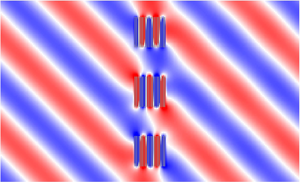
Wave scattering by plate array metacylinders of arbitrary cross-section
-
- Journal:
- Journal of Fluid Mechanics / Volume 1001 / 25 December 2024
- Published online by Cambridge University Press:
- 05 December 2024, A6
-
- Article
-
- You have access
- Open access
- HTML
- Export citation
Part III - Habitability
-
- Book:
- From Stars to Life
- Published online:
- 22 November 2024
- Print publication:
- 05 December 2024, pp 145-146
-
- Chapter
- Export citation
References
-
- Book:
- From Stars to Life
- Published online:
- 22 November 2024
- Print publication:
- 05 December 2024, pp 353-391
-
- Chapter
- Export citation
2 - From the Big Bang to Molecules
- from Part I - Astronomical Origins
-
- Book:
- From Stars to Life
- Published online:
- 22 November 2024
- Print publication:
- 05 December 2024, pp 13-36
-
- Chapter
- Export citation
Frontmatter
-
- Book:
- From Stars to Life
- Published online:
- 22 November 2024
- Print publication:
- 05 December 2024, pp i-iv
-
- Chapter
- Export citation
Appendix B - Notations and Definitions
-
- Book:
- General Post-Newtonian Orbital Effects
- Published online:
- 28 November 2024
- Print publication:
- 05 December 2024, pp 180-189
-
- Chapter
- Export citation
Appendix A - List of Acronyms and Abbreviations
-
- Book:
- General Post-Newtonian Orbital Effects
- Published online:
- 28 November 2024
- Print publication:
- 05 December 2024, pp 177-179
-
- Chapter
- Export citation
6 - Co-evolution of Life and Environment on Earth
- from Part II - Earth
-
- Book:
- From Stars to Life
- Published online:
- 22 November 2024
- Print publication:
- 05 December 2024, pp 122-144
-
- Chapter
- Export citation
11 - ‘Exotic’ Life
- from Part IV - Astrobiological Targets
-
- Book:
- From Stars to Life
- Published online:
- 22 November 2024
- Print publication:
- 05 December 2024, pp 246-265
-
- Chapter
- Export citation
5 - 1pN Gravitomagnetic Effects: Spin Dipole(s)
-
- Book:
- General Post-Newtonian Orbital Effects
- Published online:
- 28 November 2024
- Print publication:
- 05 December 2024, pp 84-118
-
- Chapter
- Export citation
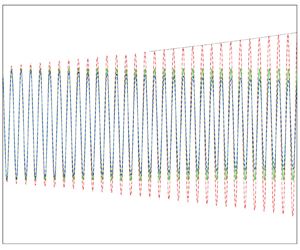
Analysis and lattice Boltzmann simulation of thermoacoustic instability in a Rijke tube
-
- Journal:
- Journal of Fluid Mechanics / Volume 1000 / 10 December 2024
- Published online by Cambridge University Press:
- 05 December 2024, A92
-
- Article
- Export citation
Appendix G - Coefficients of the Total Mixed Net Orbital Shifts of the Order of J2/c2
-
- Book:
- General Post-Newtonian Orbital Effects
- Published online:
- 28 November 2024
- Print publication:
- 05 December 2024, pp 203-206
-
- Chapter
- Export citation
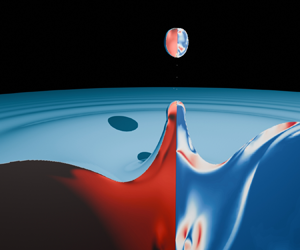
Bursting bubble in an elastoviscoplastic medium
-
- Journal:
- Journal of Fluid Mechanics / Volume 1001 / 25 December 2024
- Published online by Cambridge University Press:
- 05 December 2024, A9
-
- Article
-
- You have access
- Open access
- HTML
- Export citation
-
A gas bubble sitting at a liquid–gas interface can burst following the rupture of the thin liquid film separating it from the ambient, owing to the large surface energy of the resultant cavity. This bursting bubble forms capillary waves, a Worthington jet and subsequent droplets for a Newtonian liquid medium. However, rheological properties of the liquid medium like elastoviscoplasticity can greatly affect these dynamics. Using direct numerical simulations, this study exemplifies how the complex interplay between elasticity (in terms of elastic stress relaxation) and yield stress influences the transient interfacial phenomenon of bursting bubbles. We investigate how bursting dynamics depends on capillary, elastic and yield stresses by exploring the parameter space of the Deborah number ${{\textit {De}}}$ (dimensionless relaxation time of elastic stresses) and the plastocapillary number $\mathcal {J}$ (dimensionless yield-stress of the medium), delineating four distinct characteristic behaviours. Overall, we observe a non-monotonic effect of elastic stress relaxation on the jet development while plasticity of the elastoviscoplastic (EVP) medium is shown to affect primarily the jet evolution only at faster relaxation times (low ${{\textit {De}}}$). The role of elastic stresses on jet development is elucidated with the support of energy budgets identifying different modes of energy transfer within the EVP medium. The effects of elasticity on the initial progression of capillary waves and droplet formation are also studied. In passing, we study the effects of solvent–polymer viscosity ratio on bursting dynamics and show that polymer viscosity can increase the jet thickness apart from reducing the maximum height of the jet.


