Refine search
Actions for selected content:
238160 results in Physics and Astronomy
1 - The Foundations of Astrobiology
- from Part I - Astronomical Origins
-
- Book:
- From Stars to Life
- Published online:
- 22 November 2024
- Print publication:
- 05 December 2024, pp 3-12
-
- Chapter
- Export citation
3 - Planet Formation and Migration
- from Part I - Astronomical Origins
-
- Book:
- From Stars to Life
- Published online:
- 22 November 2024
- Print publication:
- 05 December 2024, pp 37-72
-
- Chapter
- Export citation
Strategy for mitigation of systematics for EoR experiments with the Murchison Widefield Array
-
- Journal:
- Publications of the Astronomical Society of Australia / Volume 41 / 2024
- Published online by Cambridge University Press:
- 04 December 2024, e095
-
- Article
- Export citation
Semi-empirical calibration of the oxygen abundance for LINER galaxies based on SDSS-IV MaNGA – The case for strong and weak AGN
-
- Journal:
- Publications of the Astronomical Society of Australia / Volume 41 / 2024
- Published online by Cambridge University Press:
- 04 December 2024, e099
-
- Article
- Export citation
-
In this paper, we present a semi-empirical calibration between the oxygen abundance and the N2 emission-line ratio for low ionisation nuclear emission regions (LINERs). This relation was derived by comparing the optical spectroscopic data of 118 nuclear spaxels classified as LINERs using three different BPT diagrams from the Mapping Nearby Galaxies survey (MaNGA) and sub-classified as weak (wAGN, 84 objects) and strong (sAGN, 34 objects) active galactic nucleus (AGN) from the WHAN diagnostic diagram and photoionisation model results obtained with the cloudy code assuming gas accretion into a black hole (representing an AGN). We found that our wAGN LINERs exhibit an oxygen abundance in the range of $8.50 \lesssim \mathrm{12+\log(O/H)} \lesssim 8.90 $, with an average value of $\mathrm{12+\log(O/H)}=8.68$, while our sAGN LINERs exhibit an oxygen abundance in the range of $8.51 \lesssim \: \mathrm{12+\log(O/H)} \: \lesssim \: 8.81 $, with an average value of $\mathrm{12+\log(O/H)}=8.65$. Our abundance estimations are in good agreement with those derived for another two different samples one of them with 463 Seyfert 2 objects and the other with 43 LINERs galaxies ionised by post-AGB stars, showing that the assumptions of our models are likely suitable for wAGN and sAGN LINERs. A relation between the equivalent width of the observed H $\alpha$ emission-line and the estimated ionisation parameter provided by models was obtained. Our results also suggest that LINERs does not show a clear correlation between oxygen abundances and the stellar mass of the hosting galaxies.


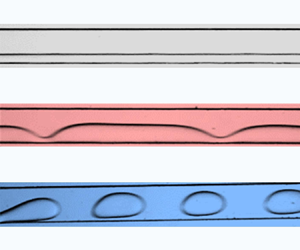
Interfacial instability in a viscoelastic microfluidic coflow system
-
- Journal:
- Journal of Fluid Mechanics / Volume 1000 / 10 December 2024
- Published online by Cambridge University Press:
- 04 December 2024, A96
-
- Article
- Export citation
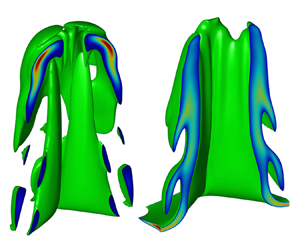
Self-generated magnetic field in three-dimensional ablative Rayleigh–Taylor instability
-
- Journal:
- Journal of Fluid Mechanics / Volume 1000 / 10 December 2024
- Published online by Cambridge University Press:
- 04 December 2024, A94
-
- Article
- Export citation
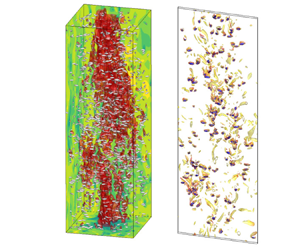
Prolate spheroids settling in a quiescent fluid: clustering, microstructures and collisions
-
- Journal:
- Journal of Fluid Mechanics / Volume 1000 / 10 December 2024
- Published online by Cambridge University Press:
- 04 December 2024, A49
-
- Article
- Export citation
-
In this study we investigate the sedimentation of prolate spheroids in a quiescent fluid by means of the particle-resolved direct numerical simulation. With the increase of the particle volume fraction $\phi$ from $0.1\,\%$ to $10\,\%$, we observe a non-monotonic variation of the mean settling velocity of particles, $\langle V_s \rangle$. By virtue of the Voronoi analysis, we find that the degree of particle clustering is highest when $\langle V_s \rangle$ reaches the local maximum at $\phi =1\,\%$. Under the swarm effect, clustered particles are found to preferentially sample downward fluid flows in the wake regions, leading to the enhancement of the settling speed. As for lower or higher volume fractions, the tendency of particle clustering and the preferential sampling of downward flows are attenuated. The hindrance effect becomes predominant when the volume fraction exceeds 5 % and reduces $\langle V_s \rangle$ to less than the isolated settling velocity. Particle orientation plays a minor role in the mean settling velocity, although individual prolate particles still tend to settle faster in suspensions when they deviate more from the broad-side-on alignment. Moreover, we also demonstrate that particles are prone to form column-like microstructures in dilute suspensions under the effect of wake-induced hydrodynamic attractions. The radial distribution function is higher at a lower volume fraction. As a result, the collision rate scaled by the particle number density decreases with the increasing volume fraction. By contrast, as another contribution to the particle collision rate, the relative radial velocity for nearby particles shows a minor degree of variation due to the lubrication effect.


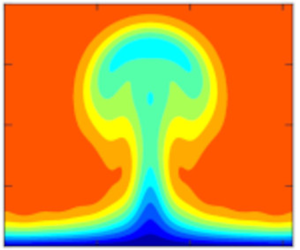
Excitation and stability of nonlinear compressible Görtler vortices and streaks induced by free-stream vortical disturbances
-
- Journal:
- Journal of Fluid Mechanics / Volume 1000 / 10 December 2024
- Published online by Cambridge University Press:
- 04 December 2024, A93
-
- Article
- Export citation
FLM volume 998 Cover and Front matter
-
- Journal:
- Journal of Fluid Mechanics / Volume 998 / 10 November 2024
- Published online by Cambridge University Press:
- 03 December 2024, p. f1
-
- Article
-
- You have access
- Export citation
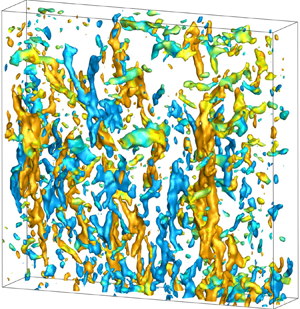
Coherent turbulent structures in a rapid contraction
-
- Journal:
- Journal of Fluid Mechanics / Volume 1000 / 10 December 2024
- Published online by Cambridge University Press:
- 03 December 2024, A63
-
- Article
-
- You have access
- Open access
- HTML
- Export citation
-
The coherent vortical structures in turbulent flow through a strong 16 : 1 three-dimensional contraction are studied using time-resolved volumetric measurements. Visualization using the vorticity magnitude criterion shows the emergence of long, stretched cylindrical vortices aligned with the mean flow. This alignment is quantified by probability density functions (p.d.f.s) of the direction cosines. We propose two measures to quantify the alignment, the peak height in the probability and a coefficient from the moment of the p.d.f., both of which reaffirm the strong streamwise alignment. The root mean square streamwise vorticity grows within the contraction to become 4.5 times larger than the transverse component, at the downstream location where the contraction ratio is $C=11$. The characteristic vortices become as long as the measurement volume, or more than 4 times the integral scale at the entrance to the contraction. We also characterize the vorticity enhancement along individual vortices, measuring 65 % strengthening over the distance where $C$ goes from 4 to 11. The prevalence of these coherent structures is estimated from 700 000 measured volumes, showing that near the outlet, it is more likely to have one or two of these structures present than none.


An asymptotic Grad–Shafranov equation for quasisymmetric stellarators
-
- Journal:
- Journal of Plasma Physics / Volume 90 / Issue 6 / December 2024
- Published online by Cambridge University Press:
- 03 December 2024, 905900608
-
- Article
-
- You have access
- Open access
- HTML
- Export citation
-
A first-order model is derived for quasisymmetric stellarators where the vacuum field due to coils is dominant, but plasma-current-induced terms are not negligible and can contribute to magnetic differential equations, with $\beta$
 of the order of the ratio induced to vacuum fields. Under these assumptions, it is proven that the aspect ratio must be large and a simple expression can be obtained for the lowest-order vacuum field. The first-order correction, which involves both vacuum and current-driven fields, is governed by a Grad–Shafranov equation and the requirement that flux surfaces exist. These two equations are not always consistent, and so this model is generally overconstrained, but special solutions exist that satisfy both equations simultaneously. One family of such solutions is the set of first-order near-axis solutions. Thus, the first-order near-axis model is a subset of the model presented here. Several other solutions outside the scope of the near-axis model are also found. A case study comparing one such solution to a VMEC-generated solution shows good agreement.

Test particle acceleration in resistive torsional spine magnetic reconnection using laboratory plasma parameters
-
- Journal:
- Journal of Plasma Physics / Volume 90 / Issue 6 / December 2024
- Published online by Cambridge University Press:
- 03 December 2024, 905900609
-
- Article
- Export citation
-
Magnetic reconnection is a basic particle acceleration mechanism in laboratory and astrophysical plasmas. Two-dimensional models have been critical to understanding the onset of reconnection in laboratory experiments, but are fundamentally limited in diagnosing ion acceleration along open magnetic field lines. These shortcomings have opened the way to three-dimensional (3-D) models of torsional reconnection, where localized rotational perturbations to a fan-spine magnetic null point topology have demonstrated bulk particle acceleration along open magnetic field lines. Previous computational studies of the torsional fan reconnection mode using both solar and laboratory parameters demonstrated collimated jet formation and acceleration along the spine axis, wherein the bulk particle final kinetic energy spectra were shown to fall within a relatively narrow range (${\sim }2$
 keV). This paper introduces typical laboratory plasma parameters in the torsional spine mode of 3-D reconnection models to diagnose its efficacy in inducing rapid ion acceleration. Using laboratory-scale length helium plasma parameters typical of capacitive discharges (singly ionized helium), we solve for relativistic particle trajectories using solutions to the steady-state, resistive, kinematic magnetohydrodynamic equations in the fan-spine topology. We find that particle acceleration at the reconnection site is highly dependent on the injection radius, and the peak accelerated particles ($\approx$
 3 keV) are trapped about the magnetic null point. While a jet is formed by ions injected close to the peak fan plane perturbation radius, their final ion kinetic energies are an order of magnitude lower ($\approx$
 0.3 keV) than the mirrored particles. Analysing the time dependence of their limited representative energy spectra shows the torsional spine mode particles follow an evolution much different than the narrow spectra of the torsional fan mode. These results have implications for diagnostic expectations of future laboratory plasma experiments designed to induce the torsional spine reconnection mode.


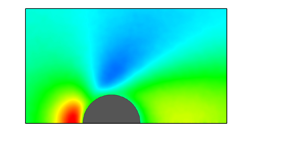
Aerothermodynamics of a sphere in a monatomic gas based on ab initio interatomic potentials over a wide range of gas rarefaction: subsonic flows
-
- Journal:
- Journal of Fluid Mechanics / Volume 1000 / 10 December 2024
- Published online by Cambridge University Press:
- 03 December 2024, A78
-
- Article
- Export citation
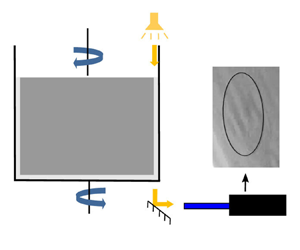
Microrheometric study of damage and rupture of capsules in simple shear flow
-
- Journal:
- Journal of Fluid Mechanics / Volume 1000 / 10 December 2024
- Published online by Cambridge University Press:
- 03 December 2024, R4
-
- Article
-
- You have access
- Open access
- HTML
- Export citation
Investigating unusual Hα features towards the Scutum Supershell
-
- Journal:
- Publications of the Astronomical Society of Australia / Volume 41 / 2024
- Published online by Cambridge University Press:
- 03 December 2024, e098
-
- Article
-
- You have access
- Open access
- HTML
- Export citation
-
We investigate the unusual H $\alpha$ features found towards the Scutum Supershell via recent arc-minute and arc-second resolution imaging. These multi-degree features resemble a long central spine ending in a bow-shock morphology. We performed a multi–wavelength study in [S II] optical, radio continuum, infrared continuum, Hi, CO, X-ray, and gamma-ray emissions. Interestingly, we found the Galactic worm GW 16.9−3.8 Hi feature appears within the Scutum Supershell, and likely influences the spine morphology. Furthermore, the rightmost edge of the bow-shock H $\alpha$ emission overlaps with [S II] line emission, 4.85 GHz radio, and both 60 and 100 $\mu$m infrared continuum emissions, suggesting some potential for excitation by shock heating. We estimated the photo-ionisation from O-type and B-type stars in the region (including those from the OB associations Ser OB1B, Ser OB2, and Sct OB3) and found that this mechanism could supply the excitation to account for the observed H $\alpha$ luminosity of the spine and bow-shock of $\sim$1–2 $\times 10^{36}\,\mathrm{erg\,s}^{-1}$ (d/2.5 kpc) $^2$. Recent MHD simulations by Drozdov et al. (2022) demonstrate the potential for supernova events to drive outflow and bow-shock types of features of the same energetic nature and physical scale as the H $\alpha$ emission we observe here. While this clearly requires many supernova events over time, we speculate that one contributing event could have come from the presumably energetic supernova (hypernova) birth of the magnetar tentatively identified in the X-ray binary LS 5039.


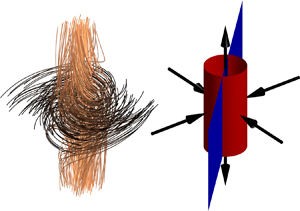
Velocity gradient partitioning in turbulent flows
-
- Journal:
- Journal of Fluid Mechanics / Volume 1000 / 10 December 2024
- Published online by Cambridge University Press:
- 03 December 2024, R5
-
- Article
-
- You have access
- HTML
- Export citation
FLM volume 999 Cover and Front matter
-
- Journal:
- Journal of Fluid Mechanics / Volume 999 / 25 November 2024
- Published online by Cambridge University Press:
- 03 December 2024, p. f1
-
- Article
-
- You have access
- Export citation
A scintillating fiber imaging spectrometer for active characterization of laser-driven proton beams
-
- Journal:
- High Power Laser Science and Engineering / Volume 12 / 2024
- Published online by Cambridge University Press:
- 03 December 2024, e70
-
- Article
-
- You have access
- Open access
- HTML
- Export citation

Complexity in Economics
-
- Published online:
- 02 December 2024
- Print publication:
- 02 January 2025
-
- Element
- Export citation
Performance enhancement in the long-wavelength low-gain region of Ti:sapphire lasers by an efficient stimulated Raman scattering process
-
- Journal:
- High Power Laser Science and Engineering / Volume 12 / 2024
- Published online by Cambridge University Press:
- 02 December 2024, e71
-
- Article
-
- You have access
- Open access
- HTML
- Export citation
