Refine search
Actions for selected content:
238160 results in Physics and Astronomy
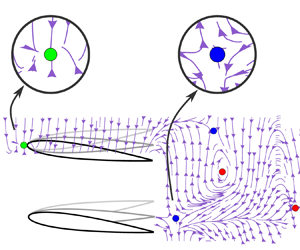
Two-dimensionally stable self-organisation arises in simple schooling swimmers through hydrodynamic interactions
-
- Journal:
- Journal of Fluid Mechanics / Volume 1000 / 10 December 2024
- Published online by Cambridge University Press:
- 02 December 2024, A90
-
- Article
-
- You have access
- Open access
- HTML
- Export citation
-
We present new constrained and free-swimming experiments and simulations in the inertial regime, with Reynolds number $\mbox{Re} = O(10^4)$, of a pair of two-dimensional and three-dimensional pitching hydrofoils interacting in a minimal school. The hydrofoils have an out-of-phase synchronisation, and they are varied through in-line, staggered and side-by-side formations within the two-dimensional interaction plane. It is discovered that there is a two-dimensionally stable equilibrium point for a side-by-side formation. This formation is super-stable, meaning that hydrodynamic forces will passively maintain this formation even under external perturbations, and the school as a whole has no net forces acting on it that cause it to drift to one side or the other. Previously discovered one-dimensionally stable equilibria driven by wake vortex interactions are shown to be, in fact, two-dimensionally unstable, at least for an out-of-phase synchronisation. Additionally, it is discovered that a trailing-edge vortex mechanism provides the restorative force to stabilise a side-by-side formation. The stable equilibrium is further verified by experiments and simulations for freely swimming foils where dynamic recoil motions are present. When constrained, swimmers in compact side-by-side formations experience collective efficiency and thrust increases up to 40 % and 100 %, respectively, whereas slightly staggered formations output an even higher efficiency improvement of 84 %, with an 87 % increase in thrust. Freely swimming foils in a stable side-by-side formation show efficiency and speed enhancements of up to 9 % and 15 %, respectively. These newfound schooling performance and stability characteristics suggest that fluid-mediated equilibria may play a role in the control strategies of schooling fish and fish-inspired robots.

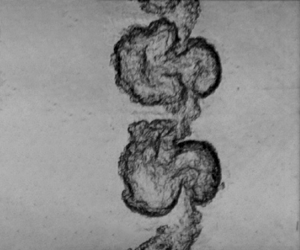
On Richtmyer–Meshkov finger collisions in a light fluid layer under reshock conditions
-
- Journal:
- Journal of Fluid Mechanics / Volume 1000 / 10 December 2024
- Published online by Cambridge University Press:
- 02 December 2024, A87
-
- Article
- Export citation
Generating synthetic turbulence with vector autoregression of proper orthogonal decomposition time coefficients
-
- Journal:
- Journal of Fluid Mechanics / Volume 1000 / 10 December 2024
- Published online by Cambridge University Press:
- 02 December 2024, A83
-
- Article
-
- You have access
- Open access
- HTML
- Export citation
-
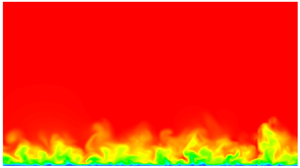
This study introduces vector autoregression (VAR) as a linear procedure that can be used for synthesizing turbulence time series over an entire plane, allowing them to be imposed as an efficient turbulent inflow condition in simulations requiring stationary and cross-correlated turbulence time series. VAR is a statistical tool for modelling and prediction of multivariate time series through capturing linear correlations between multiple time series. A Fourier-based proper orthogonal decomposition (POD) is performed on the two-dimensional (2-D) velocity slices from a precursor simulation of a turbulent boundary layer at a momentum thickness-based Reynolds number, $Re_{\theta }=790$. A subset of the most energetic structures in space are then extracted, followed by applying a VAR model to their complex time coefficients. It is observed that VAR models constructed using time coefficients of 5 and 30 most energetic POD modes per wavenumber (corresponding to $66\,\%$ and $97\,\%$ of turbulent kinetic energy, respectively) are able to make accurate predictions of the evolution of the velocity field at $Re_{\theta }=790$ for infinite time. Moreover, the 2-D velocity fields from the POD–VAR when used as a turbulent inflow condition, gave a short development distance when compared with other common inflow methods. Since the VAR model can produce an infinite number of velocity planes in time, this enables reaching statistical stationarity without having to run an extremely long precursor simulation or applying ad hoc methods such as periodic time series.


Observations on the structure of turbulent boundary layers interacting with embedded propeller tip vortices
-
- Journal:
- Journal of Fluid Mechanics / Volume 1000 / 10 December 2024
- Published online by Cambridge University Press:
- 02 December 2024, A81
-
- Article
-
- You have access
- Open access
- HTML
- Export citation
-
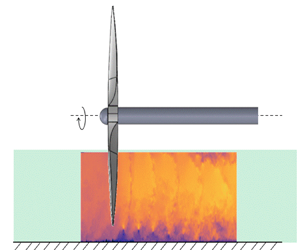
The study presents observations on the interaction of double-blade propeller tip vortices with a smooth-wall turbulent boundary layer (TBL). The wall-bounded helicoidal vortices from the propeller modify the velocity profiles and turbulence statistics. The effects of two different tip clearances, $\epsilon = 0.1\delta _0$ and $0.5\delta _0$, at a matched thrust, are explored with particle image velocimetry to understand the dynamics of tip-vortex formation within the logarithmic and wake regions of the boundary layer. The measurements are performed with $\lambda =U_{tip}/U_{\infty }$ in the range 5.3–5.9, and a blade passing frequency ( $\,f_{prop}$) of the same order of the boundary-layer time scale ( $\,f_{TBL}$). Observations indicate a reduction in the extent of the log region and an enhancement of the wake parameter $\varPi$, mirroring the behaviour seen in TBLs under adverse pressure gradient conditions. Notably, the slipstream most contracted region exhibits a significant reduction in the skin friction coefficient $C_f$ and an amplification of the velocity fluctuation statistics across the entire boundary layer. At a clearance of $\epsilon = 0.1\delta _0$, there is evidence of the formation of paired coherent wall-bounded structures. The presence of the wall decreases the amplitude of both periodic and stochastic fluctuations obtained with a phase-locked triple decomposition. An exception is observed behind the propeller for the stochastic fluctuations of the wall-normal component of the flow, which become amplified as the blades move away from the wall. This leads to the creation of a more intense phase-locked two-point spatial coherence than that observed in fluctuations aligned with the streamwise direction. Furthermore, results reveal that reduced tip clearances lead to higher viscous dissipation and more active energy exchange between the mean flow and organized motions.


Plasma rotation induced by biasing in axially symmetric mirrors
- Part of
-
- Journal:
- Journal of Plasma Physics / Volume 90 / Issue 6 / December 2024
- Published online by Cambridge University Press:
- 02 December 2024, 975900601
-
- Article
-
- You have access
- Open access
- HTML
- Export citation
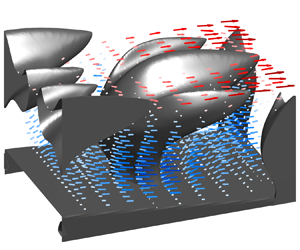
Thrust generation by shark denticles
-
- Journal:
- Journal of Fluid Mechanics / Volume 1000 / 10 December 2024
- Published online by Cambridge University Press:
- 02 December 2024, A80
-
- Article
-
- You have access
- Open access
- HTML
- Export citation
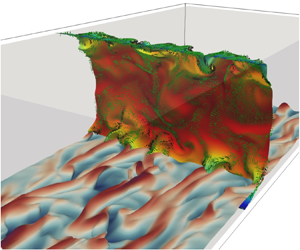
Reference map technique for Lagrangian exploration of coherent structures
-
- Journal:
- Journal of Fluid Mechanics / Volume 1000 / 10 December 2024
- Published online by Cambridge University Press:
- 02 December 2024, A84
-
- Article
-
- You have access
- Open access
- HTML
- Export citation
-
We explore the application of the reference map technique, originally developed for Eulerian simulation of solid mechanics, in Lagrangian kinematics of turbulent flows. Unlike traditional methods based on explicit particle tracking, the reference map facilitates the calculation of flow maps and gradients without the need for particles. This is achieved through an Eulerian update of the reference map, which records the take-off positions of fluid particles. This approach is found to be mathematically equivalent to the work of Leung (J. Comput. Phys., vol. 230, issue 9, 2011, pp. 3500–3524), who computed the flow map of simple two-dimensional flows using an Eulerian approach. We discuss important modifications necessary for its first application to complex three-dimensional turbulent flows, including the conservative, low-dissipation update of the flow map and the treatment of periodic boundary conditions. We first demonstrate the accuracy of finite-time Lyapunov exponent (FTLE) calculations based on the reference map against the standard particle-based approach in a two-dimensional Taylor–Green vortex. Then we apply it to turbulent channel flow at $Re_\tau =180$, where Lagrangian coherent structures identified as ridges of the backward-time FTLE are found to bound vortical regions of flow, consistent with Eulerian coherent structures from the $Q$-criterion. The reference map also proves suitable for material surface tracking despite not explicitly tracking particles. This capability can provide valuable insights into the Lagrangian landscape of turbulent momentum transport, complementing Eulerian velocity field analysis. The evolution of initially wall-normal material surfaces in the viscous sublayer, buffer layer and log layer sheds light on the Reynolds stress-generating events from a Lagrangian perspective.


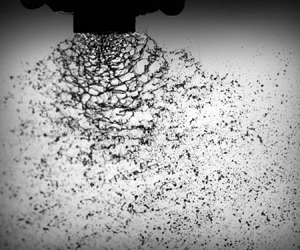
Effect of high wind speeds on droplet formation in sprays
-
- Journal:
- Journal of Fluid Mechanics / Volume 1000 / 10 December 2024
- Published online by Cambridge University Press:
- 02 December 2024, A86
-
- Article
-
- You have access
- Open access
- HTML
- Export citation
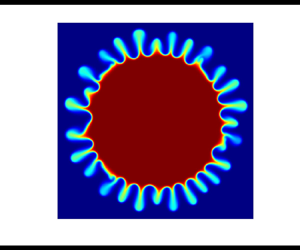
Damköhler number independent stable regime in reactive radial viscous fingering
-
- Journal:
- Journal of Fluid Mechanics / Volume 1000 / 10 December 2024
- Published online by Cambridge University Press:
- 02 December 2024, A72
-
- Article
-
- You have access
- Open access
- HTML
- Export citation
-
The impact of a chemical reaction, $A+B \rightarrow C$, on the stability of a miscible radial displacement in a porous medium is established. Our study involves a comprehensive analysis employing both linear stability analysis and nonlinear simulations. Through linear stability analysis, the onset of instability for monotonic as well as non-monotonic viscosity profiles corresponding to the same end-point viscosity are discussed and compared. We establish a $(R_b,R_c)$ phase plane for a wide range of Damköhler number ( $Da$) and Péclet number ( $Pe$) into stable and unstable regions. Here, $R_b=\ln (\mu _B/ \mu _A)$ and $R_c=\ln (\mu _C/ \mu _A)$ and $\mu _{i}$ is the viscosity of fluid $i$
$i$  $\in \{A$, $B$,
$B$,  $C$}. The stable zone in the $(R_b, R_c)$ phase plane contracts with increased $Da$ and $Pe$ but never vanishes. It exists even for $Da \rightarrow \infty$. Interestingly, we obtain a $Da$ independent stable region in the neighbourhood of $R_c=R_b$ where no transition occurs in stability despite changes in reaction rate. The study allows us to acquire knowledge about the transition of the stability for varying $Da, Pe$ and different reactions classified using $R_b, R_c$.


Laboratory study of the breaking and energy distribution of internal solitary waves over a ridge
-
- Journal:
- Journal of Fluid Mechanics / Volume 1000 / 10 December 2024
- Published online by Cambridge University Press:
- 02 December 2024, A79
-
- Article
- Export citation
-
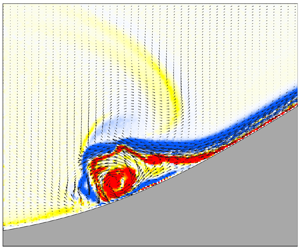
The breaking and energy distribution of mode-1 depression internal solitary wave interactions with Gaussian ridges are examined through laboratory experiments. A series of processes, such as shoaling, breaking, transmission and reflection, are captured completely by measuring the velocity field in a large region. It is found that the maximum interface descent ( $a_{max}$) during wave shoaling is an important parameter for diagnosing the type of wave–ridge interaction and energy distribution. The wave breaking on the ridge depends on the modified blockage parameter $\zeta _m$, the ratio of the sum of the upper layer depth and $a_{max}$ to the water depth at the top of the ridge. As $\zeta _m$ increases, the interaction type transitions from no breaking to plunging and mixed plunging–collapsing breaking. Within the scope of this experiment, the energy distribution can be characterized solely by $\zeta _m$. The transmission energy decreases monotonically with increasing $\zeta _m$, and there is a linear relationship between $\zeta _m^2$ and the reflection coefficient. The value of $a_{max}$ can be determined from the basic initial parameters of the experiment. Based on the incident wave parameters, the depth of the upper and lower layers, and the topographic parameters, two new simple methods for predicting $a_{max}$ on the ridge are proposed.


Darcy–Forchheimer gravity currents in porous media
-
- Journal:
- Journal of Fluid Mechanics / Volume 1000 / 10 December 2024
- Published online by Cambridge University Press:
- 02 December 2024, A89
-
- Article
-
- You have access
- Open access
- HTML
- Export citation
-
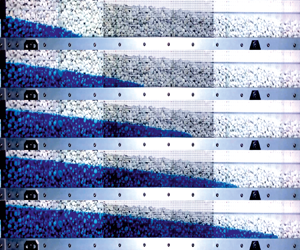
We theoretically and experimentally study gravity currents of a Newtonian fluid advancing in a two-dimensional, infinite and saturated porous domain over a horizontal impermeable bed. The driving force is due to the density difference between the denser flowing fluid and the lighter, immobile ambient fluid. The current is taken to be in the Darcy–Forchheimer regime, where a term quadratic in the seepage velocity accounts for inertial contributions to the resistance. The volume of fluid of the current varies as a function of time as $\sim T^{\gamma }$, where the exponent parameterizes the case of constant volume subject to dam break ( $\gamma =0$), of constant ( $\gamma =1$), waning ( $\gamma <1$) and waxing inflow rate ( $\gamma >1$). The nonlinear governing equations, developed within the lubrication theory, admit self-similar solutions for some combinations of the parameters involved and for two limiting conditions of low and high local Forchheimer number, a dimensionless quantity involving the local slope of the current profile. Another parameter $N$ expresses the relative importance of the nonlinear term in Darcy–Forchheimer's law; values of $N$ in practical applications may vary in a large interval around unity, e.g. $N\in [10^{-5},10^{2}]$; in our experiments, $N\in [2.8,64]$. Sixteen experiments with three different grain sizes of the porous medium and different inflow rates corroborate the theory: the experimental nose speed and current profiles are in good agreement with the theory. Moreover, the asymptotic behaviour of the self-similar solutions is in excellent agreement with the numerical results of the direct integration of the full problem, confirming the validity of a relatively simple one-dimensional model.


An extension of the compound flow theory with friction between the streams and at the wall
-
- Journal:
- Journal of Fluid Mechanics / Volume 1000 / 10 December 2024
- Published online by Cambridge University Press:
- 02 December 2024, A85
-
- Article
- Export citation
Freely rising or falling of a sphere in a square tube at intermediate Reynolds numbers
-
- Journal:
- Journal of Fluid Mechanics / Volume 1000 / 10 December 2024
- Published online by Cambridge University Press:
- 02 December 2024, A82
-
- Article
- Export citation
χ2 from redundant calibration as a tool in the detection of faint radio-frequency interference
-
- Journal:
- Publications of the Astronomical Society of Australia / Volume 41 / 2024
- Published online by Cambridge University Press:
- 02 December 2024, e097
-
- Article
-
- You have access
- Open access
- HTML
- Export citation
-
Radio-frequency interference detection and flagging is one of the most difficult and urgent problems in 21 cm Epoch of Reionisation research. In this work, we present $\chi^2$ from redundant calibration as a novel method for RFI detection and flagging, demonstrating it to be complementary to current state-of-the-art flagging algorithms. Beginning with a brief overview of redundant calibration and the meaning of the $\chi^2$ metric, we demonstrate a two-step RFI flagging algorithm which uses the values of this metric to detect faint RFI. We find that roughly 27.4% of observations have RFI from digital television channel 7 detected by at least one algorithm of the three tested: 18.0% of observations are flagged by the novel $\chi^2$ algorithm, 16.5% are flagged by SSINS, and 6.8% are flagged by AOFlagger (there is significant overlap in these percentages). Of the 27.4% of observations with detected DTV channel 7 RFI, 37.1% (10.2% of the total observations) are detected by $\chi^2$ alone, and not by either SSINS or AOFlagger, demonstrating a significant population of as-yet undetected RFI. We find that $\chi^2$ is able to detect RFI events which remain undetectable to SSINS and AOFlagger, especially in the domain of long-duration, weak RFI from digital television. We also discuss the shortcomings of this approach and discuss examples of RFI which seems undetectable using $\chi^2$ while being successfully flagged by SSINS and/or AOFlagger.


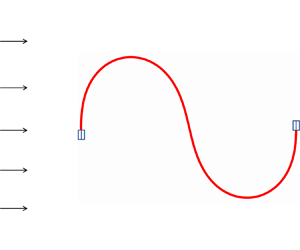
Flow-induced oscillations of an S-shaped buckled flexible filament
-
- Journal:
- Journal of Fluid Mechanics / Volume 1000 / 10 December 2024
- Published online by Cambridge University Press:
- 02 December 2024, A52
-
- Article
-
- You have access
- Open access
- HTML
- Export citation
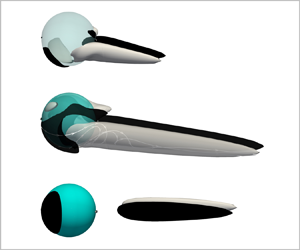
Lift force on a spherical droplet in a viscous linear shear flow
-
- Journal:
- Journal of Fluid Mechanics / Volume 1000 / 10 December 2024
- Published online by Cambridge University Press:
- 02 December 2024, A88
-
- Article
-
- You have access
- Open access
- HTML
- Export citation
-
We study numerically the flow around a spherical droplet set fixed in a linear shear flow with moderate shear rates ( $Sr\leq 0.5$, $Sr$ being the ratio between the velocity difference across the drop and the relative velocity) over a wide range of external Reynolds numbers ( $0.1<{{Re}}\leq 250$, ${{Re}}$ based on the slip velocity and the viscosity of the external fluid) and drop-to-fluid viscosity ratios ( $0.01\leq \mu ^\ast \leq 100$). The flow structure, the vorticity field and their intrinsic connection with the lift force are analysed. Specifically, the results on lift force are compared with the low- ${{Re}}$ solution derived for droplets of arbitrary $\mu ^\ast$, as well as prior data at finite ${{Re}}$ available in both the clean-bubble limit ( $\mu ^\ast \to 0$) and the solid-sphere limit ( $\mu ^\ast \to \infty$). Notably, at ${{Re}}=O(100)$, the lift force exhibits a non-monotonic transition from $\mu ^\ast \to 0$ to $\mu ^\ast \to \infty$, peaking at $\mu ^\ast \approx 1$. This behaviour is related to an internal three-dimensional flow bifurcation also occurring under uniform-flow conditions, which makes the flow to evolve from axisymmetric to biplanar symmetric. This flow bifurcation occurs at low-but-finite $\mu ^\ast$ when the internal Reynolds number ( ${{Re}}^i$, based on the viscosity of the internal fluid) exceeds approximately 300. In the presence of shear, the corresponding imperfect bifurcation enhances the extensional rate of the flow in the wake. Consequently, the streamwise vortices generated behind the droplet can be more intense compared with those behind a clean bubble. Given the close relation between the lift and these vortices, a droplet with ${{Re}}=O(100)$ and $\mu ^\ast \approx 1$ typically experiences a greater lift force than that in the inviscid limit.


Strategies for spectrum coexistence between radio telescopes and satellite networks
-
- Journal:
- Proceedings of the International Astronomical Union / Volume 20 / Issue S385 / December 2024
- Published online by Cambridge University Press:
- 19 January 2026, pp. 42-50
- Print publication:
- December 2024
-
- Article
- Export citation
Anticipating additional exoplanets in multi-planetary systems
-
- Journal:
- Proceedings of the International Astronomical Union / Volume 20 / Issue S393 / December 2024
- Published online by Cambridge University Press:
- 09 January 2026, pp. 156-160
- Print publication:
- December 2024
-
- Article
- Export citation
Fraunhofer AVIATION & SPACE and IRIS2 - a European satellite constellation
-
- Journal:
- Proceedings of the International Astronomical Union / Volume 20 / Issue S385 / December 2024
- Published online by Cambridge University Press:
- 19 January 2026, pp. 207-212
- Print publication:
- December 2024
-
- Article
- Export citation
Unveiling New Parent Bodies in Meteor Showers: A Robust Methodological Approach
-
- Journal:
- Proceedings of the International Astronomical Union / Volume 20 / Issue S393 / December 2024
- Published online by Cambridge University Press:
- 09 January 2026, pp. 14-19
- Print publication:
- December 2024
-
- Article
- Export citation
