Refine search
Actions for selected content:
26232 results in Theoretical Physics and Mathematical Physics
Notes on the two-centre problem in wave mechanics: II. Some new solutions of the wave equation
-
- Journal:
- Mathematical Proceedings of the Cambridge Philosophical Society / Volume 37 / Issue 4 / October 1941
- Published online by Cambridge University Press:
- 24 October 2008, pp. 384-396
- Print publication:
- October 1941
-
- Article
- Export citation
Momentum distribution in molecular systems: Part V. Momentum distribution and the shape of the Compton line for CH4, C2H6, C2H4 and C2H2
-
- Journal:
- Mathematical Proceedings of the Cambridge Philosophical Society / Volume 37 / Issue 4 / October 1941
- Published online by Cambridge University Press:
- 24 October 2008, pp. 406-421
- Print publication:
- October 1941
-
- Article
- Export citation
Note on semi-groups
-
- Journal:
- Mathematical Proceedings of the Cambridge Philosophical Society / Volume 37 / Issue 4 / October 1941
- Published online by Cambridge University Press:
- 24 October 2008, pp. 434-435
- Print publication:
- October 1941
-
- Article
- Export citation
A proof of the theorem of the double-six
-
- Journal:
- Mathematical Proceedings of the Cambridge Philosophical Society / Volume 37 / Issue 4 / October 1941
- Published online by Cambridge University Press:
- 24 October 2008, pp. 433-434
- Print publication:
- October 1941
-
- Article
- Export citation
On the subadditivity of the transfinite diameter
-
- Journal:
- Mathematical Proceedings of the Cambridge Philosophical Society / Volume 37 / Issue 4 / October 1941
- Published online by Cambridge University Press:
- 24 October 2008, pp. 373-383
- Print publication:
- October 1941
-
- Article
- Export citation
-
Let M be a bounded and closed set of points in the complex z plane; d(M), a set-function which is of great importance in potential and function theory, may then be defined as follows. n points z1, z2, …, zn in M are so chosen that the product of the mutual distances

has the greatest possible value
 Then it can be proved that
exists. Thus the set-function d(M), named by Fekete the transfinite diameter of M, is defined.
 Then it can be proved that
On average values of arithmetic functions
-
- Journal:
- Mathematical Proceedings of the Cambridge Philosophical Society / Volume 37 / Issue 4 / October 1941
- Published online by Cambridge University Press:
- 24 October 2008, pp. 358-372
- Print publication:
- October 1941
-
- Article
- Export citation
-
The problem considered in this paper is that of finding the least possible h = h(x) such that a given arithmetic function a(n) should keep its average order in the interval x, x + h, i.e. that we have

and

as x → ∞.
The quantum theory of radiation damping‡
-
- Journal:
- Mathematical Proceedings of the Cambridge Philosophical Society / Volume 37 / Issue 3 / July 1941
- Published online by Cambridge University Press:
- 24 October 2008, pp. 301-316
- Print publication:
- July 1941
-
- Article
- Export citation
The probability distribution of the extent of a random chain
-
- Journal:
- Mathematical Proceedings of the Cambridge Philosophical Society / Volume 37 / Issue 3 / July 1941
- Published online by Cambridge University Press:
- 24 October 2008, pp. 244-251
- Print publication:
- July 1941
-
- Article
- Export citation
On the generalized helices of Hayden and Sypták in an N-space
-
- Journal:
- Mathematical Proceedings of the Cambridge Philosophical Society / Volume 37 / Issue 3 / July 1941
- Published online by Cambridge University Press:
- 24 October 2008, pp. 229-243
- Print publication:
- July 1941
-
- Article
- Export citation
-
In this paper we are concerned with curves (C) of the following types:

where k1, k2, …, kh−1, kh = 0 (h ≤ n) are the curvatures of (C) relative to the space Vn in which (C) lie. Hayden proved that a curve in a Vn is an (A)2m, h = 2m + 1, if and only if it admits an auto-parallel vector along it which lies in the osculating space of the curve and makes constant angles with the tangent and the principal normals. Independently, Sypták∥ stated without proof that a curve in an Rn is a (B)n if and only if it admits a certain number of fixed R2's having the same angle properties; he also gave to such a curve a set of canonical equations from which many interesting properties follow as immediate consequences.
A new type of disintegration produced by deuterons
-
- Journal:
- Mathematical Proceedings of the Cambridge Philosophical Society / Volume 37 / Issue 3 / July 1941
- Published online by Cambridge University Press:
- 24 October 2008, pp. 317-323
- Print publication:
- July 1941
-
- Article
- Export citation
-
The formation of 62Cu, 106Ag and 120Sb by deuteron bombardment of copper, silver and antimony respectively is reported. The energy-yield curves for these reactions were determined and it is concluded that in each case the process involved is
 taking place, in all probability, through the formation of a ‘compound nucleus’ of the Bohr type.
 taking place, in all probability, through the formation of a ‘compound nucleus’ of the Bohr type.
PSP volume 37 issue 3 Cover and Front matter
-
- Journal:
- Mathematical Proceedings of the Cambridge Philosophical Society / Volume 37 / Issue 3 / July 1941
- Published online by Cambridge University Press:
- 24 October 2008, pp. f1-f2
- Print publication:
- July 1941
-
- Article
-
- You have access
- Export citation
PSP volume 37 issue 3 Cover and Back matter
-
- Journal:
- Mathematical Proceedings of the Cambridge Philosophical Society / Volume 37 / Issue 3 / July 1941
- Published online by Cambridge University Press:
- 24 October 2008, pp. b1-b2
- Print publication:
- July 1941
-
- Article
-
- You have access
- Export citation
On the theory of the liquid state: III. The hole theory of the viscous flow of liquids
-
- Journal:
- Mathematical Proceedings of the Cambridge Philosophical Society / Volume 37 / Issue 3 / July 1941
- Published online by Cambridge University Press:
- 24 October 2008, pp. 281-290
- Print publication:
- July 1941
-
- Article
- Export citation
On the theory of the liquid state: I. The statistical treatment of the thermodynamics of liquids by the theory of holes
-
- Journal:
- Mathematical Proceedings of the Cambridge Philosophical Society / Volume 37 / Issue 3 / July 1941
- Published online by Cambridge University Press:
- 24 October 2008, pp. 252-275
- Print publication:
- July 1941
-
- Article
- Export citation
The influence of radiation damping on the scattering of light and mesons by free particles. I
-
- Journal:
- Mathematical Proceedings of the Cambridge Philosophical Society / Volume 37 / Issue 3 / July 1941
- Published online by Cambridge University Press:
- 24 October 2008, pp. 291-300
- Print publication:
- July 1941
-
- Article
- Export citation
-
1. In the classical theory there is no difficulty in treating the effect of radiation damping on the scattering of light by a free electron in so far as it is a result of the conservation of energy. In the non-relativistic approximation the equation of motion of a free electron under the influence of a light wave is

with the periodic solution
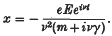
The total energy radiated per second is then

and the total cross-section(1) is

Formula (1) differs from the Thomson formula by the factor 1/(1 +κ2). This factor becomes appreciable for energies ħν ≥ 137mc2.
On the theory of the liquid state: II. Application of the hole theory to superheated liquids and supersaturated solutions of gases in liquids
-
- Journal:
- Mathematical Proceedings of the Cambridge Philosophical Society / Volume 37 / Issue 3 / July 1941
- Published online by Cambridge University Press:
- 24 October 2008, pp. 276-280
- Print publication:
- July 1941
-
- Article
- Export citation
The fractional dimensional theory of continued fractions
-
- Journal:
- Mathematical Proceedings of the Cambridge Philosophical Society / Volume 37 / Issue 3 / July 1941
- Published online by Cambridge University Press:
- 24 October 2008, pp. 199-228
- Print publication:
- July 1941
-
- Article
- Export citation
The action in a uniform field
-
- Journal:
- Mathematical Proceedings of the Cambridge Philosophical Society / Volume 37 / Issue 2 / April 1941
- Published online by Cambridge University Press:
- 24 October 2008, pp. 168-176
- Print publication:
- April 1941
-
- Article
- Export citation
-
We consider the motion of a particle in a plane field of force. We take rectangular cartesian coordinates (x, y) in the plane, and denote by V(x, y) the potential of the field, and by h the (constant) energy of the motion. If A and B, whose coordinates are (x0, y0) and (x1, y1), are any two points on an orbit, the orbit is characterized by the property that
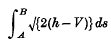
taken along the orbit is stationary as compared with the integral taken along a neighbouring curve joining the same points. Here s denotes the length of the are measured from A to B. This is one form, sometimes called Jacobi's form, of the principle of least action. The value of the integral, taken along the orbit, and expressed in terms of the coordinates of the termini and the constant of energy,

is the action function for the field V.
The motion of a solid through an infinite liquid under no forces
-
- Journal:
- Mathematical Proceedings of the Cambridge Philosophical Society / Volume 37 / Issue 2 / April 1941
- Published online by Cambridge University Press:
- 24 October 2008, pp. 150-167
- Print publication:
- April 1941
-
- Article
- Export citation
The reflexion of sound pulses by convex parabolic reflectors
-
- Journal:
- Mathematical Proceedings of the Cambridge Philosophical Society / Volume 37 / Issue 2 / April 1941
- Published online by Cambridge University Press:
- 24 October 2008, pp. 134-149
- Print publication:
- April 1941
-
- Article
- Export citation
