Refine search
Actions for selected content:
26203 results in Theoretical Physics and Mathematical Physics
The Equations of Viscous Motion and the Circulation Theorem
-
- Journal:
- Mathematical Proceedings of the Cambridge Philosophical Society / Volume 24 / Issue 4 / October 1928
- Published online by Cambridge University Press:
- 24 October 2008, pp. 477-479
- Print publication:
- October 1928
-
- Article
- Export citation
Slip in a crystal and rupture in a solid due to shear
-
- Journal:
- Mathematical Proceedings of the Cambridge Philosophical Society / Volume 24 / Issue 4 / October 1928
- Published online by Cambridge University Press:
- 24 October 2008, pp. 489-500
- Print publication:
- October 1928
-
- Article
- Export citation
The lateral vibration of non-uniform bars, with application to ships
-
- Journal:
- Mathematical Proceedings of the Cambridge Philosophical Society / Volume 24 / Issue 4 / October 1928
- Published online by Cambridge University Press:
- 24 October 2008, pp. 531-556
- Print publication:
- October 1928
-
- Article
- Export citation
A Note on the Hydrogen Chromosphere
-
- Journal:
- Mathematical Proceedings of the Cambridge Philosophical Society / Volume 24 / Issue 4 / October 1928
- Published online by Cambridge University Press:
- 24 October 2008, pp. 506-515
- Print publication:
- October 1928
-
- Article
- Export citation
On Four Mutually Orthogonal Circles
-
- Journal:
- Mathematical Proceedings of the Cambridge Philosophical Society / Volume 24 / Issue 4 / October 1928
- Published online by Cambridge University Press:
- 24 October 2008, pp. 578-584
- Print publication:
- October 1928
-
- Article
- Export citation
Proceedings at the Meetings held during the Session 1927–1928
-
- Journal:
- Mathematical Proceedings of the Cambridge Philosophical Society / Volume 24 / Issue 4 / October 1928
- Published online by Cambridge University Press:
- 24 October 2008, pp. 597-607
- Print publication:
- October 1928
-
- Article
- Export citation
The Practical Calculation of Unit Algebraical Numbers
-
- Journal:
- Mathematical Proceedings of the Cambridge Philosophical Society / Volume 24 / Issue 4 / October 1928
- Published online by Cambridge University Press:
- 24 October 2008, pp. 471-476
- Print publication:
- October 1928
-
- Article
- Export citation
Statement of Accounts of the Cambridge Philosophical Society, from January 1, 1927, to December 31, 1927
-
- Journal:
- Mathematical Proceedings of the Cambridge Philosophical Society / Volume 24 / Issue 4 / October 1928
- Published online by Cambridge University Press:
- 24 October 2008, pp. 608-609
- Print publication:
- October 1928
-
- Article
- Export citation
The mechanism of replacement as illustrated by metasomatism of the Whin Sill
-
- Journal:
- Mathematical Proceedings of the Cambridge Philosophical Society / Volume 24 / Issue 4 / October 1928
- Published online by Cambridge University Press:
- 24 October 2008, pp. 516-517
- Print publication:
- October 1928
-
- Article
- Export citation
Note on the effect of Temperature on the Auto-electronic Discharge
-
- Journal:
- Mathematical Proceedings of the Cambridge Philosophical Society / Volume 24 / Issue 4 / October 1928
- Published online by Cambridge University Press:
- 24 October 2008, pp. 518-520
- Print publication:
- October 1928
-
- Article
- Export citation
Directional Properties of Wireless Receiving Aerials
-
- Journal:
- Mathematical Proceedings of the Cambridge Philosophical Society / Volume 24 / Issue 4 / October 1928
- Published online by Cambridge University Press:
- 24 October 2008, pp. 521-530
- Print publication:
- October 1928
-
- Article
- Export citation
The Wave Theory of the Electron
-
- Journal:
- Mathematical Proceedings of the Cambridge Philosophical Society / Volume 24 / Issue 4 / October 1928
- Published online by Cambridge University Press:
- 24 October 2008, pp. 501-505
- Print publication:
- October 1928
-
- Article
- Export citation
Some experiments on the multiple scattering of alpha particles
-
- Journal:
- Mathematical Proceedings of the Cambridge Philosophical Society / Volume 24 / Issue 4 / October 1928
- Published online by Cambridge University Press:
- 24 October 2008, pp. 557-566
- Print publication:
- October 1928
-
- Article
- Export citation
PSP volume 24 issue 4 Cover and Back matter
-
- Journal:
- Mathematical Proceedings of the Cambridge Philosophical Society / Volume 24 / Issue 4 / October 1928
- Published online by Cambridge University Press:
- 24 October 2008, pp. b1-b8
- Print publication:
- October 1928
-
- Article
-
- You have access
- Export citation
On the Motion of a Rotating Circular Cylinder filled with Viscous Fluid
-
- Journal:
- Mathematical Proceedings of the Cambridge Philosophical Society / Volume 24 / Issue 4 / October 1928
- Published online by Cambridge University Press:
- 24 October 2008, pp. 480-488
- Print publication:
- October 1928
-
- Article
- Export citation
The electron in a gravitational field
-
- Journal:
- Mathematical Proceedings of the Cambridge Philosophical Society / Volume 24 / Issue 3 / July 1928
- Published online by Cambridge University Press:
- 24 October 2008, pp. 414-420
- Print publication:
- July 1928
-
- Article
- Export citation
-
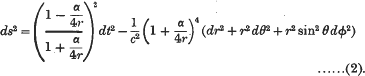
The potential of an electric charge in a gravitational field has been discussed very recently by Professor Whittaker and by E. T. Copson. The latter gives the solution

for a point centre at “distance” a from a mass of gravitational radius α. The coordinates used are such that the metric is given by
Note on Kühne's Theorem
-
- Journal:
- Mathematical Proceedings of the Cambridge Philosophical Society / Volume 24 / Issue 3 / July 1928
- Published online by Cambridge University Press:
- 24 October 2008, pp. 375-378
- Print publication:
- July 1928
-
- Article
- Export citation
A suggested theory of electric conduction
-
- Journal:
- Mathematical Proceedings of the Cambridge Philosophical Society / Volume 24 / Issue 3 / July 1928
- Published online by Cambridge University Press:
- 24 October 2008, pp. 438-444
- Print publication:
- July 1928
-
- Article
- Export citation
On Questions of Reality for Twisted Quartics of the First Kind
-
- Journal:
- Mathematical Proceedings of the Cambridge Philosophical Society / Volume 24 / Issue 3 / July 1928
- Published online by Cambridge University Press:
- 24 October 2008, pp. 379-399
- Print publication:
- July 1928
-
- Article
- Export citation
The effects produced by positive ion bombardment of solids: metallic ions
-
- Journal:
- Mathematical Proceedings of the Cambridge Philosophical Society / Volume 24 / Issue 3 / July 1928
- Published online by Cambridge University Press:
- 24 October 2008, pp. 451-469
- Print publication:
- July 1928
-
- Article
- Export citation
