Refine search
Actions for selected content:
26204 results in Theoretical Physics and Mathematical Physics
The effects produced by positive ion bombardment of solids: metallic ions
-
- Journal:
- Mathematical Proceedings of the Cambridge Philosophical Society / Volume 24 / Issue 3 / July 1928
- Published online by Cambridge University Press:
- 24 October 2008, pp. 451-469
- Print publication:
- July 1928
-
- Article
- Export citation
PSP volume 24 issue 3 Cover and Back matter
-
- Journal:
- Mathematical Proceedings of the Cambridge Philosophical Society / Volume 24 / Issue 3 / July 1928
- Published online by Cambridge University Press:
- 24 October 2008, p. b1
- Print publication:
- July 1928
-
- Article
-
- You have access
- Export citation
Note on Pauli's Exclusion Principle
-
- Journal:
- Mathematical Proceedings of the Cambridge Philosophical Society / Volume 24 / Issue 3 / July 1928
- Published online by Cambridge University Press:
- 24 October 2008, pp. 445-446
- Print publication:
- July 1928
-
- Article
- Export citation
-
A simple explanation of Pauli's principle was first given with the wave mechanics. Its interpretation in the new theory was that the wave functions of Schrödinger were antisymmetrical in all the electrons concerned. Thus when the interactions of the electrons may be neglected, the wave function (for a system of n electrons) can never be of the form

in nature, but only of the form
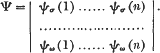
Hence σ, τ,…ω must be all distinct.
On the Connexion of a Certain Identity with the Extension of Conical Order to n Dimensions
-
- Journal:
- Mathematical Proceedings of the Cambridge Philosophical Society / Volume 24 / Issue 3 / July 1928
- Published online by Cambridge University Press:
- 24 October 2008, pp. 357-374
- Print publication:
- July 1928
-
- Article
- Export citation
On the periods of a free-free bar immersed in water
-
- Journal:
- Mathematical Proceedings of the Cambridge Philosophical Society / Volume 24 / Issue 3 / July 1928
- Published online by Cambridge University Press:
- 24 October 2008, pp. 400-413
- Print publication:
- July 1928
-
- Article
- Export citation
PSP volume 24 issue 3 Cover and Front matter
-
- Journal:
- Mathematical Proceedings of the Cambridge Philosophical Society / Volume 24 / Issue 3 / July 1928
- Published online by Cambridge University Press:
- 24 October 2008, p. f1
- Print publication:
- July 1928
-
- Article
-
- You have access
- Export citation
The Wave Mechanics of an Atom with a non-Coulomb Central Field. Part III. Term Values and Intensities in Series in Optical Spectra
-
- Journal:
- Mathematical Proceedings of the Cambridge Philosophical Society / Volume 24 / Issue 3 / July 1928
- Published online by Cambridge University Press:
- 24 October 2008, pp. 426-437
- Print publication:
- July 1928
-
- Article
- Export citation
-
In two recent papers the writer has given an account of a practical method of finding the characteristic values and functions of Schrödinger's wave equations for a given non-Coulomb central field. For terms of optical spectra the method is effectively the following. We take the wave equation in the form

and require the values of ɛ for the solutions which are zero at the origin and at r = ∞. We consider the result of integrating this equation outwards from P = 0 at r = 0 to a radius r0 at which the deviation from a Coulomb field is negligible, and inwards from P = 0 at r = ∞ to the same radius, with a given value of ɛ; the characteristic values are those values for which these two solutions join smoothly on to one another, i.e. for which they have the same value of η = −P′/P at this radius. For a given ɛ, the solution zero at the origin depends on the particular atom; the solution zero at infinity can be expressed in a form independent of any particular atom.
The motion of a particle in a periodic field of force
-
- Journal:
- Mathematical Proceedings of the Cambridge Philosophical Society / Volume 24 / Issue 3 / July 1928
- Published online by Cambridge University Press:
- 24 October 2008, pp. 447-450
- Print publication:
- July 1928
-
- Article
- Export citation
The influence of different nuclei on the absorption spectra of organic compounds
-
- Journal:
- Mathematical Proceedings of the Cambridge Philosophical Society / Volume 24 / Issue 3 / July 1928
- Published online by Cambridge University Press:
- 24 October 2008, pp. 421-425
- Print publication:
- July 1928
-
- Article
- Export citation
A Method of Generalising the Law of Mass Action for Heterogeneous Surface Reactions
-
- Journal:
- Mathematical Proceedings of the Cambridge Philosophical Society / Volume 24 / Issue 2 / April 1928
- Published online by Cambridge University Press:
- 24 October 2008, pp. 307-314
- Print publication:
- April 1928
-
- Article
- Export citation
Some Applications and Implications of Duane's Quantum Theory of Diffraction
-
- Journal:
- Mathematical Proceedings of the Cambridge Philosophical Society / Volume 24 / Issue 2 / April 1928
- Published online by Cambridge University Press:
- 24 October 2008, pp. 343-356
- Print publication:
- April 1928
-
- Article
- Export citation
On the Action of the Geiger α-particle Counter
-
- Journal:
- Mathematical Proceedings of the Cambridge Philosophical Society / Volume 24 / Issue 2 / April 1928
- Published online by Cambridge University Press:
- 24 October 2008, pp. 251-258
- Print publication:
- April 1928
-
- Article
- Export citation
The Specific Heat of Carbon Dioxide—Correction
-
- Journal:
- Mathematical Proceedings of the Cambridge Philosophical Society / Volume 24 / Issue 2 / April 1928
- Published online by Cambridge University Press:
- 24 October 2008, p. 290
- Print publication:
- April 1928
-
- Article
- Export citation
Relation between Mean Stopping Power and Mean Range of β-rays.
-
- Journal:
- Mathematical Proceedings of the Cambridge Philosophical Society / Volume 24 / Issue 2 / April 1928
- Published online by Cambridge University Press:
- 24 October 2008, pp. 315-319
- Print publication:
- April 1928
-
- Article
- Export citation
-
Wilson's cloud method, provides a means of measuring the ranges of β-rays which is free from any uncertainties arising from the scattering of the rays, and for this reason it is an invaluable method for obtaining the true rate of loss of energy of β-rays as they traverse matter. Thetrue rate of loss of energy or ‘stopping power’ is defined as the quantity
 , where
  is the mean energy lost by β-rays of energy T in travelling a distance dx measured along their paths. The cloud method of course enables one to observe only the total ranges of β-particles, and in deducing the stopping power from the mean range it is necessary to bear in mind that owing to ‘straggling,’ which in the case of β-rays is large, the differential coefficient
  , where
  is the mean range of particles of energy T, is not exactly the same as the stopping power . is however the quantity which the cloud method enables us to observe. It is the purpose of this note to consider the exact relation between these two quantities so that the information provided by the cloud method may be rigorously interpreted.
 , where
  is the mean energy lost by β-rays of energy
  , where
  is the mean range of particles of energy
 Extension of a Lemma of Stroh
-
- Journal:
- Mathematical Proceedings of the Cambridge Philosophical Society / Volume 24 / Issue 2 / April 1928
- Published online by Cambridge University Press:
- 24 October 2008, pp. 218-222
- Print publication:
- April 1928
-
- Article
- Export citation
-
The lemma I propose to discuss may be stated as follows;
If ξ, η, ζ are three quantities whose sum is zero and λ, μ, ν three positive integers (≤n) satisfying the condition

then any polynomial of order n in ξ, η, ζ can be expressed in the form

where P, Q, R are polynomials of orders n − λ, n − μ, n − ν.
A recording gyroscope
-
- Journal:
- Mathematical Proceedings of the Cambridge Philosophical Society / Volume 24 / Issue 2 / April 1928
- Published online by Cambridge University Press:
- 24 October 2008, pp. 236-250
- Print publication:
- April 1928
-
- Article
- Export citation
PSP volume 24 issue 2 Cover and Back matter
-
- Journal:
- Mathematical Proceedings of the Cambridge Philosophical Society / Volume 24 / Issue 2 / April 1928
- Published online by Cambridge University Press:
- 24 October 2008, p. b1
- Print publication:
- April 1928
-
- Article
-
- You have access
- Export citation
On the present position of the Theory of Centres of Activity in Heterogeneous Catalysis
-
- Journal:
- Mathematical Proceedings of the Cambridge Philosophical Society / Volume 24 / Issue 2 / April 1928
- Published online by Cambridge University Press:
- 24 October 2008, pp. 291-306
- Print publication:
- April 1928
-
- Article
- Export citation
The Photo-Electric Threshold and the Heat of Dissociation of the Potassium Molecule
-
- Journal:
- Mathematical Proceedings of the Cambridge Philosophical Society / Volume 24 / Issue 2 / April 1928
- Published online by Cambridge University Press:
- 24 October 2008, pp. 320-327
- Print publication:
- April 1928
-
- Article
- Export citation
Limiting forms of the frequency distribution of the largest or smallest member of a sample
-
- Journal:
- Mathematical Proceedings of the Cambridge Philosophical Society / Volume 24 / Issue 2 / April 1928
- Published online by Cambridge University Press:
- 24 October 2008, pp. 180-190
- Print publication:
- April 1928
-
- Article
- Export citation
