Refine search
Actions for selected content:
26203 results in Theoretical Physics and Mathematical Physics
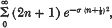
An Asymptotic Expansion for
-
- Journal:
- Mathematical Proceedings of the Cambridge Philosophical Society / Volume 24 / Issue 2 / April 1928
- Published online by Cambridge University Press:
- 24 October 2008, pp. 280-289
- Print publication:
- April 1928
-
- Article
- Export citation
-
In the theory of the specific heats of gases of diatomic molecules the function

plays a well-known and important part. The rotational specific heat Crot of a diatomic molecule, which is susceptible of representation as a rigid body with two equal principal moments of inertia, without spin about the other principal axis, is given by

where R is the gram-molecular gas-constant and

the pair of equal moments of inertia being equal to A. Whether such a model is or is not an adequate representation is a matter for determination by a detailed study of the structure of the band spectrum, particularly of the nature of the normal electronic and vibrational state. It is known to be applicable to normal molecules of the halogen hydrides, to CO and other molecules which have a normal state of type 1S including (but for a certain special feature) H2.

On the Formation of a Gaseous Helide of Radium Active Deposit
-
- Journal:
- Mathematical Proceedings of the Cambridge Philosophical Society / Volume 24 / Issue 2 / April 1928
- Published online by Cambridge University Press:
- 24 October 2008, pp. 268-275
- Print publication:
- April 1928
-
- Article
- Export citation
On the quintic surface in space of five dimensions. (Part II, Curves on the surface.*)
-
- Journal:
- Mathematical Proceedings of the Cambridge Philosophical Society / Volume 24 / Issue 2 / April 1928
- Published online by Cambridge University Press:
- 24 October 2008, pp. 191-209
- Print publication:
- April 1928
-
- Article
- Export citation
Operational Solution of Some Problems in Viscous Fluid Motion
-
- Journal:
- Mathematical Proceedings of the Cambridge Philosophical Society / Volume 24 / Issue 2 / April 1928
- Published online by Cambridge University Press:
- 24 October 2008, pp. 231-235
- Print publication:
- April 1928
-
- Article
- Export citation
The average value of an exponential function over the lattice points of a circle
-
- Journal:
- Mathematical Proceedings of the Cambridge Philosophical Society / Volume 24 / Issue 2 / April 1928
- Published online by Cambridge University Press:
- 24 October 2008, pp. 171-179
- Print publication:
- April 1928
-
- Article
- Export citation
The High-frequency Electric Discharge at Low Pressures
-
- Journal:
- Mathematical Proceedings of the Cambridge Philosophical Society / Volume 24 / Issue 2 / April 1928
- Published online by Cambridge University Press:
- 24 October 2008, pp. 259-267
- Print publication:
- April 1928
-
- Article
- Export citation
A dynamical method for the determination of Young's modulus by stretching
-
- Journal:
- Mathematical Proceedings of the Cambridge Philosophical Society / Volume 24 / Issue 2 / April 1928
- Published online by Cambridge University Press:
- 24 October 2008, pp. 276-279
- Print publication:
- April 1928
-
- Article
- Export citation
The Second Solution of Mathieu's Differential Equation
-
- Journal:
- Mathematical Proceedings of the Cambridge Philosophical Society / Volume 24 / Issue 2 / April 1928
- Published online by Cambridge University Press:
- 24 October 2008, pp. 223-230
- Print publication:
- April 1928
-
- Article
- Export citation
PSP volume 24 issue 2 Cover and Front matter
-
- Journal:
- Mathematical Proceedings of the Cambridge Philosophical Society / Volume 24 / Issue 2 / April 1928
- Published online by Cambridge University Press:
- 24 October 2008, p. f1
- Print publication:
- April 1928
-
- Article
-
- You have access
- Export citation
An Involution in the Complex Variable
-
- Journal:
- Mathematical Proceedings of the Cambridge Philosophical Society / Volume 24 / Issue 2 / April 1928
- Published online by Cambridge University Press:
- 24 October 2008, pp. 210-217
- Print publication:
- April 1928
-
- Article
- Export citation
-
Suppose that ƒ1, ƒ2, ƒ3 are three quadratics in the complex variable z with complex coefficients, say

and consider the equation

the α's being real quantities. It determines two values ζ, ζ′ of z and thus two points P, P′ in the complex plane. Clearly when P is given the ratios α1: α2: α3 are in general determinate and accordingly P′ also. This is the involutory transformation I propose to discuss.
On the arc spectrum of antimony
-
- Journal:
- Mathematical Proceedings of the Cambridge Philosophical Society / Volume 24 / Issue 1 / January 1928
- Published online by Cambridge University Press:
- 24 October 2008, pp. 85-88
- Print publication:
- January 1928
-
- Article
- Export citation
PSP volume 24 issue 1 Cover and Back matter
-
- Journal:
- Mathematical Proceedings of the Cambridge Philosophical Society / Volume 24 / Issue 1 / January 1928
- Published online by Cambridge University Press:
- 24 October 2008, p. b1
- Print publication:
- January 1928
-
- Article
-
- You have access
- Export citation
The Wave Mechanics of an Atom with a Non-Coulomb Central Field. Part I. Theory and Methods
-
- Journal:
- Mathematical Proceedings of the Cambridge Philosophical Society / Volume 24 / Issue 1 / January 1928
- Published online by Cambridge University Press:
- 24 October 2008, pp. 89-110
- Print publication:
- January 1928
-
- Article
- Export citation
The Specific Heat of Hydrogen at high temperatures
-
- Journal:
- Mathematical Proceedings of the Cambridge Philosophical Society / Volume 24 / Issue 1 / January 1928
- Published online by Cambridge University Press:
- 24 October 2008, pp. 80-84
- Print publication:
- January 1928
-
- Article
- Export citation
On the Structure of Liquids and Vitreous Solids
-
- Journal:
- Mathematical Proceedings of the Cambridge Philosophical Society / Volume 24 / Issue 1 / January 1928
- Published online by Cambridge University Press:
- 24 October 2008, pp. 19-31
- Print publication:
- January 1928
-
- Article
- Export citation
On the quintic surface in space of five dimensions
-
- Journal:
- Mathematical Proceedings of the Cambridge Philosophical Society / Volume 24 / Issue 1 / January 1928
- Published online by Cambridge University Press:
- 24 October 2008, pp. 48-55
- Print publication:
- January 1928
-
- Article
- Export citation
Note on Losses in Cable Sheaths
-
- Journal:
- Mathematical Proceedings of the Cambridge Philosophical Society / Volume 24 / Issue 1 / January 1928
- Published online by Cambridge University Press:
- 24 October 2008, pp. 65-73
- Print publication:
- January 1928
-
- Article
- Export citation
The Interference of Light in a Wedge
-
- Journal:
- Mathematical Proceedings of the Cambridge Philosophical Society / Volume 24 / Issue 1 / January 1928
- Published online by Cambridge University Press:
- 24 October 2008, pp. 150-165
- Print publication:
- January 1928
-
- Article
- Export citation
-
Briefly summing up we see that when a point source is employed the slit of the spectroscope is illuminated by light coming from one point only in the wedge, and consequently clear distinct bands will be obtained in the spectrum irrespective of which end of the wedge is towards the source, and irrespective of the angle of incidence or of the distance between the wedge and spectroscope.
With a large source, however, the slit of the spectroscope receives rays coming from many different points in the wedge. The path difference between the interfering components of each of these rays is in general different. Therefore each ray will produce a complete set of interference bands in the spectrum. These sets of bands are relatively displaced, the superposition of all causing uniform illumination.
It has been shown, however, that there is one special case in which the path difference for the interfering components of all rays is the same. In this case, each ray still produces, a complete set of bands in the spectrum but these sets are no longer relatively displaced; bright bands are superimposed on bright bands and dark bands coincide with dark bands. There is thus both an increase of intensity and definition.
It has been shown that the conditions necessary for this special case are:
(1) The thick end of the wedge is towards the source.
(2) The slit of the spectroscope is placed at a distance of
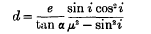
from the wedge, the distance being measured along the central ray entering the slit of the spectroscope.
The case of an air wedge has been discussed, and a possible advantage to be gained in using such for spectroscopic purposes in place of parallel plates has been mentioned.
On Reichinstein's Displacement Principle
-
- Journal:
- Mathematical Proceedings of the Cambridge Philosophical Society / Volume 24 / Issue 1 / January 1928
- Published online by Cambridge University Press:
- 24 October 2008, pp. 56-64
- Print publication:
- January 1928
-
- Article
- Export citation
Extension of a set of theorems in circle geometry
-
- Journal:
- Mathematical Proceedings of the Cambridge Philosophical Society / Volume 24 / Issue 1 / January 1928
- Published online by Cambridge University Press:
- 24 October 2008, pp. 10-18
- Print publication:
- January 1928
-
- Article
- Export citation
