Contents
Research Article
A Randomised Approximation Algorithm for Counting the Number of Forests in Dense Graphs
-
- Published online by Cambridge University Press:
- 12 September 2008, pp. 273-283
-
- Article
- Export citation
Lower Bounds for Insertion Methods for TSP
-
- Published online by Cambridge University Press:
- 12 September 2008, pp. 285-292
-
- Article
- Export citation
Independent Transversals in Sparse Partite Hypergraphs
-
- Published online by Cambridge University Press:
- 12 September 2008, pp. 293-296
-
- Article
- Export citation
-
An [n, k, r]-hypergraph is a hypergraph
 = (V, E) whose vertex set V is partitioned into n k-element sets V1, V2,…, Vn and for which, for each choice of r indices, 1 ≤ i1 < i2 < … < ir ≤ n, there is exactly one edge e ∈ E such that |e∩Vi| = 1 if i ∈ {i1, i2.…, ir} and otherwise |e ∩ Vi| = 0. An independent transversal of an [n, k, r]-hypergraph is a set T = {a1, a2,…, an} ⊆ V such that ai ∈ Vi for i = 1, 2, …, n and e ⊈ T for all e ∈ E. The purpose of this note is to estimate fr(k), defined as the largest n for which any [n, k, r]-hypergraph has an independent transversal. The sharpest results are for r = 2 and for the case when k is small compared to r.
 = (V, E) whose vertex set V is partitioned into n k-element sets V
Turán-Ramsey Theorems and Kp-Independence Numbers
-
- Published online by Cambridge University Press:
- 12 September 2008, pp. 297-325
-
- Article
- Export citation
-
Let the Kp-independence number αp (G) of a graph G be the maximum order of an induced subgraph in G that contains no Kp. (So K2-independence number is just the maximum size of an independent set.) For given integers r, p, m > 0 and graphs L1,…,Lr, we define the corresponding Turán-Ramsey function RTp(n, L1,…,Lr, m) to be the maximum number of edges in a graph Gn of order n such that αp(Gn) ≤ m and there is an edge-colouring of G with r colours such that the jth colour class contains no copy of Lj, for j = 1,…, r. In this continuation of [11] and [12], we will investigate the problem where, instead of α(Gn) = o(n), we assume (for some fixed p > 2) the stronger condition that αp(Gn) = o(n). The first part of the paper contains multicoloured Turán-Ramsey theorems for graphs Gn of order n with small Kp-independence number αp(Gn). Some structure theorems are given for the case αp(Gn) = o(n), showing that there are graphs with fairly simple structure that are within o(n2) of the extremal size; the structure is described in terms of the edge densities between certain sets of vertices.
The second part of the paper is devoted to the case r = 1, i.e., to the problem of determining the asymptotic value of
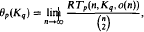
for p < q. Several results are proved, and some other problems and conjectures are stated.
On Universal Threshold Graphs
-
- Published online by Cambridge University Press:
- 12 September 2008, pp. 327-344
-
- Article
- Export citation
-
A graph G is threshold if there exists a ‘weight’ function w: V(G) → R such that the total weight of any stable set of G is less than the total weight of any non-stable set of G. Let
 n denote the set of threshold graphs with n vertices. A graph is called n-universal if it contains every threshold graph with n vertices as an induced subgraph. n-universal threshold graphs are of special interest, since they are precisely those n-universal graphs that do not contain any non-threshold induced subgraph.
In this paper we shall study minimum
n-universal (threshold) graphs, i.e.n-universal (threshold) graphs having the minimum number of vertices.It is shown that for any n ≥ 3 there exist minimum
n-universal graphs, which are themselves threshold, and others which are not.Two extremal minimum
n-universal graphs having respectively the minimum and the maximum number of edges are described, it is proved that they are unique, and that they are threshold graphs.The set of all minimum
n-universal threshold graphs is then described constructively; it is shown that it forms a lattice isomorphic to the n − 1 dimensional Boolean cube, and that the minimum and the maximum elements of this lattice are the two extremal graphs introduced above.The proofs provide a (polynomial) recursive procedure that determines for any threshold graph G with n vertices and for any minimum
n-universal threshold graph T, an induced subgraph G' of T isomorphic to G.

A Stochastic Comparison for Arrangement Increasing Functions
-
- Published online by Cambridge University Press:
- 12 September 2008, pp. 345-348
-
- Article
- Export citation
Ks-Free Graphs Without Large Kr-Free Subgraphs
-
- Published online by Cambridge University Press:
- 12 September 2008, pp. 349-354
-
- Article
- Export citation
Non-Binary Matroids Having At Most Three Non-Binary Elements
-
- Published online by Cambridge University Press:
- 12 September 2008, pp. 355-369
-
- Article
- Export citation
A Matroid Reconstruction Result
-
- Published online by Cambridge University Press:
- 12 September 2008, pp. 371-373
-
- Article
- Export citation
Obstructions for the Disk and the Cylinder Embedding Extension Problems
-
- Published online by Cambridge University Press:
- 12 September 2008, pp. 375-406
-
- Article
- Export citation
Perfect Hashing and Probability
-
- Published online by Cambridge University Press:
- 12 September 2008, pp. 407-409
-
- Article
- Export citation
Almost Safe Group Testing with Few Tests†
-
- Published online by Cambridge University Press:
- 12 September 2008, pp. 411-419
-
- Article
- Export citation
An Extension of Foster's Network Theorem
-
- Published online by Cambridge University Press:
- 12 September 2008, pp. 421-427
-
- Article
- Export citation
-
Consider an electrical network on n nodes with resistors rij between nodes i and j. Let Rij denote the effective resistance between the nodes. Then Foster's Theorem [5] asserts that

where i ∼ j denotes i and j are connected by a finite rij. In [10] this theorem is proved by making use of random walks. The classical connection between electrical networks and reversible random walks implies a corresponding statement for reversible Markov chains. In this paper we prove an elementary identity for ergodic Markov chains, and show that this yields Foster's theorem when the chain is time-reversible.
We also prove a generalization of a resistive inverse identity. This identity was known for resistive networks, but we prove a more general identity for ergodic Markov chains. We show that time-reversibility, once again, yields the known identity. Among other results, this identity also yields an alternative characterization of reversibility of Markov chains (see Remarks 1 and 2 below). This characterization, when interpreted in terms of electrical currents, implies the reciprocity theorem in single-source resistive networks, thus allowing us to establish the equivalence of reversibility in Markov chains and reciprocity in electrical networks.

Front matter
CPC volume 3 issue 3 Cover and Front matter
-
- Published online by Cambridge University Press:
- 12 September 2008, pp. f1-f2
-
- Article
-
- You have access
- Export citation
Back matter
CPC volume 3 issue 3 Cover and Back matter
-
- Published online by Cambridge University Press:
- 12 September 2008, p. b1
-
- Article
-
- You have access
- Export citation