




No CrossRef data available.
Article contents
Discrepancy in modular arithmetic progressions
Part of:
Probabilistic theory: distribution modulo $1$; metric theory of algorithms
Extremal combinatorics
Elementary number theory
Sequences and sets
Published online by Cambridge University Press: 01 December 2022
Abstract
Celebrated theorems of Roth and of Matoušek and Spencer together show that the discrepancy of arithmetic progressions in the first  $n$ positive integers is $\Theta (n^{1/4})$. We study the analogous problem in the $\mathbb {Z}_n$ setting. We asymptotically determine the logarithm of the discrepancy of arithmetic progressions in $\mathbb {Z}_n$ for all positive integer $n$. We further determine up to a constant factor the discrepancy of arithmetic progressions in $\mathbb {Z}_n$ for many $n$. For example, if $n=p^k$ is a prime power, then the discrepancy of arithmetic progressions in $\mathbb {Z}_n$ is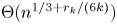 $\Theta (n^{1/3+r_k/(6k)})$, where $r_k \in \{0,1,2\}$ is the remainder when $k$ is divided by $3$. This solves a problem of Hebbinghaus and Srivastav.
Information
- Type
- Research Article
- Information
- Copyright
- © 2022 The Author(s). The publishing rights in this article are licensed to Foundation Compositio Mathematica under an exclusive licence
Footnotes
Fox is supported by a Packard Fellowship and by NSF Awards DMS-1800053 and DMS-2154169. Xu is supported by the Cuthbert C. Hurd Graduate Fellowship in the Mathematical Sciences, Stanford. Zhou is supported by NSF GRFP Grant DGE-1656518.
References
Alon, N. and Spencer, J. H., The probabilistic method, fourth edition (Wiley, Hoboken, NJ, 2016).Google Scholar
Beck, J., Roth's estimate of the discrepancy of integer sequences is nearly sharp, Combinatorica 1 (1981), 319–325.CrossRefGoogle Scholar
Beck, J. and Chen, W. W. L., Irregularities of distribution, Cambridge Tracts in Mathematics, vol. 89 (Cambridge University Press, Cambridge, 1987).CrossRefGoogle Scholar
Chazelle, B., The discrepancy method: randomness and complexity (Cambridge University Press, New York, 2000).CrossRefGoogle Scholar
Chen, W., Srivastav, A. and Travaglini, G., eds., A panorama of discrepancy theory, Lecture Notes in Mathematics, vol. 2107 (Springer, 2014).CrossRefGoogle Scholar
Erdös, P. and Sárközy, A., Some solved and unsolved problems in combinatorial number theory, Math. Slovaca 28 (1978), 407–421.Google Scholar
Hardy, G. H. and Wright, E. M., An introduction to the theory of numbers, sixth edition (Oxford University Press, Oxford, 2008).Google Scholar
Hebbinghaus, N. and Srivastav, A., Discrepancy of (centered) arithmetic progressions in  $\mathbb {Z}_p$, European J. Combin. 35 (2014), 324–334.CrossRefGoogle Scholar $\mathbb {Z}_p$, European J. Combin. 35 (2014), 324–334.CrossRefGoogle Scholar
Landau, E., Ueber die zahlentheoretische Funktion $\phi (n)$ und ihre Beziehung zum Goldbachschen Satz, Nachr. Ges. Wiss. Göttingen Math. Phys. Klasse 1900 (1900), 177–186.Google Scholar $\phi (n)$ und ihre Beziehung zum Goldbachschen Satz, Nachr. Ges. Wiss. Göttingen Math. Phys. Klasse 1900 (1900), 177–186.Google Scholar
Lovett, S. and Meka, R., Constructive discrepancy minimization by walking on the edges, SIAM J. Comput. 44 (2015), 1573–1582.CrossRefGoogle Scholar
Matoušek, J., Geometric discrepancy: an illustrated guide, Algorithms and Combinatorics, vol. 18 (Springer, Berlin, 1999).CrossRefGoogle Scholar
Matoušek, J. and Spencer, J., Discrepancy in arithmetic progressions, J. Amer. Math. Soc. 9 (1996), 195–204.CrossRefGoogle Scholar
Roth, K. F., Remark concerning integer sequences, Acta Arith. 9 (1964), 257–260.CrossRefGoogle Scholar
Weyl, H., Über die Gleichverteilung von Zahlen mod. Eins., Math. Ann. 77 (1916), 313–352 (in German).CrossRefGoogle Scholar