Contents
Research Article
A direct proof of a theorem of West on sequences of Riesz operators
-
- Published online by Cambridge University Press:
- 18 May 2009, pp. 93-94
-
- Article
-
- You have access
- Export citation
On an integral equation
-
- Published online by Cambridge University Press:
- 18 May 2009, pp. 95-98
-
- Article
-
- You have access
- Export citation
-
We shall solve the equation

where 0 <a<b, and f(x) is a continuous function on the interval (a, b).
Difference sets and planar polarities
-
- Published online by Cambridge University Press:
- 18 May 2009, pp. 99-108
-
- Article
-
- You have access
- Export citation
Certain congruences on a completely regular semigroup
-
- Published online by Cambridge University Press:
- 18 May 2009, pp. 109-120
-
- Article
-
- You have access
- Export citation
Free products of two real cyclic matrix groups
-
- Published online by Cambridge University Press:
- 18 May 2009, pp. 121-128
-
- Article
-
- You have access
- Export citation
-
We exhibit a large class K* of real 2 × 2 matrices of determinant ±1 such that, for nearly all A and B in K*, the group generated by A and B1 (the transpose of B) is the free product of the cyclic groups
 It is shown that K* contains all matrices
  of determinant ±1 with integer entries satisfying |b| > |a|, |c|, |d|. This gives a generalization of a theorem of Goldberg and Newman [2]. We also prove related results concerning the dominance of b and the discreteness of the free products
  .
.
 It is shown that
  of determinant ±1 with integer entries satisfying |
 .
.Multiplicative forms and nonassociative algebras
-
- Published online by Cambridge University Press:
- 18 May 2009, pp. 129-130
-
- Article
-
- You have access
- Export citation
-
In [1], we introduced the notion of multiplicative forms on associative algebras
 of finite rank over integral domains D, and obtained a complete classification when D ⊆, the complex field. We propose here to remove the hypothesis of associativity, using a refinement of the technique of Schafer [2]. In [l], it was noted that multiplicative forms extend uniquely under the adjunction of an identity when is associative but not unitary; this appears difficult to verify in the general case, so that some mild restriction on is required. We shall assume that is biregular, that is that contains elements eL, eR such that the linear maps x
  eL x and x xeR, are bijective on We can then (§1) reduce the biregular case to the unitary case, which is handled in §2.
 of finite rank over integral domains
  e
eOn the enumeration of planar trees of hexagons
-
- Published online by Cambridge University Press:
- 18 May 2009, pp. 131-147
-
- Article
-
- You have access
- Export citation
Counting word-trees
-
- Published online by Cambridge University Press:
- 18 May 2009, pp. 148-149
-
- Article
-
- You have access
- Export citation
On relative difference sets and projective planes
-
- Published online by Cambridge University Press:
- 18 May 2009, pp. 150-154
-
- Article
-
- You have access
- Export citation
Transform solutions of Dirichlet problems in quarter-spaces
-
- Published online by Cambridge University Press:
- 18 May 2009, pp. 156-158
-
- Article
-
- You have access
- Export citation
-
In a recent paper, Boudjelkha and Diaz [1] have considered the solutions of the Dirichlet problems for Laplace's equation

and for Helmholtz's equation

in¼–ℝn. The purpose of this brief note is to show that their formulae may be derived easily by the use of the theory of multiple Fourier transforms.

A note on regular local Noether lattices
-
- Published online by Cambridge University Press:
- 18 May 2009, pp. 159-161
-
- Article
-
- You have access
- Export citation
Bi-embeddings of graphs
-
- Published online by Cambridge University Press:
- 18 May 2009, pp. 162-165
-
- Article
-
- You have access
- Export citation
Extended Schauder decompositions of locally convex spaces†
-
- Published online by Cambridge University Press:
- 18 May 2009, pp. 166-171
-
- Article
-
- You have access
- Export citation
-
Let E[τ] be a locally convex Hausdorff topological vector space. An extended decomposition of E[τ] is a family {Ea}α∈A of closed subspaces of E such that, for each x in E and each α in A, there exists a unique point xα in Eα, with
 Here convergence will have the following meaning. Let Ф denote the set of all finite subsets of A. The sum
  is said to be convergent to x if for each neighbourhood U of 0 in E, there is an element φ0 of Ф such that
  , for all φ in Ф containing φ0. It follows that
  is Cauchy if and only if, for each neighbourhood U of 0 in E, there is an element φ0 of Ф such that
  , for all φ in Ф disjoint from φ0.
 Here convergence will have the following meaning. Let Ф denote the set of all finite subsets of
  is said to be convergent to
  , for all φ in Ф containing φ
 is Cauchy if and only if, for each neighbourhood
  , for all φ in Ф disjoint from φ
Characterizations of commutativity for C*-algebras
-
- Published online by Cambridge University Press:
- 18 May 2009, pp. 172-175
-
- Article
-
- You have access
- Export citation
-
Let
 be a C*-algebra acting on the Hilbert space H and let
  be the self-adjoint elements of . The following characterization of commutativity is due to I. Kaplansky (see Dixmier [3, p. 58]).
 be a
be a  be the self-adjoint elements of
 Matching torsion and cotorsion theories
-
- Published online by Cambridge University Press:
- 18 May 2009, pp. 176-179
-
- Article
-
- You have access
- Export citation
-
Throughout the following note R will denote an associative ring with unit element 1. We shall denote by R-mod [resp. mod-R] the category of all unitary left [resp. right] R-modules. Morphisms in these categories will be written as acting on the side opposite scalar multiplication. All other functions will be written as acting on the left. If
 is a category, we shall abuse notation and write “A∈ when we mean “A is an object of ”.
 is a category, we shall abuse notation and write “
On (v, k, λ)-configurations with v=4pe
-
- Published online by Cambridge University Press:
- 18 May 2009, pp. 180-183
-
- Article
-
- You have access
- Export citation
Corrigenda
The Convergence of Least Squares Approximations for dual Orthogonal Series†
-
- Published online by Cambridge University Press:
- 18 May 2009, p. 184
-
- Article
-
- You have access
- Export citation
-
1. Equation (4) should read

2. On p. 83 below equation (7) replace
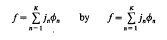
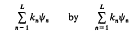
3. On p. 83 two lines above equation (9) replace
Front matter
GMJ volume 15 issue 2 Cover and Front matter
-
- Published online by Cambridge University Press:
- 18 May 2009, pp. f1-f2
-
- Article
-
- You have access
- Export citation