Contents
Research Article
Schreier systems in free products
-
- Published online by Cambridge University Press:
- 18 May 2009, pp. 61-79
-
- Article
-
- You have access
- Export citation
Affine semigroups over an arbitrary field†
-
- Published online by Cambridge University Press:
- 18 May 2009, pp. 80-92
-
- Article
-
- You have access
- Export citation
⋏-distributive Boolean matrices
-
- Published online by Cambridge University Press:
- 18 May 2009, pp. 93-100
-
- Article
-
- You have access
- Export citation
-
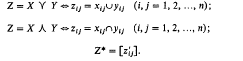
In this paper we shall be concerned with the set Mn(B) of n x n matrices whose elements belong to a given Boolean algebra B(≤, ∪,∩,').
It is well known that Mn(B) also forms a Boolean algebra with respect to the partial ordering ≼ defined by

in which union (⋎), intersection (⋏) and complementation (*) are given by
Some integrability theorems
-
- Published online by Cambridge University Press:
- 18 May 2009, pp. 101-108
-
- Article
-
- You have access
- Export citation
-
1. P. Heywood [3] proved the following theorems:
Theorem A. If 0 ≦ λ < 2, if xy−1g(x) ε L(0, π), and if

for n = 1, 2, 3,…, then the series
 is convergent.
Theorem B. If 0 ≦ λ < 1, if xy−1f(x)ε L(0, π), and if

for n = 1, 2, 3,…, then the series
 n−yanis convergent.

 n
nFront matter
GMJ volume 7 issue 2 Cover and Front matter
-
- Published online by Cambridge University Press:
- 18 May 2009, pp. f1-f2
-
- Article
-
- You have access
- Export citation
Back matter
GMJ volume 7 issue 2 Cover and Back matter
-
- Published online by Cambridge University Press:
- 18 May 2009, pp. b1-b2
-
- Article
-
- You have access
- Export citation