2059 results in Mathematika
On the distribution of √p modulo one
-
- Journal:
- Mathematika / Volume 30 / Issue 1 / June 1983
- Published online by Cambridge University Press:
- 26 February 2010, pp. 104-116
- Print publication:
- June 1983
-
- Article
- Export citation
-
It was shown by Vinogradov (see Theorem 7, Chapter 4 of [18]) that, for ε > 0, there are infinitely many solutions in primes p of the inequality

where {x} denotes the fractional part of x and y = 0.1. The value of γ was improved to
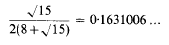
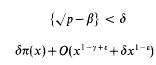
by Kaufman [9]. On the Riemann Hypothesis he showed that one can take γ =¼ The method used actually shows that, for any real β and any δ with 0 < 8 > 1, the number of primes p ≤ x satisfying
is
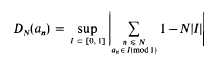
where π(x) denotes the number of primes not exceeding x. The sequence √p is, of course, a subsequence of the sequence n½ whose distribution modulo one has also been investigated (see Chapter 2, Section 3 of [10]: the argument for sequences nσ (0 < σ < 1) is entirely elementary). It is useful in this context to define the discrepancy (modulo one) of a sequence an by

The average order of magnitude of least primitive roots in algebraic number fields
-
- Journal:
- Mathematika / Volume 30 / Issue 1 / June 1983
- Published online by Cambridge University Press:
- 26 February 2010, pp. 11-25
- Print publication:
- June 1983
-
- Article
- Export citation
-
One of the oldest questions concerning primitive roots is that of the actual order df magnitude of the least positive primitive root m(p) to a large prime modulus p. During the last sixty years the interest of several mathematicians has been attracted by this problem. The history of the major results is too well known to need elaboration. The best known bound for m(p) is due to Wang [8] and Burgess [1] who independently obtained

On Kruskal's cascades and counting containments in a set of subsets
- Part of:
-
- Journal:
- Mathematika / Volume 30 / Issue 1 / June 1983
- Published online by Cambridge University Press:
- 26 February 2010, pp. 133-141
- Print publication:
- June 1983
-
- Article
- Export citation
-
Let ℱ be a set of m subsets of X = {1,2,…, n}. We study the maximum number λ of containments Y ⊂ Z with Y, Z ∊ ℱ. Theorem 9.
 , if, and only if, ml/n → 1. When n is large and members of ℱ have cardinality k or k–1 we determine λ. For this we bound (ΔN)/N where ΔN is the shadow of Kruskal's k-cascade for the integer N. Roughly, if m ∼ N + ΔN, then λ ∼ kN with infinitely many cases of equality. A by-product is Theorem 7 of LYM posets.
 ,
, Transcendental numbers arising from Drinfeld modules
-
- Journal:
- Mathematika / Volume 30 / Issue 1 / June 1983
- Published online by Cambridge University Press:
- 26 February 2010, pp. 61-66
- Print publication:
- June 1983
-
- Article
- Export citation
-
Let
 be a smooth projective, geometrically irreducible curve over a finite field
  . We fix a rational point ∞on , and consider the ring A of functions on regular away from ∞. We set k to be the function field of and k∞ its completion at ∞. After taking algebraic closure we obtain the field
  whose elements will be called “numbers”.
 be a smooth projective, geometrically irreducible curve over a finite field
  . We fix a rational point ∞on
  whose elements will be called “numbers”.
MTK volume 30 issue 1 Front matter
-
- Journal:
- Mathematika / Volume 30 / Issue 1 / June 1983
- Published online by Cambridge University Press:
- 26 February 2010, pp. f1-f2
- Print publication:
- June 1983
-
- Article
-
- You have access
- Export citation
On the general solution of a linear second order equation with variable coefficients
-
- Journal:
- Mathematika / Volume 30 / Issue 1 / June 1983
- Published online by Cambridge University Press:
- 26 February 2010, pp. 94-103
- Print publication:
- June 1983
-
- Article
- Export citation
On the densest packing of convex discs
-
- Journal:
- Mathematika / Volume 30 / Issue 1 / June 1983
- Published online by Cambridge University Press:
- 26 February 2010, pp. 1-3
- Print publication:
- June 1983
-
- Article
- Export citation
The square mean of Dirichlet series associated with cusp forms
-
- Journal:
- Mathematika / Volume 29 / Issue 2 / December 1982
- Published online by Cambridge University Press:
- 26 February 2010, pp. 278-295
- Print publication:
- December 1982
-
- Article
- Export citation
-
Let

be a cusp form of even integral weight k > 2 for the full modular group. Then the Dirichlet series

is absolutely convergent for σ > ½(k + 1). Hecke showed that LF is an entire function of s satisfying the functional equation

Further lattice packings in high dimensions
-
- Journal:
- Mathematika / Volume 29 / Issue 2 / December 1982
- Published online by Cambridge University Press:
- 26 February 2010, pp. 171-180
- Print publication:
- December 1982
-
- Article
- Export citation
-
Barnes and Sloane recently described a “general construction” for lattice packings of equal spheres in Euclidean space. In the present paper we simplify and further generalize their construction, and make it suitable for iteration. As a result we obtain lattice packings in ℝm with density Δ satisfying
 , as m → ∞ where
  is the smallest value of k for which the k-th iterated logarithm of m is less than 1. These appear to be the densest lattices that have been explicitly constructed in high-dimensional space. New records are also established in a number of lower dimensions, beginning in dimension 96.
 , as
, as  is the smallest value of
 Irrationality of lattices in finite characteristic
-
- Journal:
- Mathematika / Volume 29 / Issue 2 / December 1982
- Published online by Cambridge University Press:
- 26 February 2010, pp. 227-230
- Print publication:
- December 1982
-
- Article
- Export citation
-
Let q = pn, p a rational prime, and let
 be the finite field with q elements. The polynomial ring
  is considered as an analogue of the ring of rational integers ℤ. Completing the quotient field
  with respect to the normalized valuation at ∞, and then taking algebraic closure, we obtained the field k∞ whose elements will be called “numbers”.
 be the finite field with
  is considered as an analogue of the ring of rational integers ℤ. Completing the quotient field
  with respect to the normalized valuation at ∞, and then taking algebraic closure, we obtained the field
 Further solutions of the Falkner–Skan equation for β = – 1 and γ = 0
- Part of:
-
- Journal:
- Mathematika / Volume 29 / Issue 2 / December 1982
- Published online by Cambridge University Press:
- 26 February 2010, pp. 231-248
- Print publication:
- December 1982
-
- Article
- Export citation
-
We consider the Falkner–Skan equation
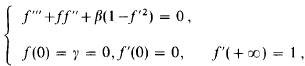
in the special case β = – 1. It is known that this equation may be integrated twice to get the Riccati equation

Packing and covering with convex discs
-
- Journal:
- Mathematika / Volume 29 / Issue 2 / December 1982
- Published online by Cambridge University Press:
- 26 February 2010, pp. 181-193
- Print publication:
- December 1982
-
- Article
- Export citation
Connectivity and freely rolling convex bodies
- Part of:
-
- Journal:
- Mathematika / Volume 29 / Issue 2 / December 1982
- Published online by Cambridge University Press:
- 26 February 2010, pp. 249-259
- Print publication:
- December 1982
-
- Article
- Export citation
MTK volume 29 issue 2 Back matter
-
- Journal:
- Mathematika / Volume 29 / Issue 2 / December 1982
- Published online by Cambridge University Press:
- 26 February 2010, p. b1
- Print publication:
- December 1982
-
- Article
-
- You have access
- Export citation
On the Riemann zeta-function ζ(s)—Gaps between sign changes of S(t)
-
- Journal:
- Mathematika / Volume 29 / Issue 2 / December 1982
- Published online by Cambridge University Press:
- 26 February 2010, pp. 264-269
- Print publication:
- December 1982
-
- Article
- Export citation
-
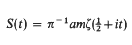
Denote by N(t) the number of zeros β + iγ of ζ(s), s = σ + it, with 0 < β < 1 and 0 < γ < t. It is well known that
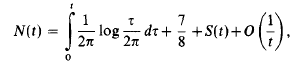
where
Power mean values of the Riemann zeta-function
-
- Journal:
- Mathematika / Volume 29 / Issue 2 / December 1982
- Published online by Cambridge University Press:
- 26 February 2010, pp. 202-212
- Print publication:
- December 1982
-
- Article
- Export citation
-
The classical mean value theorem for Dirichlet's polynomials states that

see H. L. Montgomery [7]. This formula is very useful in the theory of the Riemann zeta-function ζ(s). From the approximate functional equation

where | χ(½ + it)| = 1, u, v ≥ 1, 2πuv = t (see E. C. Titchmarsh [8]) it follows that χ(½ + it) can be well approximated by Dirichlet's polynomials of length N< t½.
MTK volume 29 issue 2 Front matter
-
- Journal:
- Mathematika / Volume 29 / Issue 2 / December 1982
- Published online by Cambridge University Press:
- 26 February 2010, pp. f1-f2
- Print publication:
- December 1982
-
- Article
-
- You have access
- Export citation
The recognition of certain Hausdorff like measures
- Part of:
-
- Journal:
- Mathematika / Volume 29 / Issue 2 / December 1982
- Published online by Cambridge University Press:
- 26 February 2010, pp. 260-263
- Print publication:
- December 1982
-
- Article
- Export citation
-
For a metric space <Ω, ρ> and a ‘measure function’ h, the Hausdorff measure mh on Ω is denned by applying Method II to the premeasure defined by τ(E) = h(d(E)), E ⊆ Ω, where
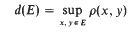
with d(Φ) = 0, is the diameter of E. The set function mh is then a metric outer measure. There are many variations on this definition producing measures also associated with the name Hausdorff. Here we are concerned with those measures which arise when there is a restriction on the sets E for which τ is defined. Such measures arise, for example, as net measures, Rogers [1]. Also we might find it useful to have τ defined only on disks, or only on squares, or only on rectangles with a given relation between vertical and horizontal sides.
Slices of L. Fejes Tóth's sausage conjecture
- Part of:
-
- Journal:
- Mathematika / Volume 29 / Issue 2 / December 1982
- Published online by Cambridge University Press:
- 26 February 2010, pp. 194-201
- Print publication:
- December 1982
-
- Article
- Export citation
-
Let
 be k non-overlapping translates of the unit d-ball Bd in euclidean d-space Ed. Let Ck denote the convex hull of their centres and let Sk be a segment of length 2(k– 1). Furthermore, let Vd denote the d-volume. L. Fejes Tóth conjectured in [1], that, for d ≥ 5,
 be
be 
On the Mertens conjecture for cusp forms
-
- Journal:
- Mathematika / Volume 29 / Issue 2 / December 1982
- Published online by Cambridge University Press:
- 26 February 2010, pp. 213-226
- Print publication:
- December 1982
-
- Article
- Export citation
-
Let f be a non-zero cusp form of weight k on SL(2, ℤ) with Fourier expansion
 We assume further that f is normalized (a(1) = 1) and that f is an eigenfunction of the Hecke operators. Define
 We assume further that
