Most read
This page lists the top ten most read articles for this journal based on the number of full text views and downloads recorded on Cambridge Core over the last 90 days. This list is updated on a daily basis.
Contents
Note on the motion of fluid in a curved pipe
-
- Published online by Cambridge University Press:
- 26 February 2010, pp. 77-85
-
- Article
-
- You have access
- Export citation
ALGEBRAIC TORI AS DEGENERATIONS OF ABELIAN VARIETIES
- Part of:
-
- Published online by Cambridge University Press:
- 20 March 2018, pp. 303-329
-
- Article
-
- You have access
- HTML
- Export citation
On the distribution of primes in short intervals
-
- Published online by Cambridge University Press:
- 26 February 2010, pp. 4-9
-
- Article
-
- You have access
- Export citation
The maximum numbers of faces of a convex polytope
-
- Published online by Cambridge University Press:
- 26 February 2010, pp. 179-184
-
- Article
-
- You have access
- Export citation
ASYMPTOTIC BEHAVIOUR OF THE SPECTRA OF SYSTEMS OF MAXWELL EQUATIONS IN PERIODIC COMPOSITE MEDIA WITH HIGH CONTRAST
- Part of:
-
- Published online by Cambridge University Press:
- 23 April 2018, pp. 583-605
-
- Article
-
- You have access
- Open access
- HTML
- Export citation
-
We analyse the behaviour of the spectrum of the system of Maxwell equations of electromagnetism, with rapidly oscillating periodic coefficients, subject to periodic boundary conditions on a“macroscopic” domain $(0,T)^{3},T>0.$ We consider the case where the contrast between the values of the coefficients in different parts of their periodicity cell increases as the period of oscillations $\unicode[STIX]{x1D702}$ goes to zero. We show that the limit of the spectrum as $\unicode[STIX]{x1D702}\rightarrow 0$ contains the spectrum of a “homogenized” system of equations that is solved by the limits of sequences of eigenfunctions of the original problem. We investigate the behaviour of this system and demonstrate phenomena not present in the scalar theory for polarized waves.


SPECTRAL THEORETIC CHARACTERIZATION OF THE MASSLESS DIRAC ACTION
- Part of:
-
- Published online by Cambridge University Press:
- 08 March 2016, pp. 701-718
-
- Article
-
- You have access
- Open access
- Export citation
-
We consider an elliptic self-adjoint first-order differential operator $L$ acting on pairs (2-columns) of complex-valued half-densities over a connected compact three-dimensional manifold without boundary. The principal symbol of the operator $L$ is assumed to be trace-free and the subprincipal symbol is assumed to be zero. Given a positive scalar weight function, we study the weighted eigenvalue problem for the operator $L$ . The corresponding counting function (number of eigenvalues between zero and a positive $\unicode[STIX]{x1D706}$ ) is known to admit, under appropriate assumptions on periodic trajectories, a two-term asymptotic expansion as $\unicode[STIX]{x1D706}\rightarrow +\infty$ and we have recently derived an explicit formula for the second asymptotic coefficient. The purpose of this paper is to establish the geometric meaning of the second asymptotic coefficient. To this end, we identify the geometric objects encoded within our eigenvalue problem—metric, non-vanishing spinor field and topological charge—and express our asymptotic coefficients in terms of these geometric objects. We prove that the second asymptotic coefficient of the counting function has the geometric meaning of the massless Dirac action.


Rational approximations to algebraic numbers
-
- Published online by Cambridge University Press:
- 26 February 2010, pp. 1-20
-
- Article
-
- You have access
- Export citation
-
It was remarked by Liouville in 1844 that there is an obvious limit to the accuracy with which algebraic numbers can be approximated by rational numbers; if α is an algebraic number of degree n (at least 2) then
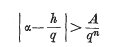
for all rational numbers h/q, where A is a positive number depending only on α.
VINOGRADOV SYSTEMS WITH A SLICE OFF
- Part of:
-
- Published online by Cambridge University Press:
- 29 November 2017, pp. 797-817
-
- Article
-
- You have access
- Open access
- HTML
- Export citation
-
Let $I_{s,k,r}(X)$ denote the number of integral solutions of the modified Vinogradov system of equations with
 $$\begin{eqnarray}x_{1}^{j}+\cdots +x_{s}^{j}=y_{1}^{j}+\cdots +y_{s}^{j}\quad (1\leqslant j\leqslant k,\;j\neq r),\end{eqnarray}$$ $1\leqslant x_{i},y_{i}\leqslant X\;(1\leqslant i\leqslant s)$ . By exploiting sharp estimates for an auxiliary mean value, we obtain bounds for $I_{s,k,r}(X)$ for $1\leqslant r\leqslant k-1$ . In particular, when $s,k\in \mathbb{N}$ satisfy $k\geqslant 3$ and $1\leqslant s\leqslant (k^{2}-1)/2$ , we establish the essentially diagonal behaviour $I_{s,k,1}(X)\ll X^{s+\unicode[STIX]{x1D700}}$ .


IN MEMORIAM KLAUS FRIEDRICH ROTH 1925–2015
-
- Published online by Cambridge University Press:
- 29 November 2017, pp. 711-712
-
- Article
-
- You have access
- HTML
- Export citation
A NOTE ON BADLY APPROXIMABLE LINEAR FORMS ON MANIFOLDS
- Part of:
-
- Published online by Cambridge University Press:
- 11 May 2017, pp. 587-601
-
- Article
-
- You have access
- HTML
- Export citation
-
This paper is motivated by Davenport’s problem and the subsequent work regarding badly approximable points in submanifolds of a Euclidean space. We study the problem in the area of twisted Diophantine approximation and present two different approaches. The first approach shows that, under a certain restriction, any countable intersection of the sets of weighted badly approximable points on any non-degenerate ${\mathcal{C}}^{1}$ submanifold of $\mathbb{R}^{n}$ has full dimension. In the second approach, we introduce the property of isotropically winning and show that the sets of weighted badly approximable points are isotropically winning under the same restriction as above.

