

Since I was awarded the Nobel Prize in Physics in 2023, one of the most frequent questions that people ask me is: Why aren’t there more women in physics? Why aren’t there more female role models for students to look up to? A few stand out: Marie Skłodowska Curie and Maria Goeppert Mayer, the only two women who were awarded the Nobel Prize in Physics during the twentieth century. Lise Meitner is another primary figure who is well-recognized. When I was asked to write the foreword of this book, I accepted, hoping that maybe I could find some of the answers to these questions in the field of quantum physics.
As I write these lines, I am also preparing a talk for the opening of the International Year of Quantum Science and Technology. Looking back in time at the history of early quantum mechanics, it is striking how much it has been dominated by male scientists, for example, Max Planck, Niels Bohr, Erwin Schrödinger, Werner Heisenberg, Paul Dirac, and Max Born, to name a few. Early quantum physics even received the nickname “boys’ physics” (Knabenphysik), highlighting that some of these scientists were also very young.
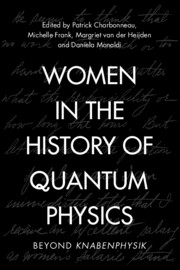
The book Women in the History of Quantum Physics: Beyond Knabenphysik, edited by Patrick Charbonneau, Michelle Frank, Margriet van der Heijden, and Daniela Monaldi, tells the life stories and scientific contributions of 16 outstanding women in quantum science from different countries and at different times. It also attempts to explain why the contributions of these women have almost all been forgotten. We learn that there is no single explanation but several: motherhood, career changes, lack of mentorship, lack of support, discrimination, collaborating couples, and isolation. To give a flavor of the stories presented in this book, I summarize below the fate of four of these women.
Williamina Paton Fleming, employed by the Harvard College Observatory in the US, identified the spectrum of ionized helium from stellar spectra, which was essential for showing the validity of Bohr’s atom model beyond neutral hydrogen. Her discovery was called the “Pickering series” after the observatory director, Edward Charles Pickering. Her own name did not make it into physics textbooks.
Johanna van Leeuwen was a theoretical physicist in the Netherlands. She showed theoretically that magnetism could not be reconciled with a classical physics description. Her work was carried out at around the same time as Bohr’s doctoral thesis and reached the same conclusion. This result was named the Bohr–Van Leeuwen’s theorem. She is one of the few women described in this book that remained in academia. She suffered, however, from discrimination, becoming a reader at the Technical University of Delft only at the age of 59.
Elisabeth Monroe Boggs was a bright computational quantum chemist in the US. During World War II, she participated in the Manhattan Project. She left academia after giving birth to a disabled child in 1945 to take care of him. She became a high-level defender of the disability rights movement in the US.
Chien-Shiung Wu, who emigrated from China to the US in 1936, is a counter-example: In spite of discrimination both as a woman and as a Chinese immigrant in the US, she made a bright career in physics, being the first person to receive the prestigious Wolf Prize in 1978. She performed seminal experiments in particle physics and conducted early studies regarding quantum entanglement with photons.
Reading the life stories and career paths of the 16 women presented in this book filled me with admiration. The hurdles that they had to overcome to fulfill their dreams were incredibly high. So high that some of them had to give up at an early stage or accept being overshadowed by a supportive partner. I was born, on average, 50 years after these women. My career path has been much easier than theirs. Was I luckier? Maybe. In any case, fortunately, I believe that things have become easier for women in physics during the last 50 years.
This book shows that quantum physics was developed not only by male physicists, but also by the contributions of many talented women. The impressive historical and scientific research summarized in the different chapters will help us remember these women and what they contributed to science.
