Contents
Research Article
The tensor product of distributive lattices: structural results
-
- Published online by Cambridge University Press:
- 20 January 2009, pp. 237-245
-
- Article
-
- You have access
- Export citation
On radicals of finite near-rings
-
- Published online by Cambridge University Press:
- 20 January 2009, pp. 247-259
-
- Article
-
- You have access
- Export citation
On the generalized heat-equation
-
- Published online by Cambridge University Press:
- 20 January 2009, pp. 261-273
-
- Article
-
- You have access
- Export citation
-
The general heat equation is defined as

where v is a fixed positive number and α is a fixed number. If v = α = 0, then (1.1) reduces to the ordinary heat equation

where u(x,t) is regarded as the temperature at a point x at time t, in an infinite insulated rod extended along the x-axis in the xt-plane. If we set
 , then (1.1) becomes

 , then (1.1) becomes
Non-orthogonalisable vector fields on spheres
-
- Published online by Cambridge University Press:
- 20 January 2009, pp. 275-281
-
- Article
-
- You have access
- Export citation
-
A (k – l)-field on Sn-1 may be given as a section ϕ of the fibre bundle
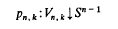
with fibre Vn-1, k-1 or, equivalently, as a semi-orthogonal map, i.e., a map
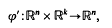
which is isometric in the second variable and such that for the basis vector e1∈Rk and every x∈Rn


Indicial equivalents of multiparameter definiteness conditions in finite dimensions
-
- Published online by Cambridge University Press:
- 20 January 2009, pp. 283-296
-
- Article
-
- You have access
- Export citation
-
Let Tm, Vmn be Hermitean linear operators on complex Hilbert spaces Hm, m=1…k. A nonzero column vector
 satisfying
will be called an eigenvalue. This type of problem has been studied extensively by Atkinson [2] from the viewpoint of determinantal operators on the tensor product
 We shall connect his work with more recent investigations [5,7] of eigenvalue indices based on minimax principles for
  , which can be viewed as an operator on
  .
.
 satisfying
 We shall connect his work with more recent investigations [5,7] of eigenvalue indices based on minimax principles for
  , which can be viewed as an operator on
  .
.The strong maximum principle for the heat equation*
-
- Published online by Cambridge University Press:
- 20 January 2009, pp. 297-299
-
- Article
-
- You have access
- Export citation
Counterexamples in intersections for C*-tensor products
-
- Published online by Cambridge University Press:
- 20 January 2009, pp. 301-302
-
- Article
-
- You have access
- Export citation
-
Let A and B be C*-algebras and A ⊗ B denote the minimal C*-tensor product of A and B. T. Huruya [1] gave examples of C*-tensor products A ⊗ B with C*-subalgebras A1⊗B2 and A2⊗B2 such that
 strictly contains
  , answering a question of S. Wassermann [3, Remark 23]. In this short note, we show that the same situation can occur even if A1 = A2
 strictly contains
  , answering a question of S. Wassermann [3, Remark 23]. In this short note, we show that the same situation can occur even if A
On the unique solvability of a class of modified boundary integral equations
-
- Published online by Cambridge University Press:
- 20 January 2009, pp. 303-311
-
- Article
-
- You have access
- Export citation
Free non-associative principal train algebras
-
- Published online by Cambridge University Press:
- 20 January 2009, pp. 313-319
-
- Article
-
- You have access
- Export citation
-
The definitions of finite dimensional baric, train, and special train algebras, and of genetic algebras in the senses of Schafer and Gonshor (which coincide when the ground field is algebraically closed, and which I call special triangular) are given in Worz-Busekros's monograph [8]. In [6] I introduced applications requiring infinite dimensional generalisations. The elements of these algebras were infinite linear forms
 in basis elements a0, a1,… and complex coefficients such that
 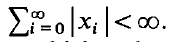 In this paper I consider only algebras whose elements are forms which only a finite number of the xi are non zero.
 in basis elements a
 In this paper I consider only algebras whose elements are forms
 Stability of barrelledness and related concepts in topological vector spaces
-
- Published online by Cambridge University Press:
- 20 January 2009, pp. 321-325
-
- Article
-
- You have access
- Export citation
-
Let E be a separated locally convex barrelled space with continuous dual E′ and algebraic dual E* and let M be a subspace of E* with
 and dim
  Robertson, Tweddle and Yeomans have recently considered the question of barrelledness under the Mackey topology τ(E,E' + M) when E is given to be barrelled under its original topology τ(E,E') [5], [6], [7].
 and dim
  Robertson, Tweddle and Yeomans have recently considered the question of barrelledness under the Mackey topology τ(E,E' + M) when E is given to be barrelled under its original topology τ(E,E') [
Sur l'image d'une fonction entiere de deux variables complexes
-
- Published online by Cambridge University Press:
- 20 January 2009, pp. 327-331
-
- Article
-
- You have access
- Export citation
-
Soit Θ un automorphisme analytique de
 , Θ ayant un point fixe attractif zo (c'está-dire il existe un voisinage V de zo tel que pour tout élément z de V, on ait
  Alors d'aprés un résultat bien connu, il existe une fonction F entiére de
  dans , injective, telle que
  Ceci provient du fait qu'il existe une fonction F, définie au voisinage de z0, telle que F'(zo)=I, vérifiant Fequation fonctionnelle
  est un automorphisme analytique de vérifiant
  pour tout z élément de .
 , Θ ayant un point fixe attractif z
 Alors d'aprés un résultat bien connu, il existe une fonction F entiére de
  dans
dans  Ceci provient du fait qu'il existe une fonction F, définie au voisinage de z
 est un automorphisme analytique de
  pour tout z élément de
 On the mutagenic radical property
-
- Published online by Cambridge University Press:
- 20 January 2009, pp. 333-336
-
- Article
-
- You have access
- Export citation
Associativity of the tensor product of semilattices
-
- Published online by Cambridge University Press:
- 20 January 2009, pp. 337-340
-
- Article
-
- You have access
- Export citation
Young tableaux and longest monotone subsequences: An inequality and a conjecture
-
- Published online by Cambridge University Press:
- 20 January 2009, pp. 341-344
-
- Article
-
- You have access
- Export citation
-
Much work has been done on the following problem, which is sometimes referred to as Ulam's problem: what is the distribution of
 , the length (i.e. number of terms) of a longest monotone increasing [decreasing] subsequence of (not necessarily consecutive) terms in a random permutation of the first N integers? For example, it has been shown that
  converges almost surely to 2 [6,7,9]. In some cases, it is important to know the value of βN(j), the number of permutations for which αN=j
 , the length (i.e. number of terms) of a longest monotone increasing [decreasing] subsequence of (not necessarily consecutive) terms in a random permutation of the first N integers? For example, it has been shown that
  converges almost surely to 2 [
Book Reviews
J. Aczél (ed.), Functional equations: history, applications and theory (D. Reidel, Dordrecht1984), pp. ix + 244, Dfl. 125.
-
- Published online by Cambridge University Press:
- 20 January 2009, pp. 345-346
-
- Article
-
- You have access
- Export citation
B. A. Barnes, G. J. Murphy, M. R. F. Smyth and T. T. West, Riesz and Fredholm theory in Banach algebras (Research Notes in Mathematics 67, Pitman, 1982), 123 pp, £7.95.
-
- Published online by Cambridge University Press:
- 20 January 2009, p. 346
-
- Article
-
- You have access
- Export citation
K. T. Smith, Primer of modern analysis (Springer-Verlag, 2nd ed.1983), xv + 446 pp. DM97.
-
- Published online by Cambridge University Press:
- 20 January 2009, pp. 346-347
-
- Article
-
- You have access
- Export citation
Wilhelm Blaschke, Gesammelte Werke, Band I ed. by W. Burau, S. S. Chern et al. (Thales-Verlag, Essen1982), pp. 365.
-
- Published online by Cambridge University Press:
- 20 January 2009, pp. 347-349
-
- Article
-
- You have access
- Export citation
J. Diestel, Sequences and series in Banach spaces (Graduate Texts in Mathematics Vol. 92, Springer-Verlag, Berlin-Heidelberg-New York, 1984) xiii + 261 pp., DM 108.
-
- Published online by Cambridge University Press:
- 20 January 2009, p. 349
-
- Article
-
- You have access
- Export citation
P. A. Perry, Scattering theory by the Enss method (Mathematical Reports Vol. 1, Part 1, Harwood Academic Publishers, New York, 1983) xiv + 347 pp., $82.
-
- Published online by Cambridge University Press:
- 20 January 2009, p. 350
-
- Article
-
- You have access
- Export citation