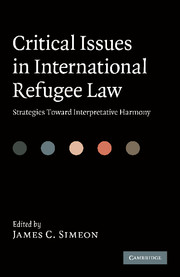
Book contents
- Frontmatter
- Contents
- Notes on contributors
- Foreword by Justice Tony North
- Acknowledgements
- Introduction
- Chapter 1 From refugee to judge of refugee law
- Chapter 2 Individual risk, armed conflict and the standard of proof in complementary protection claims:
- Chapter 3 Running scared since 9/11:
- Chapter 4 Asymmetrical sovereignty and the refugee:
- Chapter 5 Economic harm as a basis for refugee status and the application of human rights law to the interpretation of economic persecution
- Chapter 6 The fragmented nature of the international refugee regime and its consequences:
- Index
- References
Introduction
the research workshop on critical issues in international refugee law and strategies towards interpretative harmony
Published online by Cambridge University Press: 17 February 2011
Edited by

Book contents
- Frontmatter
- Contents
- Notes on contributors
- Foreword by Justice Tony North
- Acknowledgements
- Introduction
- Chapter 1 From refugee to judge of refugee law
- Chapter 2 Individual risk, armed conflict and the standard of proof in complementary protection claims:
- Chapter 3 Running scared since 9/11:
- Chapter 4 Asymmetrical sovereignty and the refugee:
- Chapter 5 Economic harm as a basis for refugee status and the application of human rights law to the interpretation of economic persecution
- Chapter 6 The fragmented nature of the international refugee regime and its consequences:
- Index
- References
Summary
Introduction
It is perhaps trite to note that one of the most pressing humanitarian issues of our time is the plight of those who seek asylum from severe human rights abuse amounting to persecution. The latest annual report of the United Nations High Commissioner for Refugees (UNHCR) indicates that there are 42 million people who are uprooted in the world today. Amongst this staggering total of “people of concern” to the UNHCR are some 15.2 million refugees including 872,000 asylum seekers with pending cases. The UNHCR further estimates that in 2008 some 839,000 individual applications were submitted for refugee status and that 9 percent of those claims were made at UNHCR offices.
It is worth noting that the number of asylum seekers making individual claims for refugee status in 2008 rose for a second year in row, up by 28 percent, and that the Republic of South Africa was the largest single recipient of individual refugee status claims estimated at the incredible number of some 207,000 applications. The United States of America came in a distant second, with 49,600 refugee status claims, a mere one-quarter of the number that were received by South Africa. France, with 35,400 claims, and Sudan, with 35,100 claims, came in at third and fourth respectively. It is also interesting to point out that the Federal Republic of Germany was the only country in the Global North to be listed as a major refugee-hosting country in 2008 with 582,700 refugees.
Information
- Type
- Chapter
- Information
- Critical Issues in International Refugee LawStrategies toward Interpretative Harmony, pp. 1 - 39Publisher: Cambridge University PressPrint publication year: 2010
References
, 2008 Global Trends: Refugees, Asylum seekers, Returnees, Internally Displaced and Stateless Persons. 16 June 2009, p. 2, “2008 in Review – Statistics at a Glance,” www.unhcr.org/4a375c426.pdf. (accessed August 10, 2009)
, “UNHCR annual report shows 42 million people uprooted worldwide,” Press Release June 16, 2009, www.unhcr.org/cgi-bin/texis/vtx/search?page=search&docid=4a2fd52412d&query=42 Million Uprooted#hit2. (accessed August 10, 2009)
, “UNHCR annual report shows 42 million people uprooted worldwide,” Press Release June 16, 2009, www.unhcr.org/cgi-bin/texis/vtx/search?page=search&docid=4a2fd52412d&query=42MillionUprooted#hit2. (accessed August 10, 2009)
: “Exclusion Under Article 1F(a) of the 1951 Convention in Canada,” International Journal of Refugee Law, 21 (2) (July 2009), 194–195Google Scholar
, “The Relevance of the Work of the International Criminal Court to Refugee Status Determination,” International Journal of Refugee Law, 20 (1) (2008), 166–185Google Scholar
,“Article 1F(a): The Notion of International Crimes,” International Journal of Refugee Law, Special Supplementary Issue 12 (1) (2000), 11–45Google Scholar
, “Convention Refugee Status and Subsidiary Protection Working Party, First Report,” in (ed.) Forced Migration and the Advancement of International Protection, 7th World Conference, November 6–9, 2006, International Association of Refugee Law Judges, (MultiCopy, Haarlem, 2008), pp. 225–237
, International Refugee Law and Socio-Economic Rights: Refuge from Deprivation (Cambridge University Press, 2007)
and (eds.), The Limits of Transnational Law: Refugee Law, Policy Harmonization and Judicial Dialogue in the European Union, (Cambridge University Press, 2010)
(ed.), The Oxford Dictionary of Current English 2nd edn, (University of Oxford, 1992), p. 200.
, International Refugee Law and Socio-Economic Rights: Refuge from Deprivation (Cambridge University Press, 2007).
, The Strange Alchemy of Life and Law (Oxford University Press, 2009). http://ukcatalogue.oup.com/product/9780199571796.do. (accessed August 23,2009)
, “Common Burdens and Standards: Legal Elements in Assessing Claims to Refugee Status,” International Journal of Refugee Law, 15 (3) (2003), 357–376Google Scholar
, “(Mis)perception of Refugees, State Sovereignty, and the Continuing Challenge of International Protection,” in (ed.) Human Rights and Refugees, Internally Displaced Persons and Migrant Workers: Essays in Memory of Joan Fitzpatrick and Arthur Helton (Boston: Martinus Nijhoff Publishers, 2006), pp. 79–81
, , , , “The Complexity of Determining Refugeehood: A Multidisciplinary Analysis of the Decision-Making Process of the Canadian Immigration and Refugee Board,” Journal of Refugee Studies, 15 (1) (2002), 43–70Google Scholar
, “The Troubling Patterns in Canadian Refugee Adjudication,” Ottawa Law Review, 39 (2) (2007–2008), 335–365Google Scholar
, , and , “Refugee Roulette: Disparities in Asylum Adjudication,” Stanford Law Review. 60 (2) (2007), 295–412Google Scholar
, “A Comparative Analysis of the Response of the UNHCR and Industrialised States to Rapidly Fluctuating Asylum Applications: Lessons and Best Practices for RSD Design and Administration,” International Journal of Refugee Law, vol. 22, No. 1 (March 2010), 72–103Google Scholar
Accessibility standard: Unknown
Why this information is here
This section outlines the accessibility features of this content - including support for screen readers, full keyboard navigation and high-contrast display options. This may not be relevant for you.Accessibility Information
Accessibility compliance for the PDF of this chapter is currently unknown
and may be updated in the future.