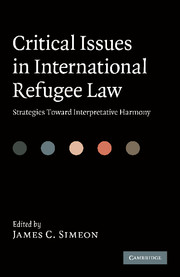
Book contents
- Frontmatter
- Contents
- Notes on contributors
- Foreword by Justice Tony North
- Acknowledgements
- Introduction
- Chapter 1 From refugee to judge of refugee law
- Chapter 2 Individual risk, armed conflict and the standard of proof in complementary protection claims:
- Chapter 3 Running scared since 9/11:
- Chapter 4 Asymmetrical sovereignty and the refugee:
- Chapter 5 Economic harm as a basis for refugee status and the application of human rights law to the interpretation of economic persecution
- Chapter 6 The fragmented nature of the international refugee regime and its consequences:
- Index
- References
Chapter 5 - Economic harm as a basis for refugee status and the application of human rights law to the interpretation of economic persecution
Published online by Cambridge University Press: 17 February 2011
By
Edited by

Book contents
- Frontmatter
- Contents
- Notes on contributors
- Foreword by Justice Tony North
- Acknowledgements
- Introduction
- Chapter 1 From refugee to judge of refugee law
- Chapter 2 Individual risk, armed conflict and the standard of proof in complementary protection claims:
- Chapter 3 Running scared since 9/11:
- Chapter 4 Asymmetrical sovereignty and the refugee:
- Chapter 5 Economic harm as a basis for refugee status and the application of human rights law to the interpretation of economic persecution
- Chapter 6 The fragmented nature of the international refugee regime and its consequences:
- Index
- References
Summary
Introduction
The 1951 Refugee Convention is so strongly linked in people's minds to the protection of civil and political rights that refugee status is often referred to as “political asylum.” Yet claims to refugee status based on economic forms of persecution and on persecution for reasons of economic status have long been recognized as falling within the Convention definition. Although refugee judges routinely assess such claims, consensus remains elusive on the extent to which the Convention properly encompasses violations of economic, social or cultural rights. Commentators note troubling inconsistencies in approach to economic claims within and between jurisdictions, as well as the de jure or de facto imposition of more restrictive standards for harm, risk, ground and/or nexus than are employed for claims based on violations of civil and political rights.
Some argue that there is further capacity for recognition of economic claims to refugee status. This case has been put most comprehensively by Michelle Foster, who contends that refugee law has so far largely failed to reflect the growth of a more sophisticated and complex understanding within the human rights realm of the content of economic, social and cultural rights. She argues that the growing maturity of this aspect of human rights law provides a principled basis for refugee judges to re-assess the Convention's scope.
However, there are diverging views as to whether the Convention can and should include a wider range of economic claims.
Information
- Type
- Chapter
- Information
- Critical Issues in International Refugee LawStrategies toward Interpretative Harmony, pp. 143 - 173Publisher: Cambridge University PressPrint publication year: 2010
References
and , The Refugee in International Law, 3rd edn. (Oxford University Press, 2007), p. 92
, International Refugee Law and Socio-Economic Rights (Cambridge University Press, 2007)
, “Comment: Economic mistreatment as persecution in asylum claims: towards a consistent standard,” U. Chi. Legal F. (2007), 471–501Google Scholar
and , “The Unsettled Status of Economic Refugees from the American and International Legal Perspectives – A Proposal for Recognition under Existing International Law,” Tex. Int'l L. J. 41 (Spring 2006) 275Google Scholar
, Complementary Protection in International Refugee Law (Oxford University Press, 2007), pp. 163–4.
and , “North Korean Refugees and International Refugee Law,”International Journal of Refugee Law, 19 (2) (2007), 215–245.Google Scholar
, “The Immigration and Naturalization Service Considerations for Asylum Officers Adjudicating Asylum Claims for Women,” International Journal of Refugee Law, Special Issue, Autumn 1997, UNHCR Symposium on Gender-Based Persecution, Geneva, 22–23 February 1996, 174–181.Google Scholar
, “Adjudicating Non-Justiciable Rights: Socio-Economic Rights and the South African Constitutional Court,” Columbia Human Rights L. Rev. 38(2) (2007), 321–86Google Scholar
, “Courts, Variable Standards of Review and Resource Allocation: Developing a Model for the Enforcement of Social and Economic Rights,” European Human Rights L.Rev. 6 (2007), 616–36Google Scholar
(ed.), Judicial Protection of Economic, Social and Ccultural Rights: Cases and Materials (M. Nijhoff Publishers, 2005)
and (eds.), Economic, Social and Cultural Rights in Practice: The Role of Judges in Implementing Economic, Social and Cultural Rights (Interights, 2004)
and (eds.), Exploring the Core Content of Socio-economic Rights: South African and International Perspectives (Protea Book House, 2002)
and (eds.), Economic, Social, and Cultural Rights: A Legal Resource Guide (University of Pennsylvania Press, 2006)
, The nature of the obligations under the International Covenant on Economic, Social and Cultural Rights (Intersentia, 2003)
and (eds.), Core Obligations: Building a Framework for Economic, Social and Cultural Rights (Intersentia, 2002)
and (eds.), Giving Meaning to Economic, Social and Cultural Rights (University of Pennsylvania Press, 2001)
Accessibility standard: Unknown
Why this information is here
This section outlines the accessibility features of this content - including support for screen readers, full keyboard navigation and high-contrast display options. This may not be relevant for you.Accessibility Information
Accessibility compliance for the PDF of this chapter is currently unknown
and may be updated in the future.
- 2
- Cited by