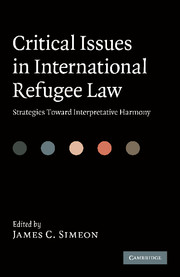
Book contents
- Frontmatter
- Contents
- Notes on contributors
- Foreword by Justice Tony North
- Acknowledgements
- Introduction
- Chapter 1 From refugee to judge of refugee law
- Chapter 2 Individual risk, armed conflict and the standard of proof in complementary protection claims:
- Chapter 3 Running scared since 9/11:
- Chapter 4 Asymmetrical sovereignty and the refugee:
- Chapter 5 Economic harm as a basis for refugee status and the application of human rights law to the interpretation of economic persecution
- Chapter 6 The fragmented nature of the international refugee regime and its consequences:
- Index
- References
Chapter 2 - Individual risk, armed conflict and the standard of proof in complementary protection claims:
the European Union and Canada compared
Published online by Cambridge University Press: 17 February 2011
By
Edited by

Book contents
- Frontmatter
- Contents
- Notes on contributors
- Foreword by Justice Tony North
- Acknowledgements
- Introduction
- Chapter 1 From refugee to judge of refugee law
- Chapter 2 Individual risk, armed conflict and the standard of proof in complementary protection claims:
- Chapter 3 Running scared since 9/11:
- Chapter 4 Asymmetrical sovereignty and the refugee:
- Chapter 5 Economic harm as a basis for refugee status and the application of human rights law to the interpretation of economic persecution
- Chapter 6 The fragmented nature of the international refugee regime and its consequences:
- Index
- References
Summary
Introduction
Though the title of this chapter implies a technical and comparative legal analysis of the standard of proof in complementary protection claims vis-à-vis Convention refugee claims, this is only part of its substance. Indeed, while the standard of proof has become a central distinguishing feature in the Canadian context between attaining protection as a ‘refugee’ or as a ‘person in need of protection’, this debate has been largely absent from the EU arena. Nevertheless, high evidentiary burdens, combined with a haphazard consideration of the three possible grounds for subsidiary protection in the EU, mean that as in Canada, subsidiary protection status is not simply a residual status for people who would be Convention refugees but for the absence of a nexus with one of the five Convention grounds. Accordingly, this chapter focuses on the legal impediments to obtaining subsidiary protection in the EU that have manifested themselves since the Qualification Directive entered into force for the EU Member States in October 2006. Its particular focus is article 15(c), which extends protection to civilians facing ‘a serious and individual threat to their life or person by reason of indiscriminate violence in situations of international or internal armed conflict’. This provision has been poorly understood, inconsistently applied across the Member States, and in some jurisdictions is the only subsidiary protection category given full consideration when a Convention claim fails.
Information
- Type
- Chapter
- Information
- Critical Issues in International Refugee LawStrategies toward Interpretative Harmony, pp. 59 - 84Publisher: Cambridge University PressPrint publication year: 2010
References
, Complementary Protection in International Refugee Law (Oxford University Press, 2007), pp. 90–110
and , The Refugee in International Law, 3rd edn. (Oxford University Press, 2007), pp. 330–35.
, ‘The EU Asylum Qualification Directive, Its Impact on the Jurisprudence of the United Kingdom and International Law’, International and Comparative Law Quarterly, 55 (2006), p.161Google Scholar
, ‘The European Union Qualification Directive: The Creation of a Subsidiary Protection Regime,’ International Journal of Refugee Law, 17 (2005), 461Google Scholar
, ‘Harmonization of Asylum in the European Union – Emergence of an EU Refugee System?’, German Yearbook of International Law, 47 (2004), p. 616–19Google Scholar
, ‘Refugee Status and Subsidiary Protection under EC Law: The Qualification Directive and the Right to be Granted Asylum’ in , and , (eds.) Whose Freedom, Security and Justice?: EU Immigration and Asylum Law and Policy (Oxford: Hart Publishing, 2007), pp. 229–64
(ed.), The Qualification Directive: Central Themes, Problem Issues, and Implementation in Selected Member States (Nijmegen: Wolf Legal Publishers, 2007
and , ‘Towards Convergence in the Interpretation of the Refugee Convention: A Proposal for the Establishment of an International Judicial Commission for Refugees’, in (ed.), Forced Migration, Human Rights and Security (Hart Publishing, Oxford, 2008)
, The Law of Refugee Status (Butterworths, Toronto, 1991), pp. 91–92 (citations omitted)
, European Asylum Law and International Law (Martinus Nijhoff Publishers, Leiden, 2006), p. 225
, ‘Réfugiés: Identification et statut des personnes à protéger. La direction “qualification”’, in , and (eds.), The European Immigration and Asylum Policy: Critical Assessment Five Years after the Amsterdam Treaty (Bruylant, Brussels, 2005)
and , ‘Subsidiary Protection and Primary Rights,’ International and Comparative Law Quarterly, 53 (2004), p. 113Google Scholar
Accessibility standard: Unknown
Why this information is here
This section outlines the accessibility features of this content - including support for screen readers, full keyboard navigation and high-contrast display options. This may not be relevant for you.Accessibility Information
Accessibility compliance for the PDF of this chapter is currently unknown
and may be updated in the future.
- 2
- Cited by