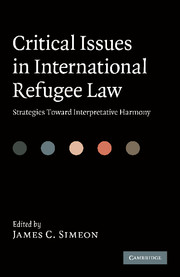
Book contents
- Frontmatter
- Contents
- Notes on contributors
- Foreword by Justice Tony North
- Acknowledgements
- Introduction
- Chapter 1 From refugee to judge of refugee law
- Chapter 2 Individual risk, armed conflict and the standard of proof in complementary protection claims:
- Chapter 3 Running scared since 9/11:
- Chapter 4 Asymmetrical sovereignty and the refugee:
- Chapter 5 Economic harm as a basis for refugee status and the application of human rights law to the interpretation of economic persecution
- Chapter 6 The fragmented nature of the international refugee regime and its consequences:
- Index
- References
Chapter 4 - Asymmetrical sovereignty and the refugee:
diplomatic assurances and the failure of due process,
Published online by Cambridge University Press: 17 February 2011
Edited by

Book contents
- Frontmatter
- Contents
- Notes on contributors
- Foreword by Justice Tony North
- Acknowledgements
- Introduction
- Chapter 1 From refugee to judge of refugee law
- Chapter 2 Individual risk, armed conflict and the standard of proof in complementary protection claims:
- Chapter 3 Running scared since 9/11:
- Chapter 4 Asymmetrical sovereignty and the refugee:
- Chapter 5 Economic harm as a basis for refugee status and the application of human rights law to the interpretation of economic persecution
- Chapter 6 The fragmented nature of the international refugee regime and its consequences:
- Index
- References
Summary
The visible state
Refugee protection forms a small but troublesome part of a wider picture within which the international community deals with the consequences of conflict. Refugees trigger states' duty to provide international protection for those whose states of nationality are unable or unwilling to protect them. The duty comes into existence when there is a serious risk of persecution or torture which are often a by-product of conflict within states and/or among them. The sovereign interstate system, represented by the United Nations, is based on the visibility of the state alone as the actor on that stage. The recognition of Kosovo as a state in March 2008 by a number of European states to the chagrin of Serbia and the Russian Federation's decision in August 2008 to recognise South Ossetia in spite of Georgian resistance are only some examples of the political contestation which surrounds efforts to acquire that visibility and in so doing, sovereignty. They also exemplify the conflict which may surround visibility struggles as the fact of recognition by some states does not necessarily result in sovereignty. If most of the world refuses to recognise a territory as a state, such as has happened in respect of Northern Cyprus, then the territory does not acquire sovereignty within the state system. However, once accepted into the interstate system, the state is entitled to enjoy equality with other states within the international community.
The starting place is the principle that all states are equally sovereign.
Information
- Type
- Chapter
- Information
- Critical Issues in International Refugee LawStrategies toward Interpretative Harmony, pp. 119 - 142Publisher: Cambridge University PressPrint publication year: 2010
References
, ‘Changes in the Westphalian Order: Territory, Public Authority and Sovereignty’ International Studies Review 2 (2) (2000), 1–28CrossRefGoogle Scholar
, Inside/Outside: International Relations as Political Theory (Cambridge University Press, 1993)Google Scholar
, The Guantanamo Files, The Stories of the 774 Detainees in Americas Illegal Prison (London, Pluto Press, 2007)Google Scholar
, Torture Team: Deception, Cruelty and the Compromise of Law (London, Allen Lane, 2008)Google Scholar
, Security and European Human Rights: Protecting Individual Rights in Times of Exception and Military Action (Nijmegen, Wolf Press, 2007).Google Scholar
, Global Changes in Asylum Regimes: Closing Doors. (Houndmills, Palgrave, 2002).CrossRefGoogle Scholar
, ‘International Terrorism and EU Immigration, Asylum and Borders Policy: The Unexpected Victims of 11 September 2001’, European Foreign Affairs Review 8 (2003), 331–346Google Scholar
Accessibility standard: Unknown
Why this information is here
This section outlines the accessibility features of this content - including support for screen readers, full keyboard navigation and high-contrast display options. This may not be relevant for you.Accessibility Information
Accessibility compliance for the PDF of this chapter is currently unknown
and may be updated in the future.