We partner with a secure submission system to handle manuscript submissions.
Please note:
You will need an account for the submission system, which is separate to your Cambridge Core account. For login and submission support, please visit the
submission and support pages.
Please review this journal's author instructions, particularly the
preparing your materials
page, before submitting your manuscript.
Click Proceed to submission system to continue to our partner's website.
To save this undefined to your undefined account, please select one or more formats and confirm that you agree to abide by our usage policies. If this is the first time you used this feature, you will be asked to authorise Cambridge Core to connect with your undefined account.
Find out more about saving content to .
To send this article to your Kindle, first ensure no-reply@cambridge.org is added to your Approved Personal Document E-mail List under your Personal Document Settings on the Manage Your Content and Devices page of your Amazon account. Then enter the ‘name’ part of your Kindle email address below. Find out more about sending to your Kindle.
Find out more about saving to your Kindle.
Note you can select to save to either the @free.kindle.com or @kindle.com variations. ‘@free.kindle.com’ emails are free but can only be saved to your device when it is connected to wi-fi. ‘@kindle.com’ emails can be delivered even when you are not connected to wi-fi, but note that service fees apply.
This paper gives a numerical method for estimating the Hausdorff-Besicovitch dimension where this differs from the fractal (or capacity or box-counting) dimension. The method has been implemented, and numerical results obtained for the set {1/n | n ∈ N} and the Cantor set. Comments about the practical use of the estimation algorithms are made.
We study models of economic equilibrium with fixed budgets and assuming superlinear connections between consumption and production. Extremal problems and the existence of equilibria are discussed for such models along with some related differential properties. Examples to illustrate the broad nature of the model are discussed.
Step changes in current through either grounded or ungrounded wires lying on the surface of a uniformly conducting half-space produce image current sources within the surface the conductor. This image current is effectively the only source term for initial changes in ∂1Bz, Ex and Ey. The general steady state electric and magnetic field components resulting from steady currents flowing through either grounded or ungrounded wires of finite length lying on the surface of a uniform half- space are derived. Then the operators mapping these steady fields into the early values of ∂tBz, Ex and Ey on or above the conducting half-plane resulting from instantaneously stopping the current flow through the wires are derived.
A problem of estimation of the critical Mach number for a class of carrying wing profiles with a fixed theoretical angle of attack is considered. The Chaplygin gas model is used to calculate the velocity field of the flow. The original problem is reduced to a special minimax problem. A solution is constructed for an extended class of flows including multivalent ones, hence M* is estimated from above. For a fixed interval [0, β0], β0 ≅ 3π/8, an estimate of M* is given from below.
An initial value problem is considered for impulsive functional-differential equations. The impulses occur at fixed moments of time. Sufficient conditions are found for Lipschitz stability of the zero solution of these equations. An application in impulsive population dynamics is also discussed.
We apply superadditivity and monotonicity properties associated with the Jensen discrete inequality to derive relationships between the entropy function of a probability vector and a renormalized arbitrary sub-vector. The results are extended to cover other entropy measures such as joint entropy, conditional entropy and mutual information.
We study an optimal control problem for a quasilinear parabolic equation which has delays in the highest order spatial derivative terms. The cost functional is Lagrange type and some terminal state constraints are presented. A Pontryagin-type maximum principle is derived.
Connections between a linear partial difference equation with constant coefficients and a nonlinear partial difference equation are established by means of a comparison theorem and a continuous dependence of parameters theorem. A linearized oscillation theorem is also established as an application.
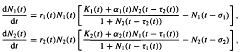
This paper considers a nonautonomous cooperative system, in which all the parameters are time-dependent and asymptotically approach periodic functions. We prove that under some appropriate conditions any positive solutions of the system asymptotically approach the unique positive periodic solution of the corresponding periodic system.